Showing posts with label Chinese theatre. Show all posts

Tuesday, February 16, 2010

Legong Dance Lessons at ARMA in UBUD, and some thoughts about Theatre Schools in China and Bali.


When I was a child, there was a lot of possibilities for fun in the field of art, but only two were taken as seriously as the beginning of a career in piano or ballet. Those were not entertaining games where doodling or playing with dough became art, there you were going to study something with discipline, you would use a technique, a particular technique, to advance, a technique which, if you didn't follow within certain parameters, you could be rejected . So, not wanting to be a pianist or a dancer I amused myself by painting and wanting to be an actor, pretending to direct orchestras, writing melodramatic dialogues and organising theatre plays among my friends say, at a very high level of improvisation and fun.

It was not until my teens that, when beginning professional acting studies, I discovered I could have started my acting career in my childhood, with the same seriousness as that in ballet or music, but not in my country but in the Far East. The stories of the wonderful Chinese and Japanese players came to my ears: great actors who began their studies at 6 or 7 years old and spent 10 or 15 years working with their masters to attain their first important role in a production; actors who learned a physical and vocal technique not through exercises as such, but through the "imitation" of their master (1). And so I also discovered how this educational process in the performing arts was a common situation in India, Thailand, Cambodia, Vietnam and, of course, Bali, the theatre island or, rather, the island of the performing arts.

China showed me the first live examples of these "serious" schools for children where there is no way to achieve perfection but through discipline and following for years a rigorous technique of imitation and repetition from the beginning. I could observe and see not only how these children were being educated, but also their results on stage after 8 to 10 years of study (before they began their professional life), and then I could understand why the technical grandeur of these actors in their youth (in their twenties and thirties). In the same way and through the direct testimony of young artists who had just entered the professional world I could hear their questioning of such a rigorous and cruel education which, in today's China, would give them a profession would that barely cover for their minimum financial needs when, in the past, it would have given them wealth and fame (2).


(click to go to the video)

(click on the link above to go to the main page of Reuters)


Unlike their Japanese and Chinese counterparts, Balinese artistic education is much more relaxed; the same principles of imitation, repetition and practice are followed, as well as the beginning of education from early childhood, but not so the tremendous discipline demands (like boarding-schools, between 10 and 12 hours of practical study, etc.) nor the violence by which several great masters of the north are known. In Bali itself children are still taught to dance and act for the Balinese, for their religious festivals and temples, for their entertainment and for the tourists who support the economy of the island, all in the same way as Miguel Covarrubias observed and filmed in the 30s of the last century.

Learning in the Balinese performing arts is a learning based on physical contact. Most of the dancers-actors begin their learning between 6 and 7 years old. At first, the student stands behind the teacher and imitates his movements. The teacher sings the melody of the dance, or uses a boom box, and follows the beat of the gongs marking a pace and giving directions based on that rhythm. Once the choreography is learned in its basic, the teacher changes and moves on par with the student, behind him, and manages the student body like a puppet. This allows the student to feel exactly the inclinations and movements of the wrists and elbows, plus the position of the back and hip. No mirrors are used, so the student follows by imitating the teacher or the teacher moves the student's body to show through physical contact the total energy and rhythm to be danced. With his voice, if that's the case, the student imitates the singing or recitation of the teacher.

In 1930 Covarrubias filmed a couple of girls learning and dancing together with their teachers. In the tiny scene (20 seconds) we can see direct imitation where the teacher handles the trainee like a puppet, and repetition is a component of teaching (the narrator's voice was added in 2004 and is not part of the original).


In the following two pictures we see I Ketut Mario, one of the greatest Balinese dancers and choreographers from the twenties and thirties of the twentieth century, and I Nyoman Kakul, in 1974, teaching their respective students. It is very clear how physical contact between teacher and pupil happens.


In my last visit to Bali in July 2009 I photographed and video-recorded a class at the ARMA Museum in Ubud, where the teacher, Nyoman Suastini, was working on a Legong Kratong piece with a group of girls; once again we note here the continuous practice, repetition and imitation of the movements of the teacher.


I do not pretend to explain the education in oriental performing arts, but to stress, by exposing them in a document, some of their essential characteristics and thus bring the reader of this blog closer to them. The differences with my personal educational experience in the field of acting are extreme, and I'm sure they are so when it comes to the educational experience of actors in most of the Western world, hence the importance of their presenting as a document. Once exposed we can pose questions, with knowledge, to our educational systems for theater, and propose possible changes to them, new avenues of exploration, or simply an enjoyment of what seems part of the weird and unknown.

Following with my experience in Bali, I can now turn to the surprising dances that I witnessed at the Royal Palace of Ubud.


(1) The film "Farewell My Concubine" has a very long and accurate sequence on the demanding education in Peking Opera in the late nineteenth century. In the following link you can see some images of drawings that show a school of Peking opera in the early twentieth century:

http://www.youtube.com/watch?v=XQ-rRPH2R5c

(2) This is one of the greatest cultural challenges in today's China, the glorification of western entertainment culture at the expense of their traditional culture. (Until the late forties of the twentieth century Peking opera was as commercial as any other current entertainment, but at present it is only a theatrical vestige of the past).

Sunday, December 27, 2009

Photographs of Wei Family Shadows Opera Theatre Troupe Performance in 2007


Two years ago I published a post on a performance I saw at South Gate Space in Dashanzi 798, in Beijing, a performance by Wei Family Shadows Opera Theatre Troupe (1). It was a very interesting example of traditional Chinese Shadows Puppet Theatre; today, after the problem I had with Youtube, re-uploading all my videos, I took advantage of the situation and extracted some still images from those videos and I got a nice group of photographs of the performance. Hope you enjoy.

Slideshow of Photographs


Friday, December 18, 2009

A BBC interview with the quickest Masks Changing performer in China


I've talked before about Masks Changing in Chinese Opera in a post on my travel to Pingyao, Shanxi Province (1). Now I just want to share a nice BBC video about it but in Sichuan Opera: an interview and demonstration with today's quickest masks changing performer in China, He Hongqing.

Click in the link bellow.


Wednesday, December 9, 2009

Beijing Opera: Interview with Mei Baojiu, Mei Lanfang's son.


I've just found that China Daily published an interview with Mei Baojiu, the son of Mei Lanfang, the greatest artist in Chinese Opera (including Beijing Opera, of course). Mei Baojiu is also an important Chinese Opera actor but he has lived with his strong father's image all his life, and it seems he has assumed it very well.

I thought this interview would be of interest for many who follow this Blog; it is not a deep approach to Mei Lanfang's work but it works as an introduction to his life and work from the perspective of an important Mei's family member.

You will notice at the end of the video that appears a photograph of a Time magazine's cover with Mei Lanfang on it, supposedly from September 1934 (or maybe 1931 it is not clare) ; I must say that I made a research inside Time's archives looking for covers from 1920 to 1940 and I did not find any cover with Mei Lanfang on it (only articles and critics). What can I say? Chinese usually do that (transforming history) but I hope (really I do) that this is a simple misunderstanding and he did appear in a special number I missed... (*)

I can not embed the video to see it in this page but here is the link to the China Daily page it was published. Enjoy it!


(*) I wrote my doubts as a comment in the page of this China daily's article and they replied to me (also as a comment) saying that I was right, it was a mistake publishing that cover without have confirmed the source of it.


Monday, September 21, 2009

Beijing Opera performance: "锁麟囊 " (Suǒlínnáng)


Suǒlínnáng does not have an exact translation, it is actually a woven bag traditionally given to any bride to have a son (good luck), depending on the wealth of the family of the bride is the beauty and luxury of her Suǒlínnáng.

The opera was created in the 40s of last century by the playwright Ouhong Weng, and was first released in Shanghai, the Beijing’s premier was a year later at Chang'An Theatre. This is not an opera of anthology but it is staged quite often because, apparently, it was made for the showcasing of the singer who plays the main character, exposing her in a series of vocal acrobacies in its arias. Unlike most known operas Suǒlínnáng has no parts of fighting or acrobatics, but it makes use of comic characters (a maid is played by a man, for example) and use of great and complicated arias.


The story is very simple: Xianling is the only daughter from a very rich family, arrogant, refuses to accept the Suǒlínnáng her mother has given to her; in a walk before her wedding finds another bride who is very poor, Xianling gave to that young girl the luxurious Suǒlínnáng. As a result (or so it appears to be the result of) to have given the Suǒlínnáng Xialing has a daughter who later gets lost during a storm. Years later Xianling, completely in disgrace, finds his daughter who had been adopted by that poor bride who she had given the Suǒlínnáng. It comes the recognition of all the characters and there's a happy ending.

I saw this Opera at Chang'An Theatre in Beijing and the Xianling character was played by a very famous singer in China, Chíxiǎoqiū, who really has a phenomenal voice. The actress and singer is no longer young to make a young lady character but as in all Chinese drama that is not an important matter, theatrical codes are not measured here as in our Western realism.


As the value of the Opera is Xianling’s arias I thought it was best to share some of thaose scenes, plus a bonus song Chixiaoqiu gave us after the performance. Enjoy.

Saturday, July 11, 2009

灯官油流鬼 L’Exécution Du Juge Infernal. Beijing Opera, Shadow Theatre and a French Theatre Director.


During the festival “Croissements” that the French government organizes each year in China there was a curious stage production, 灯官油流鬼 or "L'exécution du juge infernal" (1).

I thought this production was a curiosity because of the circumstances in which it was made and the elements involved in it: 灯官油流鬼 was directed by a French director, Sarah Oppenheim, a student specializing in traditional Chinese theater, who decided to do something the Chinese had never done before, staging an adaptation of a classical Chinese opera performed by Beijing opera actors and shadow theater puppets, two types of theater that have influenced each other during centuries but never mixed, at least till now.


Photographs (slideshow) "L'exécution du juge infernal 灯官油流鬼"


To accomplish this “exploration” Sarah was capable enough to join a great Beijing shadow theater company, "Han Feizi" (2), and a group of actors from the Youth Beijing Opera Trouppe, and then to work together staging an adaptation of the classic opera “铡判官” or “Jinchan case”, an opera called "exorcist," a term for operas with subjects like death, ghosts, and travels to the underworld.

Chinese commentators and Sarah Oppenheim herself, before the premiere, spoke of a Westernization within the traditional Chinese theater: even when using all the physical and artistic elements of Chinese theater, the structure of the assembly was in a "Western style”, according to the Oppenheim vision, of course. The director then adapted the text of the classical Chinese opera and put it on stage alternating shadow theater and Beijing Opera, in an spectacle which lasted just over an hour and a half, trying to shorten the usual duration of any Chinese opera (which is between 3 and 5 hours), keeping in mind the attention span of a contemporary viewer, and directed all actions of the story based on that (3).

Some years ago I had seen “Jinchan case”, the classical version, performed by the National Beijing Opera Trouppe (4), so when I was seeing Oppenheim’s version I could recall some of those scenes and the famous arias I had seen and listened to before. I remember that production as a high quality one, in terms of physical work at least, and with particularly spectacular acrobatic moments. I can not say that this "exploratory" performance appealed to me more than the classical one, but I found it to be easier to assimilate, and much less ambitious in terms of theatrical production. What I was absolutely impressed with, though, was the work of "Han Feizi" and their expertise in handing their puppets at a very high level, with moments of enormous beauty and ability. The Beijing Opera actors, on the other hand, young and without much experience, were less fortunate that their puppeteer colleagues; I was surprised, while I was seeing their performance, how the technical perfection by the actors I saw years ago at Chang'an Theatre (in the performance of the classical opera) was missing, and I thought about how important that is for any Beijing opera production, the sophistication and technical perfection of the physical movement, recitation and singing.

The video material will always be the best approach to the experience I had as a spectator seeing 灯官油流鬼:

Video (playlist with 12 videos) "L'exécution du Juge infernal"


Years of seeing Chinese theater and also years to elucidate its possible assimilation outside China, the use of its movements or the use of its exercises (I'm not the first one to say it, of course), never led me to think about the idea of a “westernization of its structure” and, as a western artist, to offer it to the Chinese public! It simply sounds to me a risky audacity in a lost war. But this time I was a witness of it and, surprisingly, it came from a French director. Let me explain, the "audacity" I’m talking about is trying to introduce any change in the Chinese world of tradition, extreme in itself, in the world of the “it must be”. Chinese journalists and critics spoke before the premier, many with some respect and some talking about “a surprising new idea”, some even called it "subversive" in a gentle and ironic way, but after the performance they stopped talking. Sarah got a group of traditional artists to join her in this exploration, but did not get a worthy reply from the Chinese public and from the Chinese theater cultural elite; the cultural power in this country is really part of a theological state, a “de facto” power, and the people who should be there to see it and criticize it and therefore give it a place in Chinese history were not there, silence was the worst of the responses.

I love the idea of such innovative productions, western students traveling throughout china, acquiring knowledge, learning from traditional masters, seeking to explore and practice what they learn (5), and I prefer to stay with it, that's where I think the greatest value of Oppenheim's adventure lies. In the end, tell me who (as strange and unsuccessful as it may seem), who or how many understand at high level two of the most important and specialized traditional forms of Chinese theatre, adapt them and mix them in searching for a new style?


(1) The name of the show in French, not the translation of the name in Chinese.
(2) There are at least two famous shadows theatre trouppes in Beijing, Longzaitian (which I met last year) and Han Feizi. You can see my post dedicated to my visit to Longzaitian Theatre (now demolished or undergoing renovation) in:
http://gustavothomastheatre.blogspot.com/2008/12/longzaitian-chinese-shadow-puppet.html
(3)
You can read an interview on the website of The Beijinger, an entertainment magazine in Beijing, where Sarah Oppenheim talks about the whys of her production: http://www.thebeijinger.com/blog/2009/06/08/Shadowplay-Sarah-Oppenheim-s-new-stage-production-explores-the-underworld
(4) Here's a link to my post about the performance of this classical opera; it's some video showing scenes that just seemed interesting to me, I have no critical comments:

http://gustavothomastheatre.blogspot.com/2007/02/long-bao-plans-west-side-case.html
(5) Sarah, a sinologist and a specialist in Chinese theater, travelled during a whole year throughout China in search of experiences, looking for ghosts operas and shadow theater, and learned different ways to work the traditional puppet theater. You can find a beautiful description of the cultural life of Sarah in a blog of her journey through China:
http://silkroadproject.blogspot.com/2007/02/shaanxi-province-light-and-shadow.html
"Sarah Oppenheim, my travel partner, is a petite French woman with a fierce character. Working on her masters in Chinese theatre, she is also learning the art of puppet play in Beijing. Rehearsing every day with her troupe members in a run-down shack huddled around a coal oven, she is learning how to “walk” her puppets. To learn the art of Dongbei puppets (from Northeastern China), her master insists that she needs to “walk” her puppet for at least one year to gain the dexterity of a professional. There are many walks he claims: a calm and serene character must have a slow stride, like deep breathing, up and down, slow and steady. A clown however, must be in constant movement, his head bobbing up and down, tripping occasionally – ready to make the crowd laugh. Sarah’s master insists that she can be initiated to other puppet movements, only after learning all the walks. From her almost four months of daily practice, Sarah has calloused hands and a protruding new thumb muscle. She is fed up with “walking”. Mr. Wei laughs at Sarah when she tells him what she is learning, and says that in Beijing people are too caught up on details He tells us that it only takes a month to learn the basic puppet techniques of the Huaxian shadow play and only about one year with the troupe to learn multiple dramas and most of the techniques. In past decades this apprenticeship took longer as most people were analphabet, and had to memorize the words and music for each play, which could take around three years. Sarah is excited to learn about today’s accelerated learning and Mr. Wei invites her to study with the troupe this spring. One month of study to become an ambulant puppet player. Sounds enchanting."


Thursday, May 21, 2009

Marionettes and Rod Puppet from Guangdong and Fujian at Macao Museum


Another short post, this time about a visit I realized to the Macao Museum in Macao, Southeast China in January 31st, 2006. An interesting museum where we can learn about Tea's origins (did you know the word "tea" comes from Fujianese and not from Mandarin?) and Macao history of course, but also about Chinese performing arts and specially puppet theatre developed in the region.


Macao, an ancient Portuguese island in Asia, was mostly inhabited by Chinese from Guandong and Fujian provinces and many of their traditions are evidently from those regions. One of the sources of Chinese Puppet theatre is in Fujian province, and two cities are famous for it: Quanzhou because of its marionettes and Zhangzhou because of its glove puppets; but also an important source of the so called "rod puppets" is Guangdong province. It is believed that Quanzhou marionettes and Guangdong rod puppets were first introduced to Macao and then known in Europe through the Portuguese during 16th Century.

Some of these marionettes and puppets are in exhibition at Macao Museum.


Monday, April 20, 2009

A Shadow Puppet Exibition at China Art National Museum (2007)


Thanks to Picasa (and other Internet sites) now is possible to publish Slideshows of any groups of photographs without a problem of space in the Blog, so I decided to retake some important events and dedicate some posts especially for showing the whole group of photographs I took of them.

You already have seen a Slideshow of "Tenjin Matsuri Festival" in Osaka in 2006, and this time I want to show more photogrpahs from this shadow puppet exhibition ocurred in 2007. The post referred to it was published on August 15th, 2007: http://gustavothomastheatre.blogspot.com/2007/08/chinese-shadow-puppet-exhibition-in.html

This was a very special exhibition in China, for first time there were showed in one place such amount of Puppets from the last two dinasties and from all over China.


if the photographs are not well displayed just click on the window and you will be redirected to the Picasa page.

Saturday, February 21, 2009

三枝橘制作 Théâtre des Trois Oranges: 东宫西宫 "East Palace West palace" (A Slideshow from the performance)


A Slideshow of the last performance by 三枝橘制作 "Théâtre des Trois Oranges" in Beijing, China: 东宫西宫"East Palace West Palace", an interesting story about sadomasochism, violence and homosexuality in Beijing.

Written by Wang Xiaobo and directed by Xavier Froment, this play shows how two men, a "common" Chinese citizen who looks for sex inside the underground toilets of Tian'anmen and a policeman, find some ways of fighting and increasing their sexual desire.


I recorded also a video about this production directed by Xavier Froment, it is coming soon.


Monday, January 12, 2009

Tuesday, December 23, 2008

Pingyao Tea House Theater (3): Three scenes of Shanxi Opera

Shanxi Opera (晋剧) Scenes performance: Changing Masks


Following my series of "Pingyao Tea House Theater" (1), this last part presents three scenes performed during the same spectacle for tourists I have been talking in part 1: one acrobatic scene, one comic scene and one quick-changing masks scene.

Even the spectacle that night were not only of Shanxi Opera it was an unique opportunity to see a company specialized on it playing some characteristic scenes of that kind of Chinese theatre. Shanxi Opera performances are not as easy to find than Peking Opera performances; there are no much companies and their seasons are rare, usually they give some isolated performances in very special occasions.

The acrobatic scene did not show to me anything special, being very similar to other kind of Chinese operas I have seen before, I only corroborated my appreciation of those amazing actors-acrobats always working to perfection (even in spectacles like this).

The Comic scene was an interesting surprise; it was the first time I heard singing like that, not only comically but with a very special use of the rhythm. This Shanxi Opera song showed to me a very fresh way to sing in traditional Chinese theatre, codification was still there but the difference with Peking Opera (the opera I have seen the most) seemed huge.


I couldn't miss a quick-changing Mask scene; people from all over the world come to the South of China to see these actors doing that amazing switch of masks. It was a pity they did not do that inside a real opera scene, instead of it they performed those changes like an act of Magic. Not bad but it seemed to me more Las Vegas-kind spectacle than a Shanxi Opera one.


(1) "Pingyao Tea House Theater (1): Shanxi Opera Scenes Murals.", and
"Pingyao Tea House Theater (2): Seeing today Chinese spectators as an anthropological experience?"


Texts, photographs and videos in this Blog are all author's property, except when marked. All rights reserved by Gustavo Thomas. If you have any interest in using any text, photograph or video from this Blog, for commercial use or not, please contact Gustavo Thomas at gustavothomastheatre@gmail.com.


Wednesday, December 3, 2008

Pingyao Tea House Theater (2): Seeing today Chinese spectators as an anthropological experience?


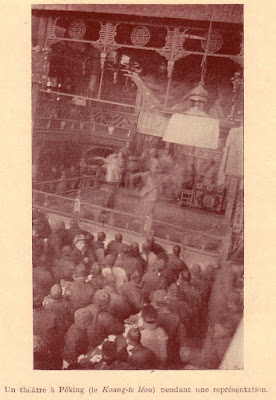
The Pingyao Tea House Theater is, as its name says, a Tea House; ancient tea houses in China were much more than their name implies to us in these days: they were hostels (special ones, not just anyone could stay there, only people from a specific region or group), party saloons, theaters, a kind of cabaret, restaurants and, of course, places where you could drink some tea. Historians say that performances in there were done in the middle of a unimaginable chaos ( it seems a common characteristic of theaters around the world in the past): people were eating, drinking, having fun, playing all kinds of table games, shouting, laughing, walking, and not always with an interest in the spectacle being performed at the moment. You can observe in detail the picture above, a Tea House performance during the last years of Qing Dinasty, as a very good example of what I am talking about.

It seems that temples and palaces were similar, a theater performance was part of a huge movement around festivities or court parties. None of these conducts seem to have bothered the artists, they were used to it.

The next photographs show not a tea house but a theatre (Kuang-te lou) in central Beijing at the beginning of 20th Century (1), you can even see tables and how, during the performance, people are served food and drinks.

Chinese spectators has changed a little bit ( in comparison to Western ones); the arriving of Western codes of conduct at theatres at the end of the 19th Century created an intellectual elite who knew very well how to act as a spectator of any Western style performance (music concerts, theatre, ballet, opera, etc), but Chinese traditional performing arts maintained the same conduct depicted above: chaos and more chaos. It is until the end of the Mao era that Chinese spectators start to see both kinds of spectacles, Western and Chinese, with only one code of conduct, the culture of silence, at least in theory. Playwright Arthur Miller had a fantastic experience in 1980's Beijing and depicts very well, in his book "Salesman in Beijing", how Chinese spectators behaved during performance. (2)

Today, a common Western spectator still perceives as different how a Chinese spectator reacts to any spectacle and how they behave during a performance, but the change with how it used to be in the past is remarkable. Even today in the VIP section you can be served tea and cookies, with waiters walking from one seat to another during the performance, people receiving phone-calls and people talking in a normal level of voice, yet the theatre staff always ask for silence and for people to turn off their mobiles.

So, that code of conduct during a spectacle is threatened with its end, except for one special place, tea houses for tourists.

Now we can come back to our post subject. The Pingyao Tea House Theater is a theater which opens for tourists, for groups and more groups of hungry and energetic Chinese tourists. They come to this place after a long day of walking and visiting temples, museums, shops around the ancient city of Pingyao, and they want to finish the day with a meal (the most important experience for any Chinese), a laugh and enjoying a very traditional show. That is what I called an anthropological experience: a bit of that ambiance and public conduct under which performances were done in the past. A game, of course, but a very interesting one.

It is kind of difficult, due to the noise during Chinese opera performances, to differentiate the spectators’ noise, but you can taste a little bit of it in the next videos:


Video: spectators getting into Prince Gong Residence Tea House Theatre


And the last one, in the turist village of Wuzhen, a Shadow Puppet Theatre spectacle; spectators were children but that afternoon none of their teachers asked for silence... (if you listen carefully you will noticed voices of adults as well)

I remember some of the words my teachers tried to define (in their ignorance of it) the Oriental theatre: a theatre where dance, acting, singing, acrobacy, secular parties and religion were mixed... and its spectator behaved in accord to it.


(1) "Théâtre et Music Modernes en Chine" by George Souliè de Morant. Librairie orientaliste Paul Geuthner. Paris, 1926.
(2) "Salesman in Beijing" by Arthur Miller. London, 1984.


Sunday, October 5, 2008

Beijing Opera Lessons 1: A Clown Scene


A few months ago a new series of educational VCDs appeared in stores in China, those digital videos were designed for teaching Peking Opera (Beijing Opera) to Primary and High school teachers: "中小学京剧进课堂必学唱段名师欣赏与教学". (1)

Chinese government decided Chinese Opera should be taught in many regions of the country as a way to introduced children in one of the treasures of traditional Chinese culture. This program has been badly criticized by many art specialists and pedagogues, and the reasons for it are simple: How teachers can transmit something they don't know? Beijing Opera (and Chinese Opera in general) is not only a very difficult Performing Art, it is simply unknown in the new China, only specialist can talk and teach about it, teachers are simply not prepared for it.

Well, these videos seems being an effort to resolve this problem, and it could help yes, but the problem is much wider I guess.

Let the Chinese government resolves this question and we can step forward taking advantage of its "products".

We are not Chinese high school teachers but we are almost in the same level of knowledge about Chinese opera (much less, of course), so we can also use them for learning this ancient and special art and we can do it with practical exercises!

I was very surprised these videos were performed by very young actors, but all of them professionals and currently teachers in professional Opera Schools in China.

Seeing it from this point of view it is a very important step to open Beijing Opera to anyone in the world, trying to show some hidden secrets on acting in this kind of theatre. I'm pretty sure that being a very codified and elaborate Performing Art, Peking Opera needs this kind of products to show how is performed and how its acting technique is without myths or second tales in between.

Of course for Westerners (actors or not) it is a real exotic curiosity but I'm sure it could be a big help to anyone interested in Asian Performing Arts and Acting techniques. Even if the videos are very basic and only spoken in Chinese, they could be understood by anyone interested just making a small effort: movements, rhythm, tempo, everything (I believe) is understandable without knowing the meaning of the speech. Of course any knowledge on Chinese language would be a great help.

The first video I want to share explains how to perform a Chinese Opera clown character, a Chou type (or Xiaohualian), in a scene called “报灯名” or Bao dengming (reporting the lights) from the opera 《打龙袍》Da Longpao (Beating the Royal Robe).


Video of Beijing Opera Lessons 1


*


(1) You can find information about this video at: www.tt-art.com (It is a Chinese site of course, but you can automatically translate the page and get the information in your language).

Monday, August 11, 2008

“Salesman in Beijing”, a book by Arthur Miller, 24 years later.


I hadn’t got to even the first half of “Salesman in Beijing”, the book Arthur Miller wrote after his second visit to China in 1984, when he was invited to stage his own “Death of a Salesman”, when my hands were already reaching for the keyboard to type about every sentence I had been reading.

Miller’s text is a whole document on an era of Beijing and on theatre in general, but at the same time it revealed the experiences I’ve had in Beijing after 3 years of living here. I didn’t come to do theatre, I came to China to live it, to explore it, and to write about it and its performing arts, to get to know it; I came to learn Taijiquan and to find myself in the strange idleness of the start of my maturity; I haven’t written nor done any theatre since I’ve been here, so I’ve become another spectator of Asian performing arts and, in this case, another reader of Miller’s book.

The first impression the text gave me was one of surprising freedom with which people back then would talk about the Cultural Revolution, which nowadays is a completely taboo subject in China; actors, writers, ordinary people shared their opinions on what had happened, who they’d lived through it, and what damage it had caused while, today, in 2008, starting a conversation on the subject would only provoke complete silence, and maybe deeply intellectual sentences that would try to steer the subject away.

Even though the subject is fascinating, especially during the time it was written, reading about it sounds somewhat outdated and only seems to be of value to those interested in the China that existed during the 80’s. That China doesn’t exist anymore, and is now living the results of its change; now it’s rich and powerful, tells the world what to do, economically invades Africa and Latin-america in search for resources for its expansion. There aren’t many studies that review this transition stage, and maybe that’s reveals the importance of the kind of comments from the heirs to the revolution, comments that Miller brings to us, a revolution that extinguished Chinese cultural life for a decade.

The description of a world outside the theatre and a world within the theatre of that China from the spring of 1984 is at times delicious, an enjoyable read and full of pleasant moments and simple but deep disquisitions. What he describes about life outside the theatre is so interesting (and unique) that I remembered the documentary Antonioni made during the cultural revolution: “Chun Kuo Cina”. Chinese style service, hygiene, the ordinary Chinese spectator, the twists of language, intellectuals and food. Miller is a professional narrator of ordinary life and a spokesperson for the bewilderment of Westerners confronted by Chinese customs.

As for what he describes about life within the theatre, it’s fascinating for someone who’s done theatre or who’s lived it. I consider it a theatrical document because in this text I see direct information on how a sincere representative of the empire of realism (1), in an honest and sincere way, tries to conquer a world that does not handle realism yet (even 100 years after its birth). It’s a document because of the way is presented, it’s a work diary and travel impressions; it’s a document because of its way of presenting the staging of the play, because of its reflections and its means to reach its goal. It’s not just a document about theatre in China, but about how Americans in the end of 20th Century viewed the requirements for their theatre through one of their most important representatives.

The play, which at the time was already almost 40 years old, was going to have its premiere in the recently opened up China. In the years where theatrical postmodernism teared realistic discourse apart in Western World, Miller was trying to “teach” a new way to Chinese actors. But the realism that was being destroyed, leaving behind new forms, inevitably remained (and remains still) with its imposing commercial presence in those post-modern Western cities.


Miller was at the same time a salesman, American theatrical realism with its own “need” for Stanislavski and the ‘interiorisation’ of the actor was being sold where their was no knowledge about it. And I remembered that tale (or real-life story) where a fridge salesman becomes rich in the North Pole selling fridges as boxes for keeping food. I have witnessed, by reading Arthur Miller’s book, how he sold his “Salesman” with the currency of personality, intellectuality, cultural exchange, and the values of non-fiction. At the end, it would seem he’s victorious, that he makes the sale, but, as it happens with the main character of his play, the former successful salesman, he fails.

More than 20 years after that text was written and after that experience, we know that the revolution in the acting of modern Chinese actors was not won by Miller’s realism, it was won by cinema and TV, the bastard or next-of-kin product of realism, realist melodrama (much more suitable to Chinese tradition). Theatre in 2008 is, in China, just a handful of stupid musicals, trite comedies with TV stars and remakes of Chinese classics from the 50’s. The ever present Chinese Opera has found its new place as an adaptation through “national pride” and gets its income from touristic interests; big directors make their modern versions of traditional opera, cause scandal in the country, go abroad and are applauded as innovators and modernisers of China’s new and burgeoning market economy. But the theatre Miller came to revolutionise, the theatre of the word, of characters, of real and deep characters, a theatre of ideas (even if he denies it), that theatre remains empty, it was killed by TV and cinema, it was killed by commerce, it was killed by Tian’anmen and Falungong.

In Beijing’s theatres I’ve seen Ibsen’s, Strindberg’s and Laoshe’s (China’s “modern” author par excellence) plays, and I don’t want to see more. Modern authors have not plays to stage or don’t want to write for theatre, the theatrical spaces (those allowed by the government) are few, the public does not exist, the government reviews (censors?) and adapts every text, foreign stars (who inherited the theatre of Miller and his co-revolutionaries) are not invited to come anymore. There’s something in our way of doing theatre that makes the managers of Chinese culture nervous, “something” about words and ideas, about “reality”. How I wish I could see one of Heiner Müller’s plays in Chinese! Müller is no realist, yet none of his plays are staged.

Then, maybe there’s nothing against realism, but against truth in one of its artistic expressions.


I found the book in London, in October 2007, but I didn’t read it until I came back to Beijing, with the required state of mind to enjoy it. I was never an unconditional fan of Miller, and I think I’ve made that clear, but I must accept that the adventure he narrates is marvelous and that his text is a true treasure.


(1) You can call it 'Realism" or 'Naturalism", it doesn't matter here.

Wednesday, August 6, 2008

Xiaweidian Style Puppet Exhibition at Mentougou Museum


Keeping the line of my two last posts about my visit to Mentougou village and its special museum (1) it is the time to share a video and some photographs I recorded of the temporal Shadow Theatre Puppet exhibition I saw there.

I repeat some words about Xiaweidian style elaboration puppets and this special exhibition:

Xiaweidian, a village in Mentougou district, is home to the west school and has a long tradition of carving and playing shadow puppets. -Beijing's "west school" style puppets are coated with water color, not the usual tung oil and offer a slightly different viewing experience-, experts say.

During Summer 2008 Mentogou Museum has an exhibition of 700 hundreds puppets from diferent parts of China, and the highlights of the exhibition are precisely those puppets from Beijing Xipai Xiaweidian School.


Photographs of puppets showed at the exhibtion


(1) - July 23rd, 2008: Mr. Li making Xiaweidian style Shadow Theatre Puppets at Mentougou Museum.
- August 1st, 2008: Chinese opera, Music instruments and Shadow Theatre Puppets at Mentougou Museum

If you are interested in using any text, image or video from this Blog, please contact the author writing your e-mail and information in comments. (comments are private)
Gustavo Thomas. Get yours at bighugelabs.com