Showing posts with label Shadow Theatre. Show all posts

Thursday, March 17, 2011

"Bali. Art, Ritual and Performance" at the Asian Art Museum of San Francisco (2011)


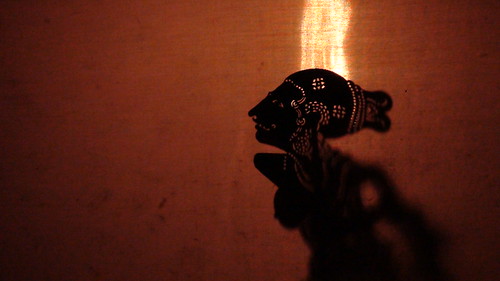
Happy to see that, little by little, my theatre photo-document work is being recognized: one of my photos of a Wayang Kulit performance (Balinese Puppet Shadow Theatre) was chosen to be on all the programs, flyers and posters of the new Asian Art Museum of San Francisco exhibition: "Bali. Art, Ritual, Performance."

The exhibition is running from February 25th till September 11th, 2011.


Saturday, January 30, 2010

Wayang Kulit Balinese Shadows Puppet Theater (2): "The Sacrifice of Bima" (The Performance)


Wayang Kulit Performance: The Sacrifice of Bima.
Wayang Kulit (By Gustavo Thomas © 2012. All Rights Reserved)


Once having explained (with help of a Balinese master, of course) the details of both the Wayang Kulit and the performance I witnessed at the Oka Kartini Gallery on July 19th 2009 (see my Blog post about it: http://gustavothomastheatre.blogspot.ca/2009/12/wayang-kulit-balinese-shadows-puppet.html), we can go on to the filmed material of the performance (which lasted approximately 20 minutes) and my experience there.

Evidently, ancient Balinese and Sanskrit were incomprehensible to me, but not so the sound of the singing (or reciting) and the music, nor the aesthetic visual aspect and the actions (I think in the video you will be able to appreciate it quite well in a manner similar to how I I lived it). Yet, there are some comments that I would like to share with you:


Kayonan


In addition to the characters that were presented in the video in the previous post, you will note the presence of a sort of leaf or butterfly (when it moves); it is a tree, "the tree of life" or Kayonan. It is one of the most important puppets and appears both at the beginning and at the end of each performance: it represents the centre, the life force, balance, which is why negative characters are placed on one side and the positive ones on the other one, with the Kayonan in the middle.


The length and public of the performance


The performance lasted a little over an hour and I noticed something that Covarrubias mentions in his book about public attitudes abroad (1): faced with a lack of understanding of the text and the lack of an ear educated to listen to the sounds of that language and music, they just started to get bored, but not so the Balinese public and some others (including me) that found an interest in them and struggled to keep from falling with the rest, but the common foreign public did fall into boredom. Some children went out to play, but others remained; in the end whole families were leaving the place before the end of the performance.


Covarrubias explains (2) it is not a children's theater, it is a religious drama featuring mythological epics that last 6 to 8 hours, full of beauty and codes that even the more stringent Balinese intellectuals enjoy (3); it is the case that the shadows, fire, song, and puppetry get the Balinese children's attention, but that's just a bonus. Hence its difficulty, hence the apparent lack of interest beyond a few minutes during the performance of almost a fifth of its normal length!

Unlike some Chinese shadow theater companies, the Balinese have not changed their themes and stagings for a child audience, nor do they show just excerpts so small only the fight scenes and acrobatics games are displayed (4). Moreover, Chinese puppets have an unparalleled movement while the Balinese ones may, in some cases, only move their arms (5)


Wayang Kulit (By Gustavo Thomas © 2012. All Rights Reserved)


The Dalang and improvisation


The technique of the Dalang (the master manipulator) is, without any doubt, the same both for this performance as well as for the one he performs inside a temple, and the only fault, if I can call it that, are some comments in English ( "Hello, How are you? Do you speak English?, etc.). that, nevertheless, belongs to improvised moments of comedy that exist in long for-Balinese-only performances too; that comedy is contemporary (with up-to-date jokes), improvised and, as I mentioned, part of the tradition of representing the Wayang Kulit.


The Dalang and battles


As expected, the battle scenes have the most movement and dramatic power of representation, and at some point we lose the awareness that this whole movement is performed by a single person behind the screen, the Dalang.


The puppets and their material behind the screen


When you see the puppets of the Balinese shadow theatre in the windows of the shops or even in a stack while carried by the company's aides, one cannot perceive the beauty they achieve when they become shadows with help of the lit oil lamp, literally giving them the energy that the Dalang then activates to achieve the movement of life. I had had such an experience in Cambodia, in Siem Reap (6) with this same type of puppets, but that performance was done by children who had developed their technique and who somehow didn't make us see their puppets in the best way possible; but here, with a Dalang (an expert), the images remained in my memory and I remember especially the light passing through the holes carved on the doll as truly spectacular moments.


I personally enjoyed the continuous image of the tree, even more so when it "flies" like a butterfly and goes away and comes back again with the flame of the lamp in the center; in the same manner, the sound of the small Gamelan orchestra (bieng the first time I listened to it beyond restaurants' or shops' background) made me enjoy the show a lot.


About the videos


The performance was about an hour and half long with no intermissions; the numbering of the videos is due to the fact that Youtube does not allow posting more than 10 minutes of material, so I split the performance into three parts (5 if I count the two extras videos, the introduction one and the one of the shots from behind the screen).


Video: Wayang Kulit "The Sacrifice of Bima" (Third part)


(1) Covarrubias "Island of Bali" page 237.
(2) Covarrubias "Island of Bali" pages 234-237
(3) Certain types of stories are performed only for the deity, as is the case with the theater and dance from India.
(4)
My post on a shadow theater performance in Wuzhen, China, is a perfect example of such only-for-kids performances: Wuzhen (II) A Chinese Shadow Theatre Experience.
(5) Some of the puppets from Java's shadow puppet theater can move the jaw.
(6) See my post on three performances of shadow theater in Siem Reap, Cambodia:
Three Shadows Puppet Theatre Plays in Siem Reap, Cambodia.


Texts, photographs and videos in this Blog are all author's property, except when marked. All rights reserved by Gustavo Thomas. If you have any interest in using any text, photograph or video from this Blog, for commercial use or not, please contact Gustavo Thomas at gustavothomastheatre@gmail.com.


Sunday, December 27, 2009

Photographs of Wei Family Shadows Opera Theatre Troupe Performance in 2007


Two years ago I published a post on a performance I saw at South Gate Space in Dashanzi 798, in Beijing, a performance by Wei Family Shadows Opera Theatre Troupe (1). It was a very interesting example of traditional Chinese Shadows Puppet Theatre; today, after the problem I had with Youtube, re-uploading all my videos, I took advantage of the situation and extracted some still images from those videos and I got a nice group of photographs of the performance. Hope you enjoy.

Slideshow of Photographs


Saturday, July 11, 2009

灯官油流鬼 L’Exécution Du Juge Infernal. Beijing Opera, Shadow Theatre and a French Theatre Director.


During the festival “Croissements” that the French government organizes each year in China there was a curious stage production, 灯官油流鬼 or "L'exécution du juge infernal" (1).

I thought this production was a curiosity because of the circumstances in which it was made and the elements involved in it: 灯官油流鬼 was directed by a French director, Sarah Oppenheim, a student specializing in traditional Chinese theater, who decided to do something the Chinese had never done before, staging an adaptation of a classical Chinese opera performed by Beijing opera actors and shadow theater puppets, two types of theater that have influenced each other during centuries but never mixed, at least till now.


Photographs (slideshow) "L'exécution du juge infernal 灯官油流鬼"


To accomplish this “exploration” Sarah was capable enough to join a great Beijing shadow theater company, "Han Feizi" (2), and a group of actors from the Youth Beijing Opera Trouppe, and then to work together staging an adaptation of the classic opera “铡判官” or “Jinchan case”, an opera called "exorcist," a term for operas with subjects like death, ghosts, and travels to the underworld.

Chinese commentators and Sarah Oppenheim herself, before the premiere, spoke of a Westernization within the traditional Chinese theater: even when using all the physical and artistic elements of Chinese theater, the structure of the assembly was in a "Western style”, according to the Oppenheim vision, of course. The director then adapted the text of the classical Chinese opera and put it on stage alternating shadow theater and Beijing Opera, in an spectacle which lasted just over an hour and a half, trying to shorten the usual duration of any Chinese opera (which is between 3 and 5 hours), keeping in mind the attention span of a contemporary viewer, and directed all actions of the story based on that (3).

Some years ago I had seen “Jinchan case”, the classical version, performed by the National Beijing Opera Trouppe (4), so when I was seeing Oppenheim’s version I could recall some of those scenes and the famous arias I had seen and listened to before. I remember that production as a high quality one, in terms of physical work at least, and with particularly spectacular acrobatic moments. I can not say that this "exploratory" performance appealed to me more than the classical one, but I found it to be easier to assimilate, and much less ambitious in terms of theatrical production. What I was absolutely impressed with, though, was the work of "Han Feizi" and their expertise in handing their puppets at a very high level, with moments of enormous beauty and ability. The Beijing Opera actors, on the other hand, young and without much experience, were less fortunate that their puppeteer colleagues; I was surprised, while I was seeing their performance, how the technical perfection by the actors I saw years ago at Chang'an Theatre (in the performance of the classical opera) was missing, and I thought about how important that is for any Beijing opera production, the sophistication and technical perfection of the physical movement, recitation and singing.

The video material will always be the best approach to the experience I had as a spectator seeing 灯官油流鬼:

Video (playlist with 12 videos) "L'exécution du Juge infernal"


Years of seeing Chinese theater and also years to elucidate its possible assimilation outside China, the use of its movements or the use of its exercises (I'm not the first one to say it, of course), never led me to think about the idea of a “westernization of its structure” and, as a western artist, to offer it to the Chinese public! It simply sounds to me a risky audacity in a lost war. But this time I was a witness of it and, surprisingly, it came from a French director. Let me explain, the "audacity" I’m talking about is trying to introduce any change in the Chinese world of tradition, extreme in itself, in the world of the “it must be”. Chinese journalists and critics spoke before the premier, many with some respect and some talking about “a surprising new idea”, some even called it "subversive" in a gentle and ironic way, but after the performance they stopped talking. Sarah got a group of traditional artists to join her in this exploration, but did not get a worthy reply from the Chinese public and from the Chinese theater cultural elite; the cultural power in this country is really part of a theological state, a “de facto” power, and the people who should be there to see it and criticize it and therefore give it a place in Chinese history were not there, silence was the worst of the responses.

I love the idea of such innovative productions, western students traveling throughout china, acquiring knowledge, learning from traditional masters, seeking to explore and practice what they learn (5), and I prefer to stay with it, that's where I think the greatest value of Oppenheim's adventure lies. In the end, tell me who (as strange and unsuccessful as it may seem), who or how many understand at high level two of the most important and specialized traditional forms of Chinese theatre, adapt them and mix them in searching for a new style?


(1) The name of the show in French, not the translation of the name in Chinese.
(2) There are at least two famous shadows theatre trouppes in Beijing, Longzaitian (which I met last year) and Han Feizi. You can see my post dedicated to my visit to Longzaitian Theatre (now demolished or undergoing renovation) in:
http://gustavothomastheatre.blogspot.com/2008/12/longzaitian-chinese-shadow-puppet.html
(3)
You can read an interview on the website of The Beijinger, an entertainment magazine in Beijing, where Sarah Oppenheim talks about the whys of her production: http://www.thebeijinger.com/blog/2009/06/08/Shadowplay-Sarah-Oppenheim-s-new-stage-production-explores-the-underworld
(4) Here's a link to my post about the performance of this classical opera; it's some video showing scenes that just seemed interesting to me, I have no critical comments:

http://gustavothomastheatre.blogspot.com/2007/02/long-bao-plans-west-side-case.html
(5) Sarah, a sinologist and a specialist in Chinese theater, travelled during a whole year throughout China in search of experiences, looking for ghosts operas and shadow theater, and learned different ways to work the traditional puppet theater. You can find a beautiful description of the cultural life of Sarah in a blog of her journey through China:
http://silkroadproject.blogspot.com/2007/02/shaanxi-province-light-and-shadow.html
"Sarah Oppenheim, my travel partner, is a petite French woman with a fierce character. Working on her masters in Chinese theatre, she is also learning the art of puppet play in Beijing. Rehearsing every day with her troupe members in a run-down shack huddled around a coal oven, she is learning how to “walk” her puppets. To learn the art of Dongbei puppets (from Northeastern China), her master insists that she needs to “walk” her puppet for at least one year to gain the dexterity of a professional. There are many walks he claims: a calm and serene character must have a slow stride, like deep breathing, up and down, slow and steady. A clown however, must be in constant movement, his head bobbing up and down, tripping occasionally – ready to make the crowd laugh. Sarah’s master insists that she can be initiated to other puppet movements, only after learning all the walks. From her almost four months of daily practice, Sarah has calloused hands and a protruding new thumb muscle. She is fed up with “walking”. Mr. Wei laughs at Sarah when she tells him what she is learning, and says that in Beijing people are too caught up on details He tells us that it only takes a month to learn the basic puppet techniques of the Huaxian shadow play and only about one year with the troupe to learn multiple dramas and most of the techniques. In past decades this apprenticeship took longer as most people were analphabet, and had to memorize the words and music for each play, which could take around three years. Sarah is excited to learn about today’s accelerated learning and Mr. Wei invites her to study with the troupe this spring. One month of study to become an ambulant puppet player. Sounds enchanting."


Monday, April 20, 2009

A Shadow Puppet Exibition at China Art National Museum (2007)


Thanks to Picasa (and other Internet sites) now is possible to publish Slideshows of any groups of photographs without a problem of space in the Blog, so I decided to retake some important events and dedicate some posts especially for showing the whole group of photographs I took of them.

You already have seen a Slideshow of "Tenjin Matsuri Festival" in Osaka in 2006, and this time I want to show more photogrpahs from this shadow puppet exhibition ocurred in 2007. The post referred to it was published on August 15th, 2007: http://gustavothomastheatre.blogspot.com/2007/08/chinese-shadow-puppet-exhibition-in.html

This was a very special exhibition in China, for first time there were showed in one place such amount of Puppets from the last two dinasties and from all over China.


if the photographs are not well displayed just click on the window and you will be redirected to the Picasa page.

Tuesday, February 17, 2009

Chinese Shadow Theatre Exhibition at Denison Museum*.


A few months ago I received an invitation from Anna Cannizzo, curator of Denison Museum, (a museum of Denison University in Ohio, USA), to collaborate with one of my videos displayed on my Youtube channel http://www.youtube.com/teatroesferico. The museum was planning an exhibition to display its collection of Chinese shadows puppet theater and also to talk about how this kind of puppets are handled; they had chosen a video I recorded at a performance by Wei family troupe from Sha'anxi in Dashanzi 798 in Beijing. The video apparently had some problems with the format and they preferred to use other, one so far the most watched of my videos, "A Monkey king fighting", recorded in 2007 in Wuzhen, Zhejiang Province.

The exhibition is called "Between Light and Shadow: Chinese Puppets from the Denison Museum" and the openning on Friday, January 23th, 2009. I share some photograps Ms. Cannizzo kindly sent to me, and of course the two videos showed there.


The text on the panel says:


Contemporary Chinese Shadow Theater The clip you are viewing is an excerpt from video taken by Gustavo Thomas, a researcher of theater arts. The video provides two perspectives of a recent shadow puppet show in Wuzhen xizhan, China. The video is entitled “Monkey King Fighting” and was recorded on March 28th, 2007. According to Thomas the “experience was very interesting: old musicians playing traditional instruments, only one puppeteer (a young woman) with her assistance, and those beautiful puppets of course. It seemed that day they expected hundreds of children so they prepared a simple fight-scene between the Monkey King and other mythological warriors, showing how the Monkey King was able to change himself into anything he wanted and it was a unique opportunity to see how one shadow puppet performance is done facing the stage and behind it, to study it or simply to enjoy this traditional theatrical culture from two different points of view.”


Here those two videos taken in Wuzhen, Zhejiang Province.


* About the Museum and the exhibition follow the link:


Wednesday, December 17, 2008

北京龙在天皮影 Longzaitian, Chinese Shadow Puppet Theatre Company: "Tale of the goat and the wolf"


About a year ago the renovation of Qianmen street begun. In downtown Beijing, Qianmen was the main avenue that for centuries led the whole of the known world to the main gate (Qianmen means “front gate”) of the walls of the forbidden city.

After the fall of the millenary Chinese empire (at the beginning of the 20th century), the pre-communist years and the communist era itself, Qianmen street became just some old houses and buildings on the verge of collapse. Surrounded by one of the neighbourhoods (hutongs) of greatest commercial and cultural tradition, Qianmen remained important only due to its location, south of Tian’anmen Square.


After a year of works, Qianmen has been mostly renovated and, though there are tinges of aesthetic falsity (its central part was conceived as a thematic luxury mall, for example), the street looks like during the best years of the Qing dynasty. What’s most interesting in this important renovation is the rescue (at least façade-wise) of the most important buildings, of traditional shops and of a series of places where Beijing’s cultural life developed for hundreds of years. And so, walking on the street and its environs we can visit famous shops, traditional pharmacies, restaurants, cinemas (the first one of China, for example) and some theatres.

One of the theatres that has had more movement thanks to the street renovation (yet not its building, which still is to be renovated) is the one that belongs to the Longzaitian (or “Dragon in the Sky” in Chinese, 北京龙在天皮影) shadow puppet theatre company.

In one building the company houses three small theatre halls, some puppet-creation workshops, and a gallery-museum.

What I found most enjoyable during this visit was the possibility to (finally) watch and watch again shadow puppet performances in Beijing; it had always been hard for me to find an established place where shadow puppet performances took place regularly and by a stable company. Until then, I had only been able to see isolated performances by provincial groups or, in very special events, by pekinese groups.

Last October 12th (Sunday) 2008 I saw two performances with two of the company’s groups: “The story of the goat and the wolf”, addressed to children, and “The three defeats of the skeleton-demon”, a traditional performance based on a story taken from “Journey to the West”, one of the greatest pieces of Chinese fantasy literature.

At that point in my stay in China, and having seen dozens of performances by different groups and companies, I think I was able to better appreciate the work needed for a performance; I recognised the use of a more “flexible” kind of puppet, and a clearer way of telling stories for the modern spectator. I still can’t recognise the differences in their techniques for handling the puppets, but it is true that, unlike the groups from the Chinese provinces, the shadow puppet groups from Beijing are (as is the case with traditional opera) oriented more to real entertainment and they manage to keep the attention of the modern spectator; they have no qualms in transforming traditional plays.

The company is made up of two groups, one for children and one for traditional performances.

I’d like to mention two curious facts. The puppets for “The tale of the goat and the wolf” are handled by puppeteers with dwarfism (the company advertises them as such; a possible translation of the Chinese words used could be “pocket puppeteers”), and they don’t sing nor play instruments (as is usual in Chinese shadow puppet groups), but instead make use of “playback”.

I managed to record the whole of “The tale of the goat and the wolf”, which lasts about 13 minutes, but the traditional piece “The three defeats of the skeleton-demon”, which lasts longer (some 23 minutes) didn’t fit in the memory of my camera and therefore I couldn’t record all of it.

For now, I share “ The tale of the goat and the wolf” and I promise to share a traditional play in a next posting.


Due to the length of the video (13 minutes) I couldn’t upload it to Youtube as one video, and split it into two; here are the links:


Complete video in Ipernity:


Wednesday, August 6, 2008

Xiaweidian Style Puppet Exhibition at Mentougou Museum


Keeping the line of my two last posts about my visit to Mentougou village and its special museum (1) it is the time to share a video and some photographs I recorded of the temporal Shadow Theatre Puppet exhibition I saw there.

I repeat some words about Xiaweidian style elaboration puppets and this special exhibition:

Xiaweidian, a village in Mentougou district, is home to the west school and has a long tradition of carving and playing shadow puppets. -Beijing's "west school" style puppets are coated with water color, not the usual tung oil and offer a slightly different viewing experience-, experts say.

During Summer 2008 Mentogou Museum has an exhibition of 700 hundreds puppets from diferent parts of China, and the highlights of the exhibition are precisely those puppets from Beijing Xipai Xiaweidian School.


Photographs of puppets showed at the exhibtion


(1) - July 23rd, 2008: Mr. Li making Xiaweidian style Shadow Theatre Puppets at Mentougou Museum.
- August 1st, 2008: Chinese opera, Music instruments and Shadow Theatre Puppets at Mentougou Museum

Friday, August 1, 2008

Chinese Opera, Music and Shadow Theatre Puppets at Mentougou Museum


Mentougou Museum, outskirts of Beijing. July 2008.


Mentougou Museum, outskirts of Beijing, is an interesting place to see documents of Chinese Performing Arts history through a small province village's point of view.

A permanent exhibition of Mentougou's Performing Arts shows us Shadow Theatre Puppets (Xiaweidian Beijing West School), Chinese Opera objects (costumes, props, and music instruments); and historical photographs.


Photographs of the permanent exhibition at Mentougou Museum:


Chinese Opera costume. Mentougou Museum.


Chinese Opera props. Mentougou Museum.


Chinese Opera musical instruments. Mentougou Museum.


Chinese Opera Musical Instruments. Mentougou Museum.


HISTORICAL PHOTOGRAPHS


The same video in Vimeo:


Chinese Opera, Music and Shadow theatre Puppets Permanent exhibition at Mentougou Museum from Gustavo Thomas on Vimeo.
If you are interested in using any text, image or video from this Blog, please contact the author writing your e-mail and information in comments. (comments are private)
Gustavo Thomas. Get yours at bighugelabs.com