Showing posts with label Performance Art. Show all posts

Tuesday, May 22, 2012

"Parting Memories" by Violeta Luna. A Conceptual Theatre. Panamerican Routes Festival in Toronto. (2012)

Violeta Luna during Parting Memories (Photo from Internet)


Last Saturday (May 21th) I went to see "Parting Memories", a piece of conceptual theater by and with Violeta Luna at the Theatre Passe Muraille in Toronto, as part of the Latin American theater festival "Panamerican Routes", organized by the Latin American-Canadian collective Aluna Theatre.

Violeta is a Mexican visual & stage performance artist who has worked as an asociated artist in La Pocha Nostra (the collective of Guillermo Gómez-Peña) and in Secos & Mojados, in the city of San Francisco. "Parting memories" is part of a project that Violeta is currently creating with Secos & Mojados about Latin American immigration to the United States and the personal burden that emmigration itself means.

I have called it "conceptual theatre" because the elements of the piece (not a dramatic one because of her performance) are linked at different levels of narrative language according to an unique concept, immigration to the United States, and it is the viewer who joins the threads of these levels.

There is a first level (which I consider is the strongest one) which consists of a recording of the narration of more than 30 years of the life of a Salvadorean illegal immigrant; a second level that presents us, at the same time as the audio narration, a video with different images, first of a woman who is unearthed in a criminal investigation process (perhaps a murder scene) and who is the artist herself (or the one that speaks, or just another immigrant in any case... ) and the different steps of preparation for crossing illegally into the United States (list of requirements, souvenirs, maps, etc.) with the ubiquity of the Mexican passport; and finally a third level, staged, alive, with Violeta Luna exposing (at the same time as the other discourses), and mainly through visual images, the body (hers) in relation to different objects of an immigrant (emigrant) memory, objects that one take on a journey of such magnitude, plus the physical experience that the body has at the moments it is classified as "illegal" and therefore as a criminal in another country.


Violeta Luna during Parting Memories (Photograph from Internet)

It is a very rich stage proposal where the dramatic power lies mainly in the story told by the Salvadorean woman, while the body of Luna offers more of a background or frame, a display material that enriches the first discourse.

Although there is a use of interaction with the public, I don't feel this acquires a cathartic power in the body of the viewer, but rather a contemplative one. In any case, there is only one point where I consider that this interaction was so strong that it went from the basic concept to the real body of the viewer, and that was when, after Violeta asked the public to stamp her half-naked body (with seals reading "illegal", "criminal" and "terrorist"), the artist stamped the leg of one of the female spectators, thus becoming the person who decided now who which stranger was to be labelled as legal or illegal.

Obviously for every traveller like me who lives continuously as an immigrant, even as a legal one, this is a very powerful work, but I have my doubts whether it is as powerful for those viewers who are part of the world that one immigrates to. Non-immigrant Canadian spectators (and I can believe that this applies to Americans of the same kind) react in a manner that I would think of melodramatic, with some sympathy. If that is part of the goal of the performance, it works, without a doubt; if not, then it is a "but" to the goal itself because, why join a series of "sentient" samples of the plight of an immigrant, like the continuous news notes and exposés that flood daily the American or Canadian press?

In any case I wonder, as in any work that offers an account of a social problem, how far does the single exposure of these problems in the world of art work beyond being part of the current affairs?

Violeta Luna will give a 3 day workshop that would be worth taking.

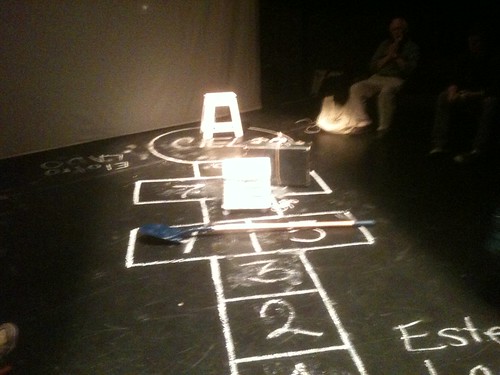
Violeta Luna's performance "Parting memories" at Theatre Passe Muraille (Toronto. May 19, 2012)
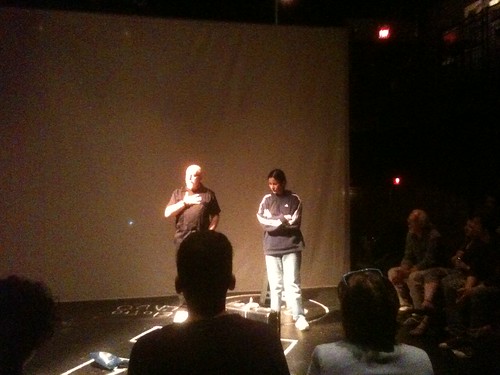
Violeta Luna after Parting Memories performance at Theatre Passe Muraille. (Photo by Gustavo Thomas. 2012)

Violeta Luna's performance "Parting memories" at Theatre Passe Muraille (Toronto. May 19, 2012)
Parting Memories stage after the performance at Theatre Passe Muraille. (Photo by Gustavo Thomas. 2012)


Texts, photographs and videos in this Blog are all author's property, except when marked. All rights reserved by Gustavo Thomas. If you have any interest in using any text, photograph or video from this Blog, for commercial use or not, please contact Gustavo Thomas at gustavothomastheatre@gmail.com.


Monday, September 19, 2011

A new book about Ron Athey, a performance art artist


I'm sharing the entirely note about a new book on Ron Athey's work, and it is because I believe in the necessity of expanding the knowledge of new forms of art, those which show our limits and watch beyond anything in our time.

This will be the first ever publication devoted to the work of Ron Athey, a central figure in the development of performance art since the 1980s. Edited by Dominic Johnson, Pleading in the Blood: The Art of Ron Athey will foreground the prescience of Athey’s work, exploring how his visceral, body-based practice foresaw and precipitated the central place afforded to the body in art and critical theory in the 1990s and after. While histories of art, performance, theatre, and subcultures have consistently acknowledged Athey’s major contribution to the development of contemporary cultures, there has never been a dedicated book about him. Pleading in the Blood aims to fill this conspicuous gap. Developed in close collaboration with Ron Athey, this book seeks to provide a critical overview of Athey’s practice. In his stagings of crisis, sexuality and death in the time of AIDS, Athey calls into question the limits of artistic practice. Athey has been a crucial figure in the development of performance art and body art; club performance; intersections between punk, queer and alternative cultures; sexual politics, specifically in relation to queer practices and the politics of HIV/AIDS; and the representation of religion and ritual.

The book will track Athey’s work from the 1980s underground through to his influential works for festivals, galleries and museums, which have crucially impacted upon the development of body art, Live Art and experimental theatre. The book will include contributions from distinguished national and international artists, writers and scholars: six newly commissioned chapters on different aspects of Athey’s work; shorter ‘testimonials’ by artists; Athey’s own writings; and extensive full-colour images. Contributors include Amelia Jones, C. Carr, Adrian Heathfield, Lydia Lunch, Dominic Johnson and Patrick Califia amongst many others.


The book will be published in 2012.


More information on Ron Athey’s work can be seen here:

http://ronatheynews.blogspot.com/

The Agency and MIT Press have already raised two thirds of the publication’s budget. However, we believe that Pleading in the Blood merits the highest possible standards and be as richly illustrated and as lavishly produced as possible. Your support will strongly enhance those production values and will be a crucially needed step in meeting our collective vision for the book.

http://www.indiegogo.com/Pleading-in-the-Blood-The-Art-of-Ron-Athey


Texts, photographs and videos in this Blog are all author's property, except when marked. All rights reserved by Gustavo Thomas. If you have any interest in using any text, photograph or video from this Blog, for commercial use or not, please contact Gustavo Thomas at gustavothomastheatre@gmail.com.

Friday, October 8, 2010

Nuit Blanche 2010. Photographs and Videos of 12 hours of Performance Art and Installations all over Toronto downtown.

Toronto Nuit Blanche 2010


Toronto Nuit Blanche is a Contemporary Art Event but it is also a big party, a popular festival, a crazy night where tax money is spent for the sake of watching, listening to and experiencing live contemporary art, and that is simply amazing. At Nuit Blanche there is no place for art exhibitions in the old sense, no place for theatre stages (even street theatre) or anything "old fashioned," here is the place for Art with new technologies in extreme contact with their spectators.

I have always thought about Nuit Blanche as an enormous one-night-only contemporary art amusement park, and in that sense it works very well: more than one million people come to downtown Toronto and walked for hours experiencing and enjoying all kinds of installations and performing art, all free and only spending their money on food and beverages. This can only happen in a developed country, of course, and it is happening in Canada, not without criticism from its ferocious conservative politicians, of course, but that always happens in the richest families.

My only question is, what about the "concept" of the works presented at Nuit Blanche? Contemporary art and, specially, Installations and Performance Art, are "Conceptual Art", there is no sense if the pieces don't have any concept behind them, and even if the participants were very aware of the conceptual origin of their work, what about the public understanding of them?

Torontonians (and tourists alike) watched more than 100 hundreds pieces in one night, and experienced contemporary art in intimate relation with new technologies. They had lots of fun (never experiencing emotions like fear or even love), but they also took those pieces, precisely, as a source of amusement, missing the possible concept, missing the expected repercussion of most of them. A piece was a thing you can forget and put in the trash bin after use, as a Junk-Art. But what could be worse is that many of those pieces of art were conceived only (from the beginning, by the artists) as a way of interacting between technology and people, giving at the end amusement for amusement itself,  giving the people an aural or visual experience alone as an art experience. 

That experience is so powerful and "cool" (as I listened to many people saying that night) that one big part of the "other" contemporary art (that what wasn't represented here) would be lost in the perspective of this more or less one million spectators.

How far away I am from the 'poor' performances at the Trigger Festival some months ago!

Well, after have seen Nuit Blanche 2010 success, I must say that all big artistic projects have their own risks.


Monday, September 13, 2010

Trigger Festival 2010: The Honesty Of Cruelty.


On June 9th, 2010, I was invited to a Performance-Party at Raging Spoon, an alternative venue in Toronto. This party was part of the Trigger Festival, an independent art festival focused on alternative ways of living and doing art.

Even though Toronto has a very large alternative community, it is hard for anyone from that community to get a place in this city, a city which dreams of being part of the success of the American way of life (Canadian-style). So, an event like the Trigger Festival was almost unknown to most Torontonians, with almost no publicity anywhere and without any special place in those "what-to-do" magazines. Even then, that night Raging Spoon was almost full of people (around 100, maybe more) looking for some crazy and different performance acts, and they were not disappointed.

Some 10 performance acts were scheduled for that night and two of them deserve my special mention because they were surprising and shocking from my point of view. I wasn't prepared to see anything interesting (I was going to a party), so I didn't bring my cameras and I only could take video and photographs with my iphone, I apologize for the bad quality of the images.


Transvestite, AIDS and a bottle of wine.

First, it was a foreign homosexual man, a transvestite who lives in Toronto, exposing his impotence and his suffering with his AIDS treatment, through a very shocking performance. (See video "first performance")
Here, the act with the actions as I can remember them.

He...

- appears dressed like a woman with a big handbag, with a juice extractor, a bottle of wine , beets and medical pills.
- cuts and prepares some slices of beet for a juice, and puts the pills on the floor.
- extracts the juice while singing,
- opens a bottle of wine.
- takes off his underwear and lies down with his back on the floor.
- introduces the mouth of the bottle into his anus and empties the contents of the bottle while singing.
- shows, in silence, the empty bottle and drinks the last drops.
- puts the glass with beet juice on the floor and, seating close to it, fills the glass with the liquid coming out from his anus.
- shows to the spectators the glasses filled with beet juice and wine from his anus.
- drinks the liquid and swallows the pills.
- cleans perfectly, using his clothes, all the area of the performing space.


A queer girl beaten

Second, a lesbian girl, from Québec, expressing her impotence before the world, the sexism and the incomprehension of society, repeating scenes of her real life when she was humiliated and beaten, inviting the public to shout and to cry if they shared her hate. (See video "second performance")
It is a little more difficult to remember exactly the order of actions but I will try to do it:

She...

- gives spectators a paper (see the photos) with a sentence in English and French inviting to shout or cry if we fell like it.
- listens to (as we do as well) several voice recordings with some men talking about her, about her appearance, her sexuality and in all cases humiliating her, as if everything were fuel for an emotional explosion.
- after several minutes of listening to the recordings she explodes into crying and shouting.
- Another girl enters and holds the first girl's arms while she's shouting loudly, it seems she is  being beaten by some people. Some spectators shout with her.
- falls on the floor, in silence.
- takes two banners with sentences in English and French: "I refuse to be a Victim" and "Thanks to the Queer community"


So, after that evening, I've being thinking a lot about what I saw there.

If we are as honest as those performers were, then those acts would change our perspective of watching spectacles.

Those were no spectacles for themselves, but they were theatrical acts, performing acts, half reality and half staging. Their performers gave a lesson of honesty, yes, but those weren't direct speeches during a real scene of crisis, those acts were also "theatre" and "performance"; we have to remember that they thought what to do on stage and what to show and say to the others; those performing acts walked on the line, on the border, of psychodrama and of personal theatre, they were in part an isolated hysterical impulse of an antisocial human being, and the summon of the creative saint-actor of "le Théâtre de la Cruauté". 

Yes, it was shocking and strange, not professional and not well staged, but unique. You won't see much of this in other parts... It was something terribly "unique".

Then some questions arise: What would happen if they were prepared actors, if they were great acrobats or very well prepared clowns? What would happen if they were educated singers? What kind of spectacle would we see? For sure something unbearable, because art and life together are Zeus' fulminating lightning.

If that combination doesn't happen, there is still the simple performance act they presented, and I think: I would rather see these honest performing acts than dozens of Off Broadways productions or those Toronto American-like plays on King street theatres, but tell me, please, who then will pay for it? who will pay for the honesty of "la cruauté" we saw that evening? Nobody will do it; well, yes, the performer himself, as it was.

It has to be an isolated act, behind the professional life, an alternative act, in a subterranean world, an underground act.

Certainly, it has to be a provocative act but outside the official and codified world of "art".

I love good theatre, good technique, the amazing way technical tradition is shown on Beijing Opera stage or Noh Theatre dramas, the way realist players can manage a character in a Tennessee Williams' play, but I'm also attracted by honesty, by cruelty, by that we can call a "trigger".

There is, undoubtedly, a dichotomy (not a contradiction) in my idea of art appreciation and creativity, but I enjoy that, it is like fuel in my creative life.

There is also a desire... and I won't say what this desire is.


Here, a slideshow of photographs of the whole event; you will recognize the acts I've been talking about.


First Performance


Friday, May 16, 2008

Street Theatre in Today China ( Part 2): Old days and Performance Art

Note: this is the Part 2 of the post I published on the 3/31/08, Street Theatre in Today China (part 1).


Acrobatics and Street Theatre in 1927 Shanghai


I invite you to observe some spectacles offered on Shanghai streets in 1927. Thanks to the preservation of a German documentary made specifically to show Shanghai’s common daily life in 1927, we can observe scenes of street comic theatre 二贵摔绞 (ergui shuaijiao), acrobatics and martial arts (all of which have been linked to each other throughout the history of Chinese spectacle), and we can also experience one kind of Chinese Opera performed in the open air. We can not forget that Chinese Opera had two lines of performance, one thought for interiors (Tea houses, saloons, theatres and palaces) and another one for exterior spaces (streets, fairs, temporary stages and squares).

These scenes are an example of the life Chinese streets had in last Century’s 1920’s, life completely lost now except on those exceptional moments the government allows.


Shanghai Street Theatre. Ergui shuaijiao. (1927)


Acrobatic Spectacle in Shanghai (1927)


Martial Arts spectacle in Shanghai (1927)


Martial Arts Spectacle in Shanghai (1927)


It is said that a big part of the evolution of Peking Opera (Beijing Opera) during the 19th Century was as open air events; some characteristics of its music, movements and stories had much to do with the requirements of performing on open air stages: attracting the public’s attention in the midst of a multitude during special events. This kind of Chinese opera doesn't exist anymore, at least in important Chinese cities where, today, Chinese Opera is a cultural institution performed always in enclosed spaces, full of depth, elegance, and only accessible to the initiated.

The Street Spectacle in China doesn't have a dramatic structure, it is generally a series of isolated acts of singing, acrobatics or dance. So far (April 2008) I have never seen any street spectacle based on any dramatic structure as (we recognize it) outside China, besides some Chinese Opera special performances in the open air.

Mass events (even those organized by the government or by television producers) are strictly controlled, yet offer an example of one aspect of street theatre evolution. Groups and theatre companies, which had been isolated or independent in the past, have been extinguished and absorbed by cultural institutions and big entertainment enterprises; now, they are part of immense choreographies where multitudes of dancers, actors or martial artists participate. Choreographies where 1000 taijiquan practitioners show their skills on television, where hundreds of children dressed like Shaolin monks perform some amazing routines, or where Chinese ballerinas in a river of movements accompany a famous singer (or just being part of a touristic experience at some important sight).

Street acts with political character are non-existent, and I'm sure the reason for their non-existence is the risk everyone in China could run by trying to produce anything outside the law.


Dashanzi 798


Spectacles have become a "Performance Art"; this artistic manifestation, a cousin of theatre and visual art, has given Beijing a singular way of expressing feelings or some ideas not dangerous to Chinese law views. There is only one place allowed to do "Performance Art", the Cultural Center Complex of Dashanzi 798, the main venue dedicated to Avant-guard culture in China.

A huge space with some useless communist factories (some of them still working), it has been converted into the new Chinese Soho. Dozens of galleries, handcrafts shops, cafés, restaurants and two or three special spaces have become the point of reference in the new artistic wave of the powerful economic China. The special characteristics of those former factory spaces, their squares and alleys, give place to creative events which try to give them new life and try to transform them.

Performance Festival in Dashanzi 798:


In Dashanzi we don't see street theatre, instead we see "performance art events"; there is no dramatic structure but they do keep some aspects of similar street artistic manifestations from the 1960’s, "the happening": improvisation, the idea of a unique act (every performance is different because of many factors, including the public and space), and of course an artistic conceptuality.

Performance Art has become the most serious way of constructing a street spectacle in a Chinese city, even though we are not strictly speaking of a theatrical manifestation. More linked to Visual Arts (painting, sculpture and video) than to Stage Theatre these, they border on it; as a postmodern way of expressing artistic ideas, it shares public and surprise with happenings from the 1960’s, but it doesn't care about dramatic structure, characters or stories. Doing performance art doesn't mean doing theatre. The Gao Brothers are one of the best examples of visual artists doing "performance art" without any knowledge of theatre (or at least it seems to me so); their importance lies in their powerful way of reaching their public with out-of-normal acts or through contexts different from which those acts are usually seen. Aside from some famous Chinese names, most of these performances are created jointly with foreign artists.

Ameret performance in Dashanzi:


Even though we can say that Performance Art is the new choice which substitutes street theatre (if that is possible), it also faces a big challenge. Performance art in China reached its peak between the 1990’s and 2000, and little by little it has become less strong and powerful (1). Since 2005 the number of new style "rebel events" has decreased, and only some not very publicized festivals have had place. No more explosions of fire along the Great Wall or people hanging for hours from their own sculpture as we can saw some years ago. Dashanzi has then become a refuge of all of them.


*


Streets are fascinating for the scene creator, they are a space where theatre goes to the scenography, where life is surprised by the fictitious act of the theatre. The Chinese government fears it because of its surprising and liberating way of reaching spectators, and it has been looking to at least control it (if not repress it), almost to its extinction. But hope for its permanence lies in all those experiences of Chinese street spectacle from the past, in the essence of it, in imagination as creator; street spectacle opens our imagination where we don't expect it and that shows us another way of getting our priceless freedom.


(1) Only as a point of reference for the reader, this is what Wikipedia says about Performance Art in China: "Performance art in China has been growing since the 1970s as a response to the very traditional nature of Chinese state-run art schools. It is becoming more and more popular in spite of the fact that it is currently outlawed. In 1999 the importance of contemporary ChineseChinese artists in the Venice Biennale. In recent years many of these artists have made performances specifically for photography or film. Interest in Chinese art has never been higher. art was recognized by the inclusion of 19 contemporary.

Some of the more extreme examples of Chinese performance art have become notorious in the West. In 2000, Zhu Yu, a painter and performance artist from Cheng Du, created a scandal by taking a number of photographs of himself, supposedly, eating a foetus as a protest against state abortions as a means of population control. Peng Yu and Sun Yuan have also worked with human body parts as well as with live animals and are equally notorious. Some younger performance artists who have exhibited widely in the west in 2005-6 are Shu Yang organiser of the Dadao performance art festival in Beijing, Yang Zhichao, famous for having his identity card number branded on his back and Wang Chuyu who went on hunger strike as part of an exhibition called Fuck Off that took place in Shanghai in 2000 in opposition to the Shanghai Biennale.

They acknowledge a debt to older performance artist/ curator Ai Weiwei. Other well known artist are Ma Luming and Zhu Ming.

The 1996 film Frozen (Chinese title: Jidu Hanleng; 极度寒冷) by Chinese director Wang Xiaoshuai, made under the pseudonym Wu Ming, has as its protagonists a group of Chinese performance artists, who are shown engaging in several street performances in the film."


If you are interested in using any text, image or video from this Blog, please contact the author writing your e-mail and information in comments. (comments are private)
Gustavo Thomas. Get yours at bighugelabs.com