Showing posts with label Noh Theatre. Show all posts

Thursday, September 13, 2012

A Kyogen Performance at the National Noh Theatre (国立能楽堂) in Tokyo. (2011)

National Noh Theatre (国立能楽堂) Program with stamps of the 2011 season. (Gustavo Thomas © 2011)

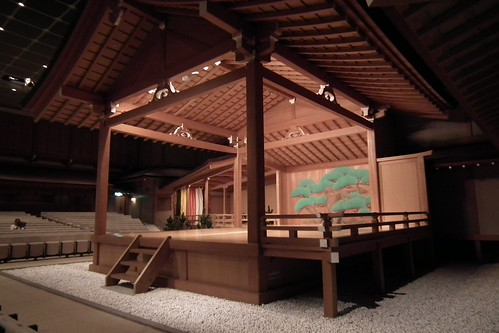
As you would expect, there is no visit I could do to no matter what Japanese city where I do not look for the opportunity of seeing a traditional theatre performance, a kind of theatre that I admire and enjoy very much. In May 2011, in Tokyo, I could only go to see Kyogen, which is a comic performance that normally accompanies Noh plays.  As it took place inside a theatre I was not allowed to take any pictures or video of the performance, but I could take some shots of the building and of the beautiful "stage" of the National Noh Theatre (国立 能 楽 堂).

Contemporary Noh and Kyogen theatres are theatres within theatres, as if the space for Noh were a permanent stage: the spectacular wooden theatre (which has not changed in form or building materials since the sixteenth century) is surrounded by a modern event space, with the consequent addition of seats where originally there was just an open space for spectators in Shinto temples.
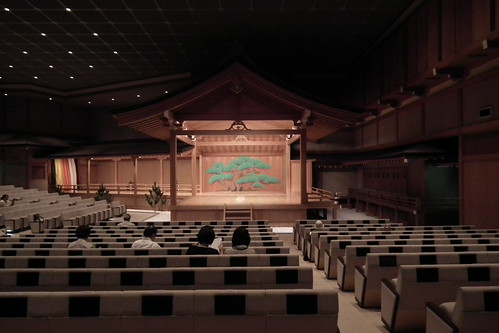

National Noh Theatre Stage (Tokyo, 2011)
Stage within the National Noh Theatre (国立能楽堂). Tokyo, Japan. (Gustavo Thomas © 2011)

National Noh Theatre Stage (Tokyo, 2011)
Stage within the National Noh Theatre (国立能楽堂). Tokyo, Japan. (Gustavo Thomas © 2011)

The lighting, which is modern, is directed to the "stage" (to the original Noh theatre) in a completely open way, with no changes during the performance and no adding any kind of "atmosphere". Occasionally during evening performances in temples or outdoors at festivals (I saw one in Osaka with the actors on a boat, for example) torches are used, giving a very special effect on the atmosphere, but the use of electrical light as part of a production’s design is never seen.

This Kyogen performance had a special meaning for me because, for the first time in my life, I was attending a performance of Japanese theatre with subtitles that translated everything to English;  every seat in the theatre had a screen, you could choose between Japanese and English, and so you could follow the performance without focusing only on the movements and the music (which can be interesting but also very tiring).  A wonderful addition for those of us who do not speak Japanese, because it really turns that performance into an event that is very enjoyable in every sense; for the first time in my life I could laugh watching Kyogen through understanding the verbal element and not only through visual cues. These are treasures of modernity that are well appreciated.

Screen with subtitles at the Noh National Theatre (国立能楽堂). Tokyo, Japan. (Gustavo Thomas © 2011)


Most viewers are people over 50, many of them fall asleep just as soon as the performance starts, but a good deal of them really enjoy the show, you can tell that they are familiar with it and they know what to expect from it.  It is not a ritual theatre anymore, of course, and it is not a theatre with great and famous actors and shouts of the public as in Kabuki, but it is highly respected, people applaud vigorously and shows are almost always sold out.


The Kyogen performance


Plays program at hall of the Noh National Theatre (国立能楽堂). Tokyo, Japan. (Gustavo Thomas © 2011)

Ticket for the Kyogen performance at the Noh National Theatre (国立能楽堂). Tokyo, Japan. (Gustavo Thomas © 2011)


Kyogen plays, in contrast to Noh, are very simple plays about earthly subjects, related with trickeries and vices, usually common people and with not very stylized movements on the stage. In the last play of that evening program, for example, The fish sermon, a drunk fisherman wants to fool people by pretending to be a monk, and when he's asked to give a sermon he starts to give a list of all the fishes he knows instead of religious sentences, as simple as that.
 
Just as a reference I transcribe the program with the plays performed that night which, as I mentioned earlier, was only Kyogen. There are many sites on Internet which resume Noh and Kyogen plays, so you can make a simple search on Google if you want to know more about them.


Three plays and a musical piece (about 90 minutes)


- Otoshi-Suo (The discovered gift)

- Tsuen (The tea Monk)

- Uo-Zekkyo (The fish sermon)

Texts, photographs and videos in this Blog are all author's property, except when marked. All rights reserved by Gustavo Thomas. If you have any interest in using any text, photograph or video from this Blog, for commercial use or not, please contact Gustavo Thomas at gustavothomastheatre@gmail.com.


Wednesday, January 13, 2010

Hosho Nohgakudo Theatre in Tokyo. A Glance to the interior.


Beginning this 2010 with a nice memory to my visit in January of 2008 to one of the most important Nō Theatre Buildings in Japan, the Hosho Nohgakudo Theatre. I went to see a whole program of Nō and Kyōgen (1), but it was impossible to record any video of it, so I only can show a glance of the building interior; not bad at all I think, specially its traditional stage made entirely by wood.


(1) You can see an example of this kind of program in my post:


Wednesday, March 7, 2007

(Noh Theatre) Kanze Seinen Kenyu Nō: Nō appreciation event.


On Saturday July 29th 2006, in Kyoto, Kanze Seinen Kenyu Nō (1) presented a special Nō appreciation event at Kanze Kaikan (Kanze theatre). It was summer and children were on holidays, it was a good opportunity to reach and to teach them how to appreciate Nō theatre in a practical way. The next day the same company would perform a full 6 hour long session of Nō and Kyogen. (2)

The program of the Saturday appreciation event read: ‘Young performers will give a demostration of Tamoe, Ikkaku sennin, and Tsuchigumo, as well an explanation on costumes and a small lesson of Nō performance.’ Tickets cost ¥1,500 (¥1000 for students). (3)
From 10:00 am to 2:00 pm entire families, in a Theatre full to capacity, amused themselves while learning about one of their most precious national treasures.
As I wasn’t able to understand Japanese I decided only to record on video some scenes of the demostration and some part of the explanations and lessons. I’ve always thought that’s the best way to share online my visit experience .

This was the event’s schedule:

9:30 Entrance.

As the organiser asked, we arrived at 9:30, yet the whole theatre was already full of people. Most of them were children but there were also old people.


10:00 Demostration of Nō plays: Tamoe, Ikkaru sennin, and Tsuchigumo.

They started on time and presented part of three plays, with explanations about movements, ways of singing and stories.


The video shows one of the Nō players performing a whole scene without a costume, which helped explain the choreography and the perfection of the details. (4)


12:00 All the next activities took place at the same time (5):

Theatre’s hall: explanation of costumes, masks and texts.


The hall was divided into four sections for the explanations: one for costumes, one for masks, and another one for texts. As all of them were done in japanese, so I decided to enter the theatre and see what was going on inside.


Theatre stage: lesson on how to wear a costume, mask, and on walking with them on.


These are extremely beautiful images of professional Nō players dressing up children with real costumes and masks and showing them the right way to walk wearing that on stage.

First floor: small lessons on singing, holding a fan, dialogue, choreography with objects, etc.


People were happy and excited waiting their turn for the small personalised lessons on singing, dance and dialogues; I say personalised, because Nō has only one way of teaching its acting: from master to student, one on one.

At that moment, Nō had become a family experience, an entertainment, and an exceptional way for one strange meeting: the common people of our age with a refined traditional performing art.


(1) Kanze Seinen Kenyu Nō is the Nō company in charge of managing the Kanze theatre. As many other Japanese theatre companies its structure of power consists mainly of a big family, recognised for centuries, though today some parts of this structure have changed and some non-family members can be accepted.
(2) See post of 21th of february, 2007:
http://gthomastheatre.blogspot.com/2007/02/kanze-seinen-nekyu-n-three-n-plays-and.html
There I give detailed information about that performance, including a sinopsis, video and photographs.
(3) Of course, I didn’t translate the theatre brochure, I took one extract from a note inside an English language magazine. About the costs of tickets, I could get a student discount thanks to my chinese Qinghua university ID card.
(4) It’s a pity I lost the other part of the video where the same player shows the same movement and choreography with the whole Nō costume.
(5) That way of giving the explanation and lesson was not problematic at all, it was even exciting, as it created a brilliant work dynamic where everyone could do something, wherever you went you’d find somehting interesting to learn. It was a kind of No carnival, joyful and noisy. A fantastic experience.


Monday, February 26, 2007

(Noh Theatre) Kanze Seinen Kenyu Nō: Three Nō plays and one Kyogen.


On July 30th, 2006, during my visit to Kyoto, Japan, for the first time in my life I had the chance to see one complete session of Nō and Kyogen at the Kanzai Kaikan (Kanzai Theatre). My experience seeing this kind of theatre includes two occasions at some Theatre festivals in Mexico City, where troupes from Japan performed short sessions of Nō. This time the Kanze Seinen Kenyu Nō performed for 6 hours, three Nō plays and one Kyogen piece. Among the pieces presented there was Hagoromo, or The Robe of Feathers (one of the most famous Nō plays in Japan), and a short play, Shimizu, which belongs to Kyogen, the comic part of this dramatic art.

Nō Theatre in Japan is one of the national performing arts treasures, with a long tradition and commanding high respect, and around the world this kind of Theatre is seen as one of the finest artistic manifestations of humankind. As a simple spectator of Nō, I preferred to look into scholars’ papers to explain some parts of it, to give a simple description about my experience and to share one video, some photographs and my impressions of the performance.

The session of that Sunday 30th of July at Kanzai Kaikan started at 11:00 am and finished at 5:00 pm; it was performed in this order:

1- Tamura 田村 (Nō) Author: Zeami (1).
2- Shimizu 志水 (Kyogen) I don’t know who the author is.
3- 10 minute break.
4- Hagoromo 羽衣 (Nō) Author: Zeami.
5- 10 minute break.
6- Performance of some ritual chants.
7- Ukai 鵜飼 (Nō) Author: Enami no Saemon (2).

Tickets cost ¥2500 (US$25,00) The theater was about 50% full, mostly with old people, and almost no foreigners.

1- Tamura 田村 (Nō) A priest visiting the Kiyomizu-dera hears from a boy working there how the temple was founded by Genshin under the patronage of Sakanoue no Tamura-maru, after the priest had met a manifestation of Kannon. The child points out the famous spots around the temple and then vanishes into the Tamura Hall. The priest recites the Lotus Sutra throughout the night, until the ghost of Tamura-maru appears and tells of the divine assistance he received from Kannon in his task of bringing peace to the land and driving away devils. (3)


2- Shimizu 志水 (Kyogen): The story of the lazy servant Tarokaja and his master. Tarokaja is told to fetch water for his Master's tea ceremony. Tarokaja shirks his duty by telling his master that he was attacked by a demon before he could fetch the water. The master goes to fetch the precious water container that Tarokaja left behind, and Tarokaja attacks him while wearing a demon mask. The master is frightened at first, but sees through the disguise when he recognizes Tarokaja's voice.

Shimizu is a comedy but it doesn’t seem anything close to it; it provoked some smiles in a few spectators, but nothing more. The history of Kyogen is absolutely interesting: its evolution from a sort of popular pantomime with simple dialogues to this cold technique and monotonic speech make me curious about how it evolved this way.

In ancient times, Kyogen was a comic, very useful play that would lighten up the heavy ritual of Nō, using words and dialogue closer to that of the common people, with simple plots and less technical movements.

Today, the Japanese spectator doesn’t understand anymore this kind of dialogues, so he needs to follow the text with a transcription and even a translation of it.

Of course, there are differences between Nō and Kyogen. If we compare the two styles of theatre I saw that day, we’ll find many differences in rhythm, tempo and technique: some moments in Shimizu could be called “surprising” and quick (when Tarokaja wears the mask and scares his master, for example). But simply put, nowadays, if we want to enjoy Kyogen as it is performed, we must have a deep understanding of this Japanese performing art.


3- Hagoromo 羽衣 “The Robe of Feathers” (Nō): Some fishermen are walking at Matsubara on Mio Bay when one of them finds a beautiful robe hanging from the branch of a pine tree. He is about to take this home when an angel comes to claim it, explaining that is a feather robe from Heaven. This makes the fisherman determined to keep it as a national treasure, but when the angel tells him that without it she can never again ascend to Heaven he is so moved by her distress that he agrees to return it if she will dance for him. He at first refuses to give it back before she dances for fear again, but when the angel tells him that such behavior is only to be found in the ways of men, the angel puts it on and dances. Then, calling down blessings without number on the land, she disappears up to Heaven among the mists and clouds. (4)

I expected too much from this play. I had read about it and had even found the English translation of the text on internet. I wanted to see the dancing moment, in my way of picturing this spiritual style of theatre I thought an angel dancing with her feathered robe would be impressive. Hagoromo has been a success since ancient times (Zeami talks about how people liked the play), but for my uneducated eye it resulted a very slow dance and without spiritual feeling, and I couldn’t see anything special about the physical technique of playing it.

I could not take video from the play but I found a short one in Youtube, and you can picture a little bit about the performance:


This disappointment of mine is not only the result of an uneducated eye, I’ve seen performances for more than 25 years with depth of understanding and I’ve always thought about the ways of putting anything on stage. It’s clear that Japanese Traditional Theatre has lost something during its own evolution; reading Zeami and his contemporaries, the descriptions about how Nō was performed and the new studies analysing its history I found many interesting topics as causes of this amazing but cold theatre we see today. Oriental theatre, mainly in China and Japan, is media that plays an important political role as a recipient of its country’s culture, which means that changes in it are essentially related to mental health, patriotism and nationalism. We know that many put their hands in the conformation of its actual style and its internal political power structure, and that many were suppressed and silenced on the way; here, tradition means power.(5) The text of Zeami shows movement, scenography, even a possibility for improvisation, but that is past, and now Hagoromo is part of the Nō and Kyogen of the 21st century, part of Japan’s national treasures, and it’s performed like a jewel, technically perfect.

4- Ukai 鵜飼 (Nō): When two travelling priests meet an old cormorant fisher one of them recognises him as the man who gave him shelter two or three years ago. The old man then tells them that as he broke the strict prohibition against taking life in the nearby river by fishing there nightly with his cormorants, he has been drowned in the river as punishment. In return for the priests’ promises to pray for his soul he shows them how the fishing is done and then disappears. Nichiren (one of the priests) takes up some stones and after writing part of the Lotus Sutra on them, throws them into the river. Emma, the King of Hell, appears and tells them that although the fisherman deserves to suffer for his sins, he will send him to Paradise because of the kindness he showed the priest. (6)

This last play was a real surprise. I’d never before in my life experienced the feeling this performance gave to me: that fantastic moment when Emma, The King of Hell, dances; there was that perfect technique of voice and movements, but also very dramatic changes of rhythm. I felt a demon, its mask became a real image of Hell and its movements beat on me with energetic explosions. It’s a pity that I don’t have a visual recording of it.(6)


(1) Zeami Motokiyo or Kanze Motokiyo, c.1363–c.1443 is the father of Nō theatre, a very respected figure of Japanese culture. Actor, playwright, director and the first theorist of Japanese theatre; his texts have been studied and recognised by the most important Western and Occidental theatre theorists
(2) Enami no Saemon, actor and playwright. No further information available about him.
(3) P. 185 Tamura (Translation by Peri). “A Guide To Nō” by P.G. O’Neill. Hinoki Shoten (Publisher). Tokyo, Japan.
(4) P. 47 Hagoromo (Translation by Waley) . “A Guide To Nō” by P.G. O’Neill. Hinoki Shoten (Publisher). Tokyo, Japan.
(5) P. 203 Ukai (Translation by Waley and Renondeau). “A Guide To Nō” by P.G. O’Neill. Hinoki Shoten (Publisher). Tokyo, Japan.
(6) For Chinese theatre see: Jo Riley: “Chinese theatre and the actor in performance”. Cambridge Studies in Modern theatre. New York 2000. For Nō theatre see: Eric C. Rath: “The Ethos of Noh. Actors and their Art.” Harvard University Asia Center. Harvard, EEUU 2004; and, Kunio Komparu: “The Noh Theater. Principles and perspectives.” Floating World Editions.Tokio, Japan 2005.
(7) I could take photos and video of Tamura and one photo of Shimizu, but then someone politely told me it was forbidden.

If you are interested in using any text, image or video from this Blog, please contact the author writing your e-mail and information in comments. (comments are private)
Gustavo Thomas. Get yours at bighugelabs.com