Showing posts with label Japan. Show all posts

Thursday, May 9, 2013

To Mount Fuji. A Butoh improvisation at Kamakura beach (2013)


To Mount Fuji. A Butoh improvisation at Kamakura beach (Gustavo Thomas © 2013)


I was just going for a walk on Kamakura beach; some colleagues at Kazuo Ohno dance Studio told me that it was nice to come to Kamakura and just walk on the beach instead of going to the temples which is what the city is known, as I'd already visited most of its dozens temples I decided to take the advice and have that walk.

I didn't expect to see Mount Fuji from there, never!

And it's not always like that, Mount Fuji is a shy guy, usually is not visible and hides himself behind clouds or the brilliant sunlight, today it seemed something special was happening over there.

My excitement at the moment to see that Japanese icon appearing behind the mountains -and in a so clear way- was so big that I stopped my walk, immediately set my camera on the tripod and started to move in his honour, with my Butoh dedicated to him.

Here you have some of the still images from the video I recorded, just sharing what I consider some of the best moments of that "dance".


, 
To Mount Fuji. A Butoh improvisation at Kamakura beach (Gustavo Thomas © 2013)

To Mount Fuji. A Butoh improvisation at Kamakura beach (Gustavo Thomas © 2013)

To Mount Fuji. A Butoh improvisation at Kamakura beach (Gustavo Thomas © 2013)

To Mount Fuji. A Butoh improvisation at Kamakura beach (Gustavo Thomas © 2013)

To Mount Fuji. A Butoh improvisation at Kamakura beach (Gustavo Thomas © 2013)

To Mount Fuji. A Butoh improvisation at Kamakura beach (Gustavo Thomas © 2013)

To Mount Fuji. A Butoh improvisation at Kamakura beach (Gustavo Thomas © 2013)

To Mount Fuji. A Butoh improvisation at Kamakura beach (Gustavo Thomas © 2013)

To Mount Fuji. A Butoh improvisation at Kamakura beach (Gustavo Thomas © 2013)


Texts, photographs and videos in this Blog are all author's property, except when marked. All rights reserved by Gustavo Thomas. If you have any interest in using any text, photograph or video from this Blog, for commercial use or not, please contact Gustavo Thomas at gustavothomastheatre@gmail.com.


Thursday, September 13, 2012

A Kyogen Performance at the National Noh Theatre (国立能楽堂) in Tokyo. (2011)

National Noh Theatre (国立能楽堂) Program with stamps of the 2011 season. (Gustavo Thomas © 2011)

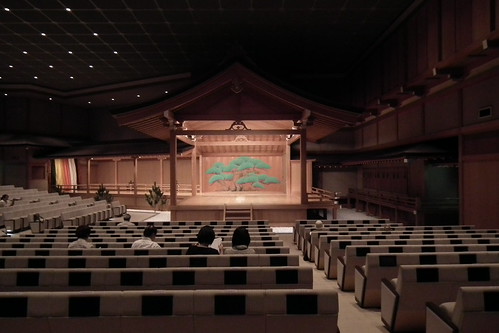
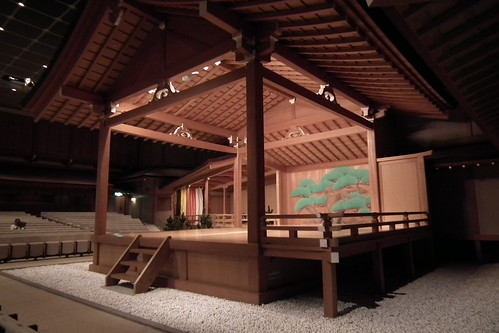
As you would expect, there is no visit I could do to no matter what Japanese city where I do not look for the opportunity of seeing a traditional theatre performance, a kind of theatre that I admire and enjoy very much. In May 2011, in Tokyo, I could only go to see Kyogen, which is a comic performance that normally accompanies Noh plays.  As it took place inside a theatre I was not allowed to take any pictures or video of the performance, but I could take some shots of the building and of the beautiful "stage" of the National Noh Theatre (国立 能 楽 堂).

Contemporary Noh and Kyogen theatres are theatres within theatres, as if the space for Noh were a permanent stage: the spectacular wooden theatre (which has not changed in form or building materials since the sixteenth century) is surrounded by a modern event space, with the consequent addition of seats where originally there was just an open space for spectators in Shinto temples.


National Noh Theatre Stage (Tokyo, 2011)
Stage within the National Noh Theatre (国立能楽堂). Tokyo, Japan. (Gustavo Thomas © 2011)

National Noh Theatre Stage (Tokyo, 2011)
Stage within the National Noh Theatre (国立能楽堂). Tokyo, Japan. (Gustavo Thomas © 2011)

The lighting, which is modern, is directed to the "stage" (to the original Noh theatre) in a completely open way, with no changes during the performance and no adding any kind of "atmosphere". Occasionally during evening performances in temples or outdoors at festivals (I saw one in Osaka with the actors on a boat, for example) torches are used, giving a very special effect on the atmosphere, but the use of electrical light as part of a production’s design is never seen.

This Kyogen performance had a special meaning for me because, for the first time in my life, I was attending a performance of Japanese theatre with subtitles that translated everything to English;  every seat in the theatre had a screen, you could choose between Japanese and English, and so you could follow the performance without focusing only on the movements and the music (which can be interesting but also very tiring).  A wonderful addition for those of us who do not speak Japanese, because it really turns that performance into an event that is very enjoyable in every sense; for the first time in my life I could laugh watching Kyogen through understanding the verbal element and not only through visual cues. These are treasures of modernity that are well appreciated.

Screen with subtitles at the Noh National Theatre (国立能楽堂). Tokyo, Japan. (Gustavo Thomas © 2011)


Most viewers are people over 50, many of them fall asleep just as soon as the performance starts, but a good deal of them really enjoy the show, you can tell that they are familiar with it and they know what to expect from it.  It is not a ritual theatre anymore, of course, and it is not a theatre with great and famous actors and shouts of the public as in Kabuki, but it is highly respected, people applaud vigorously and shows are almost always sold out.


The Kyogen performance


Plays program at hall of the Noh National Theatre (国立能楽堂). Tokyo, Japan. (Gustavo Thomas © 2011)

Ticket for the Kyogen performance at the Noh National Theatre (国立能楽堂). Tokyo, Japan. (Gustavo Thomas © 2011)


Kyogen plays, in contrast to Noh, are very simple plays about earthly subjects, related with trickeries and vices, usually common people and with not very stylized movements on the stage. In the last play of that evening program, for example, The fish sermon, a drunk fisherman wants to fool people by pretending to be a monk, and when he's asked to give a sermon he starts to give a list of all the fishes he knows instead of religious sentences, as simple as that.
 
Just as a reference I transcribe the program with the plays performed that night which, as I mentioned earlier, was only Kyogen. There are many sites on Internet which resume Noh and Kyogen plays, so you can make a simple search on Google if you want to know more about them.


Three plays and a musical piece (about 90 minutes)


- Otoshi-Suo (The discovered gift)

- Tsuen (The tea Monk)

- Uo-Zekkyo (The fish sermon)

Texts, photographs and videos in this Blog are all author's property, except when marked. All rights reserved by Gustavo Thomas. If you have any interest in using any text, photograph or video from this Blog, for commercial use or not, please contact Gustavo Thomas at gustavothomastheatre@gmail.com.


Saturday, September 1, 2012

Japanese Sleeping Beauty (Digital Art Over Photograph. By Gustavo Thomas. 2011)


Japanese Sleeping Beauty / Bello durmiente japonés (Digital Art. 2011)
Japanese Sleeping Beauty (Digital Art Over Photograph. Gustavo Thomas © 2011)


I was travelling on the train from Yokohama to central Tokyo, while the car was emptying I could observe the image of a young man sleeping in his seat, exactly in front of me: his long hair and the shape of his face made me think that it was a teenage girl rather than a young man; he, as a well educated Japanese, kept his body very upright while sleeping. Then I decided to photograph him and later try to transform that image digitally. I'd discovered him as the live image of a "Japanese sleeping beauty".


Texts, photographs and videos in this Blog are all author's property, except when marked. All rights reserved by Gustavo Thomas. If you have any interest in using any text, photograph or video from this Blog, for commercial use or not, please contact Gustavo Thomas at gustavothomastheatre@gmail.com.


Sunday, August 26, 2012

Bugaku (舞楽) Dance Performance at Meiji Shrine, Tokyo (2011)

Bugaku Dance Performance at Meiji Shrine (2011)
Bugaku (舞楽) Dance Ritual performance at Meiji Shrine, Tokyo (Por Gustavo Thomas. 2011)

In May 2011 I had the opportunity to see live a Bugaku 舞楽 dance ritual performance at one of the most beautiful temples of Japan, the Meiji Shrine, in Tokio. 

Bugaku is a group of court dances with more than 1200 years of age and it was till the 1950's of the last century that those dances were hidden from the general public.

Obviously I'm not a connoisseur but it seems that what I saw that day was a very standard version of these dances: very slow, smooth and rhythmic movements with a royal attitude performed by a group of dancers wearing Buddhist clothes (even when the Meiji shrine, in this case, is a Shinto temple).

The act of dancing is very short; the music and the musicians have a very important role; and the preparation and the exit of the dancers occupies most of the time of the performance itself (that's a very common characteristic of Japanese ritual performing arts).

In my point of view (very ignorant in anything about Japanese ritual dances) what's remains in the memory of everyone is the visual beauty of the spectacle with such a formidable set around.


Bugaku Dance Performance at Meiji Shrine (2011)
Bugaku (舞楽) Dance Ritual performance at Meiji Shrine, Tokyo (Por Gustavo Thomas. 2011)

Bugaku Dance Performance at Meiji Shrine (2011)
Bugaku (舞楽) Dance Ritual performance at Meiji Shrine, Tokyo (Por Gustavo Thomas. 2011)

Bugaku Dance Performance at Meiji Shrine (2011)
Bugaku (舞楽) Dance Ritual performance at Meiji Shrine, Tokyo (Por Gustavo Thomas. 2011)


You can see in other post of this Blog, about my first visit to Tokyo in 2008, some ancient documents from the National Museum depicting Bugaku dancers: http://gustavothomastheatre.blogspot.ca/2010/03/ancient-scroll-images-of-bugaku.html


Texts, photographs and videos in this Blog are all author's property, except when marked. All rights reserved by Gustavo Thomas. If you have any interest in using any text, photograph or video from this Blog, for commercial use or not, please contact Gustavo Thomas at gustavothomastheatre@gmail.com.


Thursday, August 23, 2012

Seven Imaginary Pictures of Mount Fuji (Digital Paintings By Gustavo Thomas. 2011)

Imaginary Mount Fuji 7. Seven Imaginary Pictures of Mount Fuji (Digital Art 2011)
Imaginary Mount Fuji 7. Seven Imaginary Pictures of Mount Fuji (Digital Art By Gustavo Thomas. 2011. All Rights Reserved)

Anyone who knows me well knows my love for everything oriental, specially for Japan. Although I've never seen clearly Mount Fuji (just once kind of blurry from a Tokyo skyscraper), it's an image that stays very deep in my memory because of the Japanese classic paintings and engravings and becuase of the collective imaginary.

One day of 2011, in Toronto, I missed those images of Japan, I heard in my memory some characteristic sounds of crows and thought in that Japan of my travels and my books, then I took the iPad and started to paint and explore digitally with those memories; finally I created these seven paintings that touched me personally and I'm sharing them to all of you today.

Imaginary Mount Fuji 1. Seven Imaginary Pictures of Mount Fuji (Digital Art 2011)
Imaginary Mount Fuji 1. Seven Imaginary Pictures of Mount Fuji (Digital Art By Gustavo Thomas. 2011. All Rights Reserved)
Imaginary Mount Fuji 2. Seven Imaginary Pictures of Mount Fuji (Digital Art 2011)
Imaginary Mount Fuji 2. Seven Imaginary Pictures of Mount Fuji (Digital Art By Gustavo Thomas. 2011. All Rights Reserved)
Imaginary Mount Fuji 3. Seven Imaginary Pictures of Mount Fuji (Digital Art 2011)
Imaginary Mount Fuji 3. Seven Imaginary Pictures of Mount Fuji (Digital Art By Gustavo Thomas. 2011. All Rights Reserved)
Imaginary Mount Fuji 4. Seven Imaginary Pictures of Mount Fuji (Digital Art 2011)
Imaginary Mount Fuji 4. Seven Imaginary Pictures of Mount Fuji (Digital Art By Gustavo Thomas. 2011. All Rights Reserved)
Imaginary Mount Fuji 5. Seven Imaginary Pictures of Mount Fuji (Digital Art 2011)
Imaginary Mount Fuji 5. Seven Imaginary Pictures of Mount Fuji (Digital Art By Gustavo Thomas. 2011. All Rights Reserved)
Imaginary Mount Fuji 6. Seven Imaginary Pictures of Mount Fuji (Digital Art 2011)
Imaginary Mount Fuji 6. Seven Imaginary Pictures of Mount Fuji (Digital Art By Gustavo Thomas. 2011. All Rights Reserved)

Imaginary Mount Fuji 7. Seven Imaginary Pictures of Mount Fuji (Digital Art 2011)
Imaginary Mount Fuji 7. Seven Imaginary Pictures of Mount Fuji (Digital Art By Gustavo Thomas. 2011. All Rights Reserved)


Texts, photographs and videos in this Blog are all author's property, except when marked. All rights reserved by Gustavo Thomas. If you have any interest in using any text, photograph or video from this Blog, for commercial use or not, please contact Gustavo Thomas at gustavothomastheatre@gmail.com.

Friday, August 17, 2012

石井満隆 Mitsutaka Ishii and 大森政秀 Masahide Ohmori Butoh Dance Performance at Terpsichore Theatre (Tokyo, 2011)

石井満隆 Mitsutaka Ishii and 大森政秀 Masahide Ohmori Butoh Dance Performance at Terpsichore (Tokyo, 2011)
Mitsutaka Ishii (right) and Masahide Ohmori (left). Butoh Performance. Terpsichore, Tokyo. (By Gustavo Thomas. 2011)

Mitsutaka Ishii (石井満隆), disciple and colleague of Tatsumi Hijikata (土方 巽), is already a legend in Japanese Butoh; Masahide Ohmori (大森政秀), somewhat younger than Ishii, and also related to Hijikata's Butoh, may have less fame but has a truly surprising force on the stage. 

At the performance I had the opportunity to see, at the legendary little Terpsichore theatre in Nakano, in May 2011, Masahide Ohmori's stage-presence was what stayed in my mind: in his first choreography of the night, a solo, Ohmori, who has an impressive physique due to a kind of abscess or tumor on the right side of his head, wearing a woman black Victorian style dress, with his face and arms in white makeup and his hair completely scrambled (as is normal in Butoh), showed us a slow walking movement filled with inner tension and with a Wagner's piece as background music. There was simply no way our bodies were pushed backwards by the force he literally threw on to us; those were only 10 or 15 minutes of that unforgettable choreography, but my nerves, more than one year later, are still living that moment in my memory as fresh as that evening. 

Each one had a solo, and after that they performed a choreography together where virtually Ohmori was Ishii's second company; Ishii's movements marked all the performance. 

Even with the strength of Ohmori's performance that night, the Japanese public was deeply respectful of the very presence of Mitsutaka Ishii and gave him the biggest applause. This presentation turned into a tribute to this legendary (as I said) Butoh dancer. 

I was not allowed to take photos of the presentation, of course, but I could take pictures of the moment of the applause and of a very small improvisation at the end when they thanked the public, plus some photos of the cocktail that night. As an extra information, the theatre was full of dancers, critics and friends from the world of Butoh in Japan, and among them I recognized the also famous Ko Murobushi. 

It is a wonderful memory, and I didn't want to miss mentioning it and sharing it, even without a live document of the moment that, I said, I was so impressed by.

石井満隆 Mitsutaka Ishii and 大森政秀 Masahide Ohmori Butoh Dance Performance at Terpsichore (Tokyo, 2011)
Mitsutaka Ishii (left) and Masahide Ohmori (right). Butoh Performance. Terpsichore, Tokyo. (By Gustavo Thomas. 2011)

石井満隆 Mitsutaka Ishii and 大森政秀 Masahide Ohmori Butoh Dance Performance at Terpsichore (Tokyo, 2011)
Mitsutaka Ishii (right) and Masahide Ohmori (left). Butoh Performance. Terpsichore, Tokyo. (By Gustavo Thomas. 2011)

石井満隆 Mitsutaka Ishii and 大森政秀 Masahide Ohmori Butoh Dance Performance at Terpsichore (Tokyo, 2011)
Mitsutaka Ishii (left) and Masahide Ohmori (right). Butoh Performance. Terpsichore, Tokyo. (By Gustavo Thomas. 2011)


Texts, photographs and videos in this Blog are all author's property, except when marked. All rights reserved by Gustavo Thomas. If you have any interest in using any text, photograph or video from this Blog, for commercial use or not, please contact Gustavo Thomas at gustavothomastheatre@gmail.com.


Sunday, July 17, 2011

“If you feel that the flower is beautiful, then you are beautiful.” (Learning Butoh with Yoshito Ohno)

(Translated by Tadeo Berjon)


Being a flower. Yoshito Ohno studio. (By Gustavo Thomas. Yokohama 2011.)

Yoshito tells us that Hijikata used to say: “Your body possesses everything within, you just have to find it” and he would add that the way in which Kazuo Ohno and Hijikata did that was through Butoh.  Moving every day, each moment of their lives, every moment of doubt, of inspiration, of relaxation, of crisis; moving every moment of discipline and work, of dreaming, of pain, of remembrance.  And it’s true, that attitude is completely logical:  else, how could we find the all within our bodies if we don’t immerse ourselves totally in it, rummaging in every detail of our unknown interior?
The search is done initially by walking, and the slow pace would seem a premise.  In our slow walking we discover that the experience is risky too:  if our body contains all, then, besides life and prayer and love, it also contains death itself and its ghosts, that which others suffer and others ask themselves, violence and grudges, fears and anguish, mental labyrinths and hells... everything.
In those games of the logic of being congruent with our Butoh, Yoshito adds other words from Hijikata:  “the dead body always walks risking life.”
Nothing in the studio of master Ohno is compulsory; a proposal for movement is not an order, nobody is forced to search for their hates, their fears or their violence; everything is simple, soft; something is commented, something is told, something is proposed, and then we must move.  The risk appears because it finds you when you move, like a sunlight or a mother that cradles her baby. 
So, while moving in that search of the all within, I could write at the end of my second session:  “I’ve just arrived from my work with Yoshito Ohno.  Today, dancing, I was a three-day flower, a blossoming peach tree that died in the wind, a prayer, and a child’s heart.”
Our body contains everything and can transform itself into anything.  The proposal was always “be”, “you are...”
“If you feel that the flower is beautiful, then you are beautiful” would tell us Kazuo Ohno through the voice of his son,  Yoshito.
Tens of photos, both of Kazuo Ohno and of Tatsumi Hijikata, show them “being” that which they imagined while moving.  I remember them and learn too.
Hijikata being earth. Photo by Eikoh Hosoe. (book Kamaitachi)

Kazuo Ohno, a pond. Book cover of Hidden Body, The World of Kazuo Ohno.


And in that studio, for various sessions, we were dozens of flowers, under different circumstances and conditions; we were silk, and with it we learned the softness and strength of our bodies, by being the characteristics of silk, by touching silk, we discovered in movement the characteristics of our bodies; and we were bamboo too, and with bamboo in our hands, we explored the strength of our exterior and the emptiness of our interior, the hollowness of our physicality.


Silk. Yoshito Ohno studio. (Photo by Gustavo Thomas. Yokohama, 2011)
We were all if we found it in movement.  There are no fixed structures but each session some patterns repeated themselves:  Yoshito talks, shows, demonstrates, exposes, asks us to move based on that, we always do it with music, after some 5 minutes he stops, continues talking about the same subject or changes to a new one.  And so for two hours every session.  At the end, some tea and snacks while we talked about the petty details of life.
How happy I was because I was never judged on whether I really was the flower, silk, bamboo, the sea or the wave!  That’s right, I was never judged, nor were the others: we were invited to be and to move while being, and just that.
Looking at pictures of Rodin’s sculptures we learnt that he, like Butoh, was revolutionary because they didn’t imitate the movement of the body, but were simply the body that was expressed in itself, it was a kiss or a hug or a pride.  We learnt that impressionist painters, like Butoh, were revolutionary because they offered life from other angles, and that those impressionists got their inspiration to discover those angles from Hokusai and, in particular, his piece “The Wave.”
And then we moved being water, being the sea, being waves, being the force of gravity, the moon itself, and the wave again.  We were, in the line of the water (and not always in the same session), the feminine and the moon; we danced to a piece by Chopin, we remembered the mother, the bosom of the mother; we lived the night and retook the sea.
With a piece of cloth we discovered the intensity of our interior:  by stretching it or squeezing it the intensity was bigger; by relaxing its stretching our interior diminished its intensity.  We played with emotions without knowing which ones they were; it was my mind that associated to some, to my past, to my inventions, to my hidden desires, it responded to what the cloth itself was, my body in contact with the force applied to that piece of cloth. 

Working at Yoshito Ohno Workshop. (By Gustavo Thomas. Yokohama, 2011)


Yoshito tells us about the “remnants of emotion”, that which remains after squeezing the cloth of our emotions, that which remains and weighs and drags within.  While he commented he moved, his walking was slow, tense, heavy.  He talked about the difficulty of expressing those remnants on stage, of the so called “forte pianissimo” and he also moved with great intensity but in an extremely soft way: - “forte pianissimo” - he repeated while moving, and invited us to try.  “This is a challenge to face, every day” - he would explain.  Kazuo Ohno was a master of that “forte pianissimo”.
In the line of emotions we made them body and voice:  on a single occasion (and explaining that he did it specially because I was an actor), he asked me to say a sentence on the heaviness of life, in my language, and to say it while walking.  We were all charged with the search for the forte pianissimo.  Then he asked one of the participants to climb on my back and let his weigh drop on me; I was supposed to continue repeating the sentence during all my walking. That night we didn’t talk more.
I felt the flower was beautiful, then I was beautiful...
Yes, that night we didn’t talk more; but some other days we sang...


Texts, photographs and videos in this Blog are all author's property, except when marked. All rights reserved by Gustavo Thomas. If you have any interest in using any text, photograph or video from this Blog, for commercial use or not, please contact Gustavo Thomas at gustavothomastheatre@gmail.com.


Friday, June 24, 2011

A Secret (Learning Butoh with Yoshito Ohno)

Yoshito Ohno drinking tea at his studio. Yokohama. (By Gustavo Thomas. 2011)


-As you pray (while we pray in motion) gather your hands .-

And the hands lead us, thinking about what we are praying, seeing it, dancing.

Yoshito stops and, approaching us, says: - A secret! -

He takes the page of a large photo book and shows it to us:

-Nara, a beautiful city, a very old and important Japanese city. There are many Buddhas there but one of them is special; this Buddha is special, look...-

Then he brings the photo of the Buddha closer to us... What's special about it?

Cover of Buddha of Nara Photo Book. Yoshito Ohno studio. (By Gustavo Thomas, 2011)

- Look at his hands ... They don't come together; there is a minimal separation in between, barely a rice-paper fits in between them.  There is not another one like it in all Nara. That makes it very special. Everything is compressed between his hands; it is powerful. Kazuo Ohno knew that; it is a secret ... 

He looks at us, smiling and thoughtful, at each and every one of us around ...

-Pray with your hands together and feel a separation the width of rice-paper.-

And our hands worked with that separation, and we moved with Maria Callas and Anthony singing in the background. In later sessions we used a handkerchief. That separation could be not only in our hands, but between our knees, as a young and caring woman, and you could also feel that paper between the arms and trunk, between the feet and the ground as the walk of a Japanese Noh master.

Yoshito Ohno shows all while speaking: he is the Buddha of Nara, he is the beautiful and shy teen who walks with a minimal separation between her knees, he is Kazuo Ohno when he performed a woman and his arms barely touched the flanks of his trunk and he is also a walker on rice paper.  He continually separates from us and takes a few steps with his hands almost joined together and raising them to heaven. He doesn't pretend to be a role model, it is just that he must inevitably move as he speaks.

Yoshito Ohno and the rice-paper between his hands. Yokohama. (By Gustavo Thomas, 2011)


Yes, his sessions are full of little and big secrets about Butoh, on how to achieve the inner strength of our movement:

- pay attention to your back, as if it spoke;
- a direct encounter with the whole of the space, with its corners, the front, the back, the up and down; thanking the space...
- know where to land your gaze while walking; if you look down you always seems sad, it is better to look neutrally forward, openly.

We "move" every secret, we explore every secret, we practice, without further instructions, without judgement.

The examples to reveal the secrets each are given, as always happens in his workshop, with the remembrance of passages from the two great masters of Butoh, Kazuo Ohno and Tatsumi Hijikata, but also with simple drawings: geometric patterns to discover the different displacements of our body in space, or Chinese characters (Japanese writing originated in, and retains the use of, Chinese characters) on the body, on man, on day. He talks while drawing, he shows us each drawing he makes, he lets us touch it and review it.

The showing of a palpable example when mentioning every secret functions as an inspiration pivot, as a guide beyond than words or formal instructing; at the end every secret comes to us through an internal image that is created from listening to him, seeing him move, looking at a picture or touching an object. We did it, as I'll talk about in the next post, touching flowers, silk, bamboo, balls...

Zen circle image at Yoshito Ohno studio. Yokohama. (By Gustavo Thomas, 2011)

That painting, so simple, known as the "Zen circle" is one of the biggest inspirations for the discovery of the body in motion as a circle, as a whole, as philosophy on scene. Yoshito tells us that his father was also a philosopher and that he philosophized on stage through Butoh, and that one of the inspirations for philosophizing while moving was that image of the circle drawn by a Zen monk, a circle that clearly doesn't close but which we know includes everything. Kazuo Ohno was not Buddhist but he was a sensitive, religious man, wherever he found inspiration he stopped and moved.

That circle is explored everywhere, be it in the space, be it inside and outside the body, be it with our hands. The hands that emanate from the circle itself, those hands that he tells as waterfalls of force surging from Hijikata. Hands are the holders of the circle that is a sphere, the moon. Yoshito asks us to look at the moon, to feel the moon and see it as a manifestation of that zen circle, and the sphere. Our hands can touch the moon, take it, split it into two, move with it, with its strength, with its attraction, with its poetry.

Moving with the spheres on each hand. Yokohama. (By Gustavo Thomas, 2011)


Several sessions with a number of spheres; inner images that move us, and that make us philosophize without thinking, while moving ... How can one philosophize without thinking? I never asked myself that question while working ... Perhaps there was also another secret.

Those secrets and that philosophizing cause a change in others, teacher Yoshito Ohno tells us. For years people around the world came to the workshop of his father, they listened to him speak, watched him move, moved with him and then something happened, they changed, their life changed. Kazuo Ohno had the force to change others through their own secrets unveiled at each session (secrets that no one could decipher or explain), explored through the philosophical or poetic or surreal movement of Butoh. 
After a few sessions, those visitors changed the paths of their creativity and, in many cases, their very lives.


Texts, photographs and videos in this Blog are all author's property, except when marked. All rights reserved by Gustavo Thomas. If you have any interest in using any text, photograph or video from this Blog, for commercial use or not, please contact Gustavo Thomas at gustavothomastheatre@gmail.com.
If you are interested in using any text, image or video from this Blog, please contact the author writing your e-mail and information in comments. (comments are private)
Gustavo Thomas. Get yours at bighugelabs.com