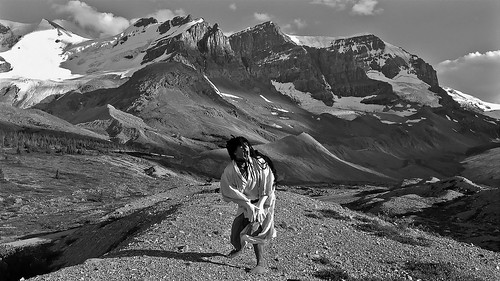
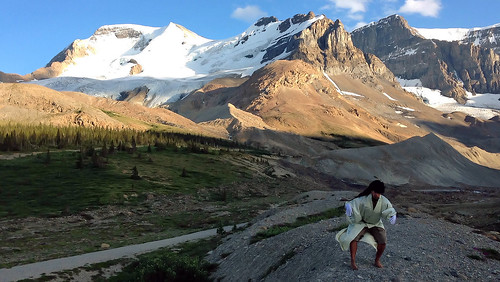
The Rocky Mountainsare animpressivelineofmountainswhich goes from theUnited Statestonorthern Canada.Following one to another dozens ofnationalparks were created in the two countries for the conservation of thesenatural wonders.As myself living in Canadaconsidered a mustvisiting this placeand this summerof2013 went to the national parks of Banff and Jasper in the province of Alberta.
Very personal reasons(as always happens) took methere, but I keptthe wish to dosomeButoh improvisationsin thoselandscapes fullof snowy mountains, hugeglaciersandbeautiful lakes.
Performing Butohin these placeswas not onlyforframing my work with abeautiful -or impressive- natural setting, but also entailed a real Butoh practicing in total relation with the basic teachings of TatsumiHijikataandKazuoOhno, the creators of Butohin Japan: the dialogue withthe natural environment with our movement. Our body, in the thought ofHijikata, has been domesticatedin every waythrough the lifein the city, our movementsare codifiedand we must seekbreak those codes (Kazuo Ohnospokeof moving our body withthe impulse coming from the heart); a way to break those codes of movementis going backto our natural sources, places which by their unique force bring us backto ourprimordial state. That means, of course, hard work,practiceand exploration, but since I started mywork with Butoh I decided thatthis exploration with the natural sources should have a big importancein my professional life, a big importance inmy owntechnicalfindings.
I am a man born and raised in a city, so I could not go to find my sources to my original place out of the city -like Hijikata in the Akita region, for example-, but I can go to places where I feel impressed by their beauty or by their own force. Every improvisation in those places brings the source I'm looking for, it is an adventure and I feel how my body revolutionizes itself, feeling the soil, the wind, the sun, the extreme weather.
Weeks before this travel I had many rich and powerful experiences with several masters of Butoh, first in Japan with Yoshito Ohno, Natsu Nakajima and Seisuko, and after that with Denise Fujiwara, and Ko Murobushi who visited Toronto. All of them have a different interpretation of Butoh but they are also great teachers and guides, so I can find my own way of absorbing their teachings without any fight in my mind. Those teachings were practised in these improvisation in The Rockies and I felt great.
In this post I share one of the four improvisations I performed there, but my plan, if I find the time to edit everything, is to share the all four, of course.
With this video in the Blog you can see some photographs I considered of some value to illustrate better what I experienced.
Video "Phantom"
Gustavo Thomas Butoh improvisation in front of Athabasca Glacier, Jasper
Texts, photographs and videos in this Blog are all author's property, except when marked. All rights reserved by Gustavo Thomas.
If you have any interest in using any text, photograph or video from this Blog, for commercial use or not, please contact Gustavo Thomas at gustavothomastheatre@gmail.com.
Here the video I extracted the photographs posted in this Blog some months before. Remember that the temperature in Saurbaer was almost minus 15 degrees Celsius with cold winds, so just I'm asking you to imagine that the movement of the camera is what filmmakers call "subjective shot" and not someone dying of cold.
As is common with my Butoh videos, the music you listen is not what I was listening in that moment (in this case none). Hope you like it.
Video
Butoh Solo Improvisation at Saurbaer Church Graveyard, Northern Iceland (December, 2013)
Texts, photographs and videos in this Blog are all author's property, except when marked. All rights reserved by Gustavo Thomas.
If you have any interest in using any text, photograph or video from this Blog, for commercial use or not, please contact Gustavo Thomas at gustavothomastheatre@gmail.com.
I knew about a loss and its pain, when I saw that image (posted above) depicting those moments in the life of someone very dear to me I could only write a poem about what this image evoked in me.
As the original poem is written in Spanish I'm publishing here both versions: the original one and an almost literal translation in English:
Then Omar created his own poem in video, using my voice and the poem itself, which I greatly appreciate, because the product is absolutely beautiful and strong, very strong, and yet full of great tenderness.
Texts, photographs and videos in this Blog are all author's property, except when marked. All rights reserved by Gustavo Thomas.
If you have any interest in using any text, photograph or video from this Blog, for commercial use or not, please contact Gustavo Thomas at gustavothomastheatre@gmail.com.
I've been recording in video some of my poems reading by me (in Spanish); first the reading and after the text. We'll see how it goes.
I'm a writer in Spanish so, my writings are in that language; sometimes I publish the translation to English, but sometimes not, it will be always an approximation to the original one.
Texts, photographs and videos in this Blog are all author's property, except when marked. All rights reserved by Gustavo Thomas.
If you have any interest in using any text, photograph or video from this Blog, for commercial use or not, please contact Gustavo Thomas at gustavothomastheatre@gmail.com.
This is part of my Butoh Vlog, part of my daily morning training, and nothing else.
After
walking and working with some postures and inner images as a warm up (and always with music), a short
choreography emerges, that's what you see in this Butoh vlog.
The music you are listening to in the video is not what I was listening to during the exercise, it was added later.
Texts, photographs and videos in this Blog are all author's property, except when marked. All rights reserved by Gustavo Thomas.
If you have any interest in using any text, photograph or video from this Blog, for commercial use or not, please contact Gustavo Thomas at gustavothomastheatre@gmail.com.
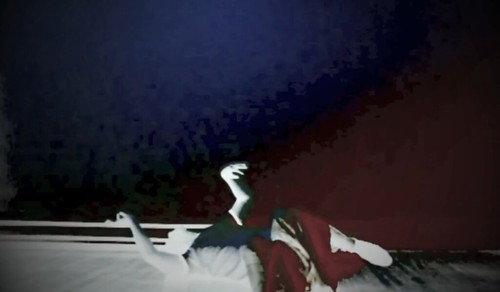
Photograph extracted from the short video "Un recuerdo en cuatro actos", directed by Omar Ramírez Casas (2012)
My last visit to Mexico City was in May 2011 and I went there for a very personal affair, even though I could save some time to meet my dear friend, the poet and video artist Omar Ramírez Casas.
Omar and I have talked about working together with our own video explorations for some years now, and this was a short but unique opportunity to do something we wanted. Without more preparations we decided one afternoon to go to plaza Río de Janeiro (Rio de Janeiro square) in la colonia Roma and play, as simply as that: he exploring with his camera and me exploring with my physical movement. After some random shots we headed to his home where we recorded some other scenes, and we finished the day drinking some mezcales at a bar in Mexico City downtown.
Omar Ramírez Casas during that video session recording in May 2011 (Photo by Gustavo Thomas. 2012)
During some time we interchange some mails with ideas and video and sound archives trying to finish something with the material recorded in May but, as it happens with many projects, the distance and our occupations left the time go.
It wasn't till August 15, 2012 that I received a private message from him sending me the link to the video I'm showing today in this post; this video was edited by Omar as a gift for my birthday (the next day, on August 16th). Omar, as the poet he is, knows how to work with images in different ways than the usual story-telling of other video film makers, and his work has a very interesting aura of mystery and novelty (from my point of view); I really like his interpretation of what we recorded last year without any planning.
I'm happy to be the origin of this creation and also very proud of being his colleague in it.
Texts, photographs and videos in this Blog are all author's property, except when marked. All rights reserved by Gustavo Thomas.
If you have any interest in using any text, photograph or video from this Blog, for commercial use or not, please contact Gustavo Thomas at gustavothomastheatre@gmail.com.
Texts, photographs and videos in this Blog are all author's property, except when marked. All rights reserved by Gustavo Thomas. If you have any interest in using any text, photograph or video from this Blog, for commercial use or not, please contact Gustavo Thomas at gustavothomastheatre@gmail.com.
La danza del padre. Quinto Movimiento: Le Père se meurt pour 1ére fois
Music:
"Except The Darkness In Our Hearts"
by Subliminal
2009 - Licensed under
Creative Commons
Attribution (3.0)
Texts, photographs and videos in this Blog are all author's property, except when marked. All rights reserved by Gustavo Thomas. If you have any interest in using any text, photograph or video from this Blog, for commercial use or not, please contact Gustavo Thomas at gustavothomastheatre@gmail.com.
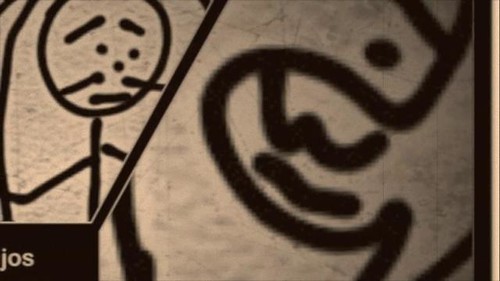
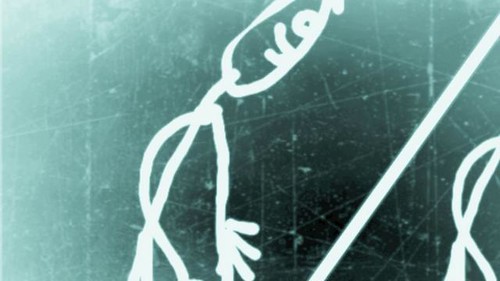
In La Danza del padre (Father's dance)creation-process the original drawings have got movement, first through the shape of a comic strip and now as a video. Its singular drama is getting more power and clarifying its theatrical story.
These are only tests, experiments around, but I'm almost sure that's the way to do this. I'm very excited because everything is new for me and feel passionate exploring it.
First movement: Le père qui danse
Basic or original drawing
Comic strip based in the original drawing and text of the First Movement
http://ccmixter.org/files/subliminal/28890
is licensed under a Creative Commons license:
http://creativecommons.org/licenses/by-nc/3.0/
Texts, photographs and videos in this Blog are all author's property, except when marked. All rights reserved by Gustavo Thomas. If you have any interest in using any text, photograph or video from this Blog, for commercial use or not, please contact Gustavo Thomas at gustavothomastheatre@gmail.com.
One of the reasons I visited Singapore this end of May was to attend the premiere of Mark Chan’s “Dreaming Kuanyin Meeting Madonna”.Mark is one Singapore’s most important musicians; he is a musician with a theatrical vision. First a painter and a swimmer, then a pop singer and a Chinese flute player, now a complete musician and composer.
“Dreaming Kuanyin Meeting Madonna” is, obviously, an attractive title, it provokes curiosity. Chan’s music was both recorded and live, he sang as well as acted, used video art on stage (Brian Gothong Tan) and dance (Arts Fission Company), everything pointed to a Multimedia Spectacle, and it was.
As part of the Singapore Arts Festival 2007 and performing at The Victoria Theatre, one of Singapore’s most historical theatres, the spectacle had a good number of spectators (the theatre was almost full to capacity) and I could see Dan Tun, the great Chinese composer, among the public.
The program offered a synopsis:
“Kuanyin appears in a half-dram to an insomniac artist in a most foreign land.
She confronts him and says: “You ask me for a sign?
Again and again you ask! You artists are all the same, you teenagers are all the same…!”
The vision which I will give you is this.
This is your life. All its bumps, all its sadness, all its wonders and splendours, all its boredom.
This is your vision.
Do with it as you see fit.
But, remember, you are responsible for all that it becomes.
And the artist’s life and work forever changed.
Firstly, the insomnia leads to depression and panic attacks.
The inevitable breakdown requires great care, the learning of chants, prayers, sutras and mantras.
The recovery comes in time.
But it leads to a change of heart and to seeing the world in different ways.
It leads him back to the real world.
Where somewhere in between praying in the church of St Gervais and St Protais in Paris and watching Madonna at the Tokyo dome he realizes that life is a fine balance.
Clubbing, pushing for fame, for fortune, for his own space.
These are all important too but they are not everything.
He has to make a space where he can be both himself and be of use and service to others.
He sees that he must be shared freely with others.
Om mani Padem Hom – Caritas omnia suffert omnia credit omnia sperat omnia sustinet”
Mark Chan doesn’t have any problems putting himself on stage and talking about his life, exposing his beliefs and fears (He said the goddess Kuanyin appeared in his room one bad night in Amsterdam). He talks about anything, speaking, criticizing, depicting his way of life in Europe, playing facing the spectators. Mark played without technique, he didn’t care, he was playing like a child, we knew he was in his own game and he enjoyed imitating the goddess that appeared in his dreams and changed his life. Kuanyin is the Chinese Madonna, Madonna, the singer, had just a little bit to do there, just as a point of reference in Mark’s story, everything finished (Chan’s crisis) with Mark as a spectator of Madonna’s Tokyo concert.
His music is sometimes sublime, with deep emotive and cultural roots, and sometimes incomprehensible, just like pop, like a commercial thing. Mark is definitely a complex artist, like his own professional and personal history. But I keep in my mind three pieces of his music from that evening, pieces which not only made me feel good but made me imagine and even create from listening to them.
Arts Fission, the dance company, gave the spectacle an interesting touch, but was almost outside of it. I felt most of the time that the choreography had too little to do there: nice movements, good dancing technique, interesting poses, and gestures, everything behind Mark’s story. It was something supplementary, not a fusion with Mark’s creation.
The video art was in part also illustrative, but for a moment during the spectacle it became an individual creation; then sometimes music and video were walking together, but another instant the video artist only used the music and then we enjoyed his own image. I don’t think the triple screen disposition was a good choice, it became monotonous; even the image play and the digital edition didn’t save us from feeling that monotony.
As a multimedia spectacle “Dreaming of Kuanyin Meeting Madonna” used some media, yes; as a story by Mark the spectacle had unity; but as a creation object it lacked unity in all its parts: sometimes they crossed, sometimes everyone had their own way, perhaps the process was too short for each one of the parts to fit with the others; they would already know it by now.
It’s a pity I can’t show material recorded by myself, but regulations in Singapore are very strict and even Mark was respectful of them, so the only thing I can offer as images are one promotional video that appeared in Youtube, one “social” photograph with Mark and me, and the link to Mark Chan’s site on My Space, where you can listen to his music.
The National Library of Singapore is one of those enormous cultural complexes the city-nation has: a gigantic 4-storey building, and on the third floor a theatre with a capacity of more than 1000 spectators, The Drama Centre Theatre. This theatre was the place where T’ang quartet, in collaboration with Theatre Cryptic, put on stage “Optical Identity”(1).
T’ang quartet is a very good string quartet from Singapore, young (I don’t believe they are more than 40 years old) but with a solid artistic maturity and a great impulse for stage experimentation.
This spectacle, “Optical Identity”, offered in the Singapore Arts Festival 2007, was a real experiment; it seems it is not unique in T’ang’s trajectory, and that they have had some other experiments with music, technology and visual arts.
Theatre Cryptic is a visual performing company from Scotland that combines stage with music and video, and today it is a group with an international image.
I have to be very clear about what I saw: on the one hand, the music: an exceptional performance of very interesting works; on the other hand, the mis-en-scene: a disastrous experiment even in the use of technology, as well as the way the theatrical direction managed the performance.
There is an equation that makes my appreciation about “Optical Identity” that evening more colorful: T’ang Quartet played that night with such mastery for the simple reason that they have worked hard for many years, learning, practicing, exploring, listening; you can’t expect the same level on stage when that work could have been planned for just some months. It seems to me that the two parts, music and stage, were isolated from each other, and the creative processes were different even though it was the same performance. The big problem, I think, was that they decided the musicians would also be the dancers, the stage workers, the actors, without the same level between their musical performance and their theatrical one.
Some of the works played were memorable to listen, enjoyable and interesting; but not that experiment of sound (music) distortion, the use of the software seemed too basic, even chaotic, without route. A similar impression was caused by the live video (by the Swiss digital artist Jasch) and that computer generated video-image through, very common in performing Arts these days; I feel like having seen a technician without experience, with little talent to improvise and not many skills on stage, no rhythm in the product (video-image), nor capacity to manage visual angles; he knew how to take video and to use the software, but that’s not enough to be on stage, I think; he was not inside that musical performance.
I liked the recorded video showing T’ang quartet playing their instruments, the combinations with their naked bodies and the movements and music, very interesting: that idea of a part of a body playing music, only parts, showing details of their skins, muscles in movement, it was a visual aspect, really beautiful.
Even after those severe comments, the worse part of my comments is about to come: the theatrical performance (quartet T’ang were not only musicians, they were also dancers and actors and prop technicians!) and the stage direction (by Cathie Boyd). Big blocks of metal cut geometrically being used as windows, chairs, walls or nothing, sometimes they were more a problem than a practical solution; then our musician-performers had to move them during the whole performance, but the director considered that moving was simple or something and then proposed or accepted (at the end it’s the same) that they move with some attitude, with some state of… something. They also moved like dancing, then changed into percussionists, tried to keep a silent conversation between instruments and the video camera… Please, tell me, who can do all that (well done I mean) while playing music? I don’t know of anyone yet.
There was no depth nor conscience about the theatrical work. I believe the interpreters and their musical level was so much higher that the theatrical level of the stage director and the video artist.
Experimenting in Performing Arts is always welcome (from my point of view, of course), even with the problems I saw. Music performances in our days are missing something. T’ang quartet have the talent, the strength, the musical level, and they have exploring as an objective, the only thing left is to find the right artistic partners for it.
Working in the Arts in this country is a blessing; artists have a support of their authorities and institutions like I’ve never seen in my country. I saw the work of T’ang quartet, Mark Chan, and those street performers in Orchard Road. Independently of the quality of all of them, it seems to me that being an artist in Singapore is like taking part of a political idea: finding the sources of the new Singaporean cultural face beyond races and religion, Arts as the Identity of Singapore.
(1) This is the information about the T’ang quartet performance I found in the Festival site: Optical IdentityTheatre Cryptic and T'ang Quartet (UK/Singapore)Music to be seen, not just heard. A spectacle that weds sight and sound, teasing the eye while pleasing the ear!From Singapore and Scotland, a consort of talents join hands for a visual musical journey, entering a sumptuous realm of the global, sensual, virtual and real.The agility and depth of homegrown T'ang Quartet shine through their interpretation of four acclaimed contemporary composers – Kevin Volan (South Africa), Franghiz Ali-Zadeh (Azerbaijan), Rolf Wallin (Norway) and a commission by Joby Talbot (UK).Directed by Cathie Boyd, artistic director of Theatre Cryptic, the stage is sculpturally styled by Singapore’s award-winning furniture designer Jason Ong and couture house BAYLENE.As if in a spell, the stage space and movement shift through music, light, object, fabric and film with interactive technologies played live by Swiss digital artist Jasch.The T’ang Quartet performs in an immersive environment not encountered before. Programme Kevin Volans White Man Sleeps Rolf Wallin Phonotope 1 (Asian Premiere) Franghiz Ali Zadeh Mugam Sayagi Joby Talbot Manual Override (World Premiere)(Duration: 80mins no intermission)
If you are interested in using any text, image or video from this Blog, please contact the author writing your e-mail and information in comments. (comments are private)