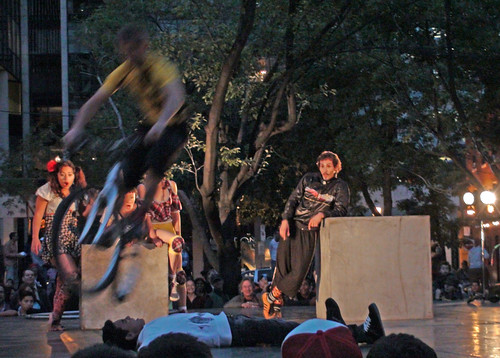
Sunday, September 9, 2012
"Golem", A street perfomance by Shadowland Theatre at the Ashkenaz Festival in Toronto (2012)
Thursday, August 30, 2012
Toronto Buskerfest 2012 (Some photographs)
This occasion I could only spend some hours of one of the four days of Toronto Buskerfest 2012, the already famous street performances festival organized in many Canadian cities during summer. I had the opportunity to see two full spectacles, one by a Mexican acrobat, Pancho Libre, and another one by Ernest The Magnifique, an australian performer.
I'm sharing some of my photographs and I hope you like them.
Tuesday, June 14, 2011
Two Street Butoh Performances at Noge Street Performance Festival in Yokohama (2011)
(1) See my post of April 4, 2011: Traditional Japanese Street Puppet Theatre Performance: A Drunk Scene and The Lion and the Butterflies.
Texts, photographs and videos in this Blog are all author's property, except when marked. All rights reserved by Gustavo Thomas. If you have any interest in using any text, photograph or video from this Blog, for commercial use or not, please contact Gustavo Thomas at gustavothomastheatre@gmail.com.
Tuesday, August 31, 2010
ID, A Cirque Éloize Performance at Toronto Buskerfest 2010
Friday, August 27, 2010
Sau'rus, A Close-Act Theatre Performance at Buskerfest 2010 in Toronto
Monday, November 16, 2009
Illuminite and Circus Orange Performance at Dundas Square, Toronto.

I expected too much (I know that's a mistake) from what I had seen on Internet (videos, photographs and some reviews) about Circus Orange's past productions and performances; when I was watching those videos I recalled the work of Tascabile di Bergamo (Italy), La Fura dels Baus (Spain), Noridan (Korea) and of course, Cirque du Soleil (Quebec) among others, sharing from my point of view many similar characteristics with them: the street, acrobatics, music, dance, theatrical subjects, etc. and I expected something like that and I was not wrong, The work of Circus Orange is very similar,... but at another level of quality.
This was the published order of acts to see that evening:
Sara Westbrook Sara Westbrook, Motivational Singer/Songwriter/Speaker, will have you clapping along while singing her upbeat tunes, including some holiday classics. Time 6:00pm
Free Laser Etching – Enjoy getting free laser etching Time 6:00 – 8:00pm
Flame Throwers
Circus Orange will bring in thrilling flame throwers who will do fire sets with various props.
Pyro Oil Drummers
Industrial oil drummers perched high above the Square will create an entrancing beat while illuminating pyrotechnics create dramatic silhouettes around them.
Flame Thrower Trampoline
A dramatic act where flame throwers are fired directly under an acrobatic trampolinist.
Tree Lighting Finale
Watch Circus Orange performers weave you through a path of fire and pyrotechnics until the 45 foot sculptural light tree goes off with a bang.
Now what I saw:
Once we arrived to Dundas Square, we felt a total disorganization, this was not Circus Orange's problem, of course, but it didn't help later to keep our attention as spectators. They started with some acrobatics using a trampoline, just as an introduction; simple and non spectacular jumps.
Then the singer, not from Circus Orange, but within the event. Absolutely out of place, boring as a result. Very difficult job for the girl.
The Circus Orange's spectacle re-started and continued with the same kind of acrobatic acts on the trampoline, this time with fire around and those barrel-drums music improvisations.
With a very low quality of jumps it was like seeing a gymnastic training, very little theatricality and very low technical difficulty. The musical improvisation was interesting but not spectacular, and the musicians, even while sitting on a very well illuminated roof, seemed to disappear in the immensity of the square, with not presence at all.
On the stage we saw two or three juggler acts, all with fire, and some pyrotechnics, dancers (also with torches) and as a final act a procession towards the Christmas tree. That procession was the most vivid moment, at least getting people to move to open way for the players.
The lighting was spectacular (as usual) but with a horrible choreography.
When the spectacle re-started after the singer's performance, many people were tired and wanted to leave, but they were there to see fire, acrobatics and the new Christmas tree illuminated, so they waited, and what did they see? Fire, acrobatics and the new Christmas Tree illuminated, that's was all. Circus Orange didn't surprise anyone. They work with fire, but they don't have bodies well prepared for a spectacular performance with fire (at least not till this past evening), there is almost no acting nor dancing training, and the staging is closer to a television show than a Street theatre spectacle. Fire and acrobatics worked perfectly, but that is not all what we spectators of a big and great city as Toronto is today deserve.
I know, any artistic company has its own process, and for a circus company with very high goals, it must be a very long one. I'm sure we have to wait and follow Circus Orange's process to see it as we see any other great company in the World. (1)
When you see the documents (videos and photographs) I published here try to clean your eyes, forget for a moment fire and costumes, and see those actors' bodies, their movements and make your own opinion of it. You can also search on internet videos of the companies I mentioned before and compare. This could be a very good exercise on observation and taste.
(1) The most recognized groups started with almost no training and only their artistic impulse.
Wednesday, May 28, 2008
Street Spectacle in China Today (III). Chengde.
Last April (2008) I travel to the city of Chengde, in Hebei Province, in the north of the country, and even though I didn’t find any contemporary street theatre, I could experience the Chinese reaction to it: a re-creation of the past.
Any street spectacle in Chengde is linked to tradition; we can see street theatre which was a common sight before the Communist era (at the end of the last dynasty, the Qing, at the beginning of the 20th Century). It is a street theatre without soul, it is part of a cultural policy which is aiming to preserve the past or even reinvent it, always based on the preconceptions the government has of it. Street theatre has become a stamp from the Chinese past, a way to recreate the imperial dream when spectacles fed the people (yes, communist goals remain). Today, this street theatre gets its own stage: new traditional (and touristy) streets where acrobats and musicians can perform under the watchful eye of the police of cultural policy and keeping the order of the Chinese society.
Never before until now had I experienced the latent danger of the art I chose as a living. Its non existence speaks for itself.
Spectacles with animals, an Asian tradition
Everywhere in the world we can see street spectacles which utilize animals, but it is in Asia, especially in Japan, where these spectacles have reached a really high quality; spectacles where the treatment of the animals in question could be considered “humane” or “professional”. From my point of view they, the animals, well treated or not, are being abused in any form. The imitating (though they don’t imitate knowingly) or mocking (nor do they mock knowingly either) of human behavior provokes smiles, laughs and applause.In China the situation is less nice and interesting. If street spectacles are under the police eye of cultural government policy, spectacles using animals are simply not an issue: they are not dangerous (they are using animals, not humans), they are not regulated, they are few and they co-exist with beggars, like casual acts. Using animals in China has a religious origin, linked with the past, but today there is no trace of that, we can only observe small groups of two or three beggar-like men, exploiting (without any scruple) animals in productions of very poor quality.
Traditional street spectacle makes a come back at Puning Temple
Chengde is known as the summer city for Chinese emperors; there, emperors built a palace to spend a big part of the summer because of the terrible heat of Beijing during that season; around the palace there are dozens of small replicas of the biggest and well known provincial icons of imperial China, sites where emperors wanted to please their provincial chiefs by showing how big their knowledge about their culture was. Small replicas meant big temples, like the replica of the Potala palace of Tibet for example. So, the city of Chengde is a very expensive theatrical production where temples and palaces don’t function as such, where they were visitor parlors, halls for receptions (one or two receptions!), expensive guest rooms for personalities and, now, they are museums of uselessness, beautiful replicas, but nothing else. We see a big theatrical scenario without any plays.
Puning temple is a real religious (Buddhist) point of reference in Chengde, and it’s a very important tourist site for the local government; it has the biggest statue in China of the Kuanyin with many arms. The temple was rebuilt and now it is the only beautiful spot inside the modern, ugly and polluted city of Chengde. Its monastery is now a very interesting traditional hotel and restaurant, with a special “tourist street” called “Puning street”, where Chinese life at the end of Qing dynasty is recreated, with shops, actors (real actors) dressed like people from that time and performing short spectacles which were usually given on the street: acrobatics, pantomime, musicians, storytellers, etc.
Even though this wasn’t a kind of modern street theatre, my interest was to record them in video and compare these spectacles with those I have seen in ancient films about Chinese life in 1927. For me it was a kind of anthropological production; Children acrobats, 二贵摔绞 (ergui shuaijiao) an actor in comic pantomimes, 拉洋片 (Layangpian) storytellers and their “image machines”. Puning’s small spectacles were technically not as good as their counterparts from the past, and people, that important ingredient, showed a little less interest that you can see in the ancient films.
Layangpian, the storyteller and his “image machine”, grabbed most of my attention. I had seen one of them at another temple fair in Beijing almost three years ago and from both experiences I can recall some elements: the voice technique, the rhythm and melody and, of course, how the story is told. The spectacle consisted more of the voice more than the images, but your eyes must focus on the inside the machine, watching the cartoons, while your ears create the world the voice proposes (2).
The video I took is frustratingly short because of some technical problems with my camera, but I could get one from Youtube that shows a scene of this street scenic manifestation and where you can appreciate the whole experience.
Now, you can compare what I videotaped in Chengde with these performances from a German documentary 80 years ago.
Girl Acrobat in Shanghai, year 1927
二贵摔绞 (ergui shuaijiao) Comic pantomime, Chengde, year 2008.
二贵摔绞 (ergui shuaijiao) Comic pantomime, Shanghai, year 1927
拉洋片 Layangpian. Story teller and his “image machine”. Chengde, year 2008
I will keep waiting for the new wave of Chinese street spectacles, where, possibly, tradition becomes a trampoline for a new way of doing theatre.
(1) This or any other manifestation that is not viewed as dangerous in China will remain so until some foreign NGO criticizes such manifestation or until it is negatively reviewed in some publication as an error of Chinese cultural policy, thus shaming the Chinese government.
(2) Layangpian is quite an important activity in China’s cultural tradition. The use of the machine is not very common nowadays, but the tradition persists as comic shows with two or three actors, telling stories, telling jokes, using some vocal play. But only with the use of the machine, of the Magic Lantern, and the fantastic use of voice rhythms, that the show becomes, from my point of view, remarkable.
.
Friday, May 16, 2008
Street Theatre in Today China ( Part 2): Old days and Performance Art
Acrobatics and Street Theatre in 1927 Shanghai
I invite you to observe some spectacles offered on Shanghai streets in 1927. Thanks to the preservation of a German documentary made specifically to show Shanghai’s common daily life in 1927, we can observe scenes of street comic theatre 二贵摔绞 (ergui shuaijiao), acrobatics and martial arts (all of which have been linked to each other throughout the history of Chinese spectacle), and we can also experience one kind of Chinese Opera performed in the open air. We can not forget that Chinese Opera had two lines of performance, one thought for interiors (Tea houses, saloons, theatres and palaces) and another one for exterior spaces (streets, fairs, temporary stages and squares).
These scenes are an example of the life Chinese streets had in last Century’s 1920’s, life completely lost now except on those exceptional moments the government allows.
Acrobatic Spectacle in Shanghai (1927)
Martial Arts spectacle in Shanghai (1927)
Martial Arts Spectacle in Shanghai (1927)
Spectacles have become a "Performance Art"; this artistic manifestation, a cousin of theatre and visual art, has given Beijing a singular way of expressing feelings or some ideas not dangerous to Chinese law views. There is only one place allowed to do "Performance Art", the Cultural Center Complex of Dashanzi 798, the main venue dedicated to Avant-guard culture in China.
A huge space with some useless communist factories (some of them still working), it has been converted into the new Chinese Soho. Dozens of galleries, handcrafts shops, cafés, restaurants and two or three special spaces have become the point of reference in the new artistic wave of the powerful economic China. The special characteristics of those former factory spaces, their squares and alleys, give place to creative events which try to give them new life and try to transform them.
In Dashanzi we don't see street theatre, instead we see "performance art events"; there is no dramatic structure but they do keep some aspects of similar street artistic manifestations from the 1960’s, "the happening": improvisation, the idea of a unique act (every performance is different because of many factors, including the public and space), and of course an artistic conceptuality.
Performance Art has become the most serious way of constructing a street spectacle in a Chinese city, even though we are not strictly speaking of a theatrical manifestation. More linked to Visual Arts (painting, sculpture and video) than to Stage Theatre these, they border on it; as a postmodern way of expressing artistic ideas, it shares public and surprise with happenings from the 1960’s, but it doesn't care about dramatic structure, characters or stories. Doing performance art doesn't mean doing theatre. The Gao Brothers are one of the best examples of visual artists doing "performance art" without any knowledge of theatre (or at least it seems to me so); their importance lies in their powerful way of reaching their public with out-of-normal acts or through contexts different from which those acts are usually seen. Aside from some famous Chinese names, most of these performances are created jointly with foreign artists.
Even though we can say that Performance Art is the new choice which substitutes street theatre (if that is possible), it also faces a big challenge. Performance art in China reached its peak between the 1990’s and 2000, and little by little it has become less strong and powerful (1). Since 2005 the number of new style "rebel events" has decreased, and only some not very publicized festivals have had place. No more explosions of fire along the Great Wall or people hanging for hours from their own sculpture as we can saw some years ago. Dashanzi has then become a refuge of all of them.
Some of the more extreme examples of Chinese performance art have become notorious in the West. In 2000, Zhu Yu, a painter and performance artist from Cheng Du, created a scandal by taking a number of photographs of himself, supposedly, eating a foetus as a protest against state abortions as a means of population control. Peng Yu and Sun Yuan have also worked with human body parts as well as with live animals and are equally notorious. Some younger performance artists who have exhibited widely in the west in 2005-6 are Shu Yang organiser of the Dadao performance art festival in Beijing, Yang Zhichao, famous for having his identity card number branded on his back and Wang Chuyu who went on hunger strike as part of an exhibition called Fuck Off that took place in Shanghai in 2000 in opposition to the Shanghai Biennale.
They acknowledge a debt to older performance artist/ curator Ai Weiwei. Other well known artist are Ma Luming and Zhu Ming.
The 1996 film Frozen (Chinese title: Jidu Hanleng; 极度寒冷) by Chinese director Wang Xiaoshuai, made under the pseudonym Wu Ming, has as its protagonists a group of Chinese performance artists, who are shown engaging in several street performances in the film."
Monday, April 21, 2008
Shameful Street Spectacle in Chengde
It is sad to say that there are still some shameful street spectacles in China, land where tradition is almost lost.
China is a contradictory country with contradictory actions. Animals (and even humans) don't have the same rights that Western democracies (1) have tried to achieve since many years ago, but they say there are, just they have a different perspective of human and animal rights (?).
Last Saturday I made a trip to the small city of Chengde on the North side of the country, just after I had arrived I saw in front of the train station this street spectacle using animals, three monkeys. As in many countries happened 100 hundreds years ago these ignorant group of men were enjoying a cruelty way to amuse people.
I spent some moments trying to take the face of the "tamer" exposing his state of mind. I had to stop the video because his partner wanted I paid for it and I refused.
This is not the only example I found in Chengde, there was another one (with monkeys as well) on my way to the touristic sight, so it is a regular practice in this part of the country.
It is a pity because in this city I also found some very interesting examples of other street theatre spectacles I was looking for. Nothing is perfect.
(1) China is not the only case, Japan also share this way to entertain people in the street (maybe with less cruelty). About Western countries, it exists, yes (not anymore in the street), and it is still a problem to resolve, but there is also a big movement of consciousness among public in general about animals and spectacle. (thanks for your comment Emmanuel)
Monday, March 31, 2008
Street Theatre in Today China (Part 1)
The European street theatre tradition has grown into a fantastic development of acting and directing techniques, and dramatic structure as well, and those improvements have sprouted almost all over the world. Groups and companies like the Odin Teatret of Denmark, Tascabile di Bergamo and Teatro Potlach from Italy, have even created a new school within the theatre itself; La Fura dels Baus deserves a special chapter in this matter.
Latin America, Australia, the USA and Canada have joined their own traditions to these new ways of doing street theatre. Some oriental regions, like Kerala and Bali for example, have an enormous influence over these new ways of doing. The result has been stunning spectacles everywhere in the world: festivals, ceremonies, incursions in all kinds of mass-gathering, etc.
China is a different story. Chinese street theatre and all its performing arts have been hidden (and in one moment, during the cultural revolution, were almost erased) for many years; censorship and bans are common words in theatrical language here. Today, street theatre is fighting for its right to exist.
Street theatre is prohibited in China.
This is a strong sentence but also a misleading one. Well, not really, Street theatre is not banned in China; there is not one article in Chinese law banning street theatre, but we all know that not everything in law is written and clear. Chinese law prohibits any public demonstration without a permit from the police. Bad memories from the Tian’anmen square protest in 1989 are the origin of this ban, plus the usual censorship over any kind of public artistic expression. The Olympics and an impressive economic growth have not done anything for improving these conditions, and they’ve even pushed back any kind of improvement. (1)
There are no Chinese groups of street theatre in mainland China; groups and companies of traditional dance, commercial companies dedicated to creating mass spectacles, etc., yes, but nothing like the new street theatre I talked about.
Even with this dismal panorama, if we are lucky, we can find some ‘actions’ or ‘manifestations’ that we can call ‘theatre’. China is a huge country with dozens of cities with more that one million people and many things happen there, even that different kind of theatre.
My experience is centered on the two main cities, Beijing and Shanghai, as they are a good example of what is happening here.
Wangfujing and Chaoyang Park
Squares and streets can’t be taken by surprise and the police don’t give permission to perform to anyone without some link with the government; it is inside ‘special’ public places where we can find some kind of street theatre; talking about streets and squares, we have Wangfujing street, the most famous commercial street in Beijing, and Chaoyang park, which is also an amusement park.
The surprise that usually comes with the incursion of the theatrical play in the daily life of any street or square in the city finishes when the place is chosen for anyone and prepares the public for the spectacle, but it is also a common practice in the Western world: festivals have their own schedule and people know the who, where and when of performances and, of course there are laws that allow or not the spectacle to take place, depending of many factors, including security ones, of course. The difference in Beijing is that there are no other places to do it and you almost never find Chinese independent groups.
Till now (March 2008) I have not seen in Wangfujing any street theatre spectacle as we know them in Occident, but many touristic festivals and some dance group performances. I know by direct sources that some spectacles have been suspended because they didn’t have the right permits, and I have seen some foreign festivals taking place on this street.
Chaoyang Park (and its amusement park) is the main venue for festivals which use any kind of street spectacle; it has some squares just for performing arts and concerts. Foreign groups usually perform their street theatre here, and Chinese spectators react not much differently from a spectator from the Western world. I have never seen or heard about any Chinese groups performing here.
Beggars in Shanghai
It is also possible to see some street spectacles from every day life: beggars playing music are the usual one.
In Beijing, begging is not permitted, but Shanghai is a slightly more liberal city and doesn’t care much about it, so I could find some examples of this street spectacle.
Fairs: Liulichang and its Chinese New Year fair
On some special occasions as important holidays the government organize fairs; millions of people enjoy eating traditional food, buying regional art-crafts and seeing spectacles; these spectacles are always tinted with Chinese tradition and none of them are “contemporary”: traditional chinese dance, traditional Chinese music and singing, Chinese opera and traditional Chinese acrobatics.
Liulichang street in Hepingmen, a very traditional street area in downtown Beijing, hosts every year one Spring festival (or Chinese New Year festival) fair. This 2008 I found, among millions walking all around, two interesting street spectacles: the dance of the lion and acrobatics with stilts.
Nuo Theatre and traditional open air theatre
Traditional theatre and dances are part of the touristic program of the Chinese government. Every part of China, every village, has one special program to attract tourists displaying their “cultural treasures”, many of them just recovered from their ashes after the cultural revolution in the 60s and 70s of the 20th Century, and many of these dances have also lost their religious origin.
Among these “cultural treasures’ we can find the Nuo theatre from Fujian province in the South of China, which is one of the last remains with religious-origin theatre. (2)
(2) Jo Riley in “Chinese Theatre and The Actor in Performance” (Cambridge Studies in Modern Theatre. Cambridge University Press) explores ritual sources of Nuo Theatre and its similitude with Beijing Opera.
Any comment, please, if you want a reply write your e-mail. China has already blocked Blogger so I can't acces to my posts and read your comments (I can read them thanks I receive a mail with them)


St. Patrick's Parade at Wangfujing
AP: Bands Music Parade at Wangfujing