Showing posts with label Asia. Show all posts

Saturday, May 14, 2011

Kazuo Ohno Dance Studio in Yokohama: The Place and its Objects.

Kazuo Ohno Dance Studio (Yokohama, 2011)


The first step is the place, the space: no one can imagine dance without a space.
My dream to visit, step into and and learn at the study of Kazuo Ohno in Yokohama must then begin by a small account of the space.
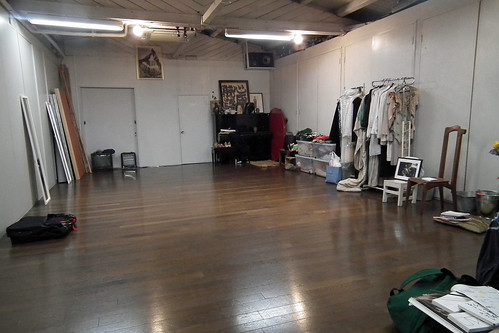
Kazuo Ohno built his studio, back in the 60's, next to his home on the hills of Kamihoshikawa, part of Yokohama's metropolitan region, less than an hour by train from central Tokyo. It was, and still is, a humble studio, simple but very functional: it has a wooden floor, a piano, several closets, a bathroom, a kitchenette, lounge chairs, a television, a glass cupboard, a sound system, a small illumination system; it's built from wood and metal sheets, with a group of supports that, when it rains, keep the studio from flooding by water running down the hill; outside, there is a shelf for shoes and a basket for umbrellas . From the entrance one can see the dining room and part of the kitchen of Ohno's house, and one feels ashamed to enter into the privacy of the home and prefers to look away.
Getting to the studio is a journey, is not easy, and everyone gets lost their first time, be they foreigners or Japanese - it's not a matter of language. And that's because, being in a hilly area where alleys and labyrinthine stairs are the only ways, one can not find the one alley and stair leading to the studio. For about 35 minutes I went up and down the hill several times, took several stairs, asked passers-by, checked the map a dozen times; exhausted and with so tired my legs were shaking, in the end I decided to take the first alleyway off the road and follow its roundabout path and there, after a turn which was not visible from the main road, the sight of the stairs that would finally lead to the study.
Mid-way up the hill you discover a wooden sign that reads, in Japanese and English, "Kazuo Ohno Dance Studio."
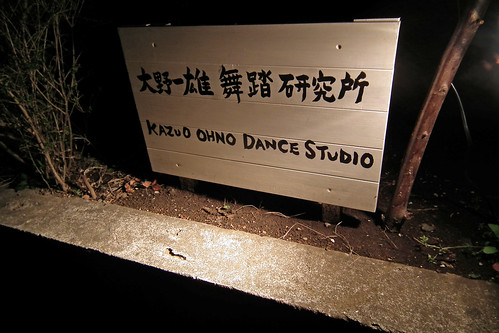
Sign entrance at Kazuo Ohno Dance Studio (Yokohama, 2011)


I was finally in front of that sign, a highpoint in my life as a student: I was there after that weary journey to find the place, after a month of uncertainty due to the earthquake in the north of the country and problems at the Fukushima nuclear power plant, after a year of studying and discovering Butoh dance with several teachers in Canada, and after a little more than 20 years after first seeing the figures of Kazuo and Yoshito Ohno on stage, setting their work as an example before all my students, my colleagues and myself. There was I, in front of that sign, and I stood there for several minutes.
It was night already, some wind was blowing lightly, you could hear the trains passing in the distance,  you could also hear some crickets, and nothing else.
Before meeting master Yoshito Ohno I got to know the studio, I could see his objects exactly as Kazuo Ohno used them (Yoshito Ohno has respected in full the arrangement of things and nothing has changed place): his chair, his music, his dolls, puppets and masks, his books, his costumes, the shoes of his female characters, his hats, the floor.
As is the usual Japanese (and Eastern) custom, you leave your shoes at the entrance and enter barefoot, that way you can go around the premises with the confidence that you won't damage anything nor will bother anyone the noise of your walking. And so I did, I entered like that, barefoot, and so I stepped where Kazuo and Yoshito stepped and danced together, where sometime they stepped and danced along with Hijikata, where now, by himself, Yoshito Ohno steps and dances, as the heir that is .
I remembered some pantomime class that I had taken in my university years, where for the first time in my life I heard the idea that the workspace was a sacred place, that you should greet it and ask it for permission to enter. I thought of the feet of the teachers, of their bodies falling and rolling, and to those images, as my mother used to say, I "entrusted myself"
In my stepping I checked all of the space and my eyes fell on a picture on a tiny wooden chair: was the moment when Pina Bausch visited an ailing Kazuo and gave him a kiss; a really beautiful photograph, a very hard one, which made me tremble. Strange paradoxes of life, Pina visited the ailing, and perhaps dying Kazuo, but she would die a year before him.
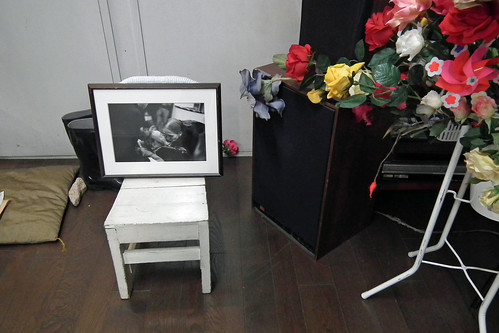

Kazuo Ohno Dance Studio (Yokohama, 2011)

I know some of you, artists or not, understand my dwelling on this first step into the workspace of the studio of master Ohno, my devoting a blog entry to this account of the place where one has dreamed of being and of learning in.  I know some of you have dreamed of stepping into a place you really felt was sacred; it is you I'm addressing and for whom I write these texts, I took these photos and this video that illustrates that first step in my visit to the dance studio of master Kazuo Ohno in Yokohama, last April 20th 2011.


Texts, photographs and videos in this Blog are all author's property, except when marked. All rights reserved by Gustavo Thomas.
If you have any interest in using any text, photograph or video from this Blog, for commercial use or not, please contact Gustavo Thomas at gustavothomastheatre@gmail.com.


Thursday, April 28, 2011

Traditional Japanese Street Puppet Theatre Performance: A Drunk Scene and The Lion and the Butterflies.

Traditional Puppet Theatre at Noge Street Performance Festival, Yokohama
(By Gustavo Thomas. All Rights Reserved. 2011)

Last Sunday 24th, 2011, I went to enjoy a big party in Yokohama, the Noge Street Performance Festival. This festival has place every year since 1974 (this is its 37th year) with dozens of street performers from all over Japan and the World. Of course my main interest was around those japanese performers rarely viewed in our western World and I was not deceived.

Among many of those performances it was this Japanese traditional puppet theatre: charming, simple and very interesting. 

I took some photographs and two videos. Enjoy.


Traditional Puppet Theatre at Noge Street Performance Festival, Yokohama
(By Gustavo Thomas. All Rights Reserved. 2011)

Traditional Puppet Theatre at Noge Street Performance Festival, Yokohama
(By Gustavo Thomas. All Rights Reserved. 2011)

Traditional Puppet Theatre at Noge Street Performance Festival, Yokohama
(By Gustavo Thomas. All Rights Reserved. 2011)

Traditional Puppet Theatre at Noge Street Performance Festival, Yokohama
(By Gustavo Thomas. All Rights Reserved. 2011)

Traditional Puppet Theatre at Noge Street Performance Festival, Yokohama
(By Gustavo Thomas. All Rights Reserved. 2011)

Traditional Puppet Theatre at Noge Street Performance Festival, Yokohama
(By Gustavo Thomas. All Rights Reserved. 2011)

Traditional Puppet Theatre at Noge Street Performance Festival, Yokohama
(By Gustavo Thomas. All Rights Reserved. 2011)

Traditional Puppet Theatre at Noge Street Performance Festival, Yokohama
(By Gustavo Thomas. All Rights Reserved. 2011)

Video: 


Video:


Monday, July 26, 2010

Topeng Tua Dance Performance at Ubud Royal Palace, Bali


Topeng Tua Dance is part of a group of mask dance-dramas in Bali named Topeng, which literally means "to close or press against the face"(in reference to the use of a mask, of course). Covarrubias depicts these dances as "masked actors playing local historical plays (babad); mostly pantomime, but with dialogue by the comic characters"(1) 


According to I Wayan Dibia and Rucina Ballinger "Topeng is done for Odalan (temple festivals) and a myriad of other rituals. In a traditional performance, five men play all the roles (called Topeng Panca, meaning "five dancers") simply by changing masks and headdresses. The drama begins with the panglembar or introductory characters who pave the way for the entrance of the king. The dancer show off his virtuosity through pure dance movements. The three most popular masks are Topeng Keras, a strong primer minister character with red or brown face denoting strength and courage; Topeng Keras Bues, strong yet goofy with bulbous eyes and large, humorous movements; and the beloved Topeng Tua, an old man who remembers his youth. He stumbles, wipes the sweat off his brow, breathes heavily with exertion and blows his nose"(2) It is a long ritual dance-drama festivity where these three characters, the king and clowns interact with the people in a rather comic way.


That evening at Ubud Royal Palace's stage, in July 2009, I only had the opportunity to see the Topeng Tua Dance, the dance of the old men remembering his youth, a short choreography (6 minutes) among the 9 other dance performances, so it was only a small bite of the Topeng dances. From my point of view it wasn't the best choreography of that night, especially after have seen the Legong Kraton and the Baris Tunggal dances, but it kept my attention very well and I enjoyed it.


You will see in the video I recorded how the old character, Topen Tua, as they said (I Wayan Dibia and Rucina Ballinger) "stumbles, wipes the sweat of his brow, breathes heavily with exertion and blows his nose", but also how he picks up a head lice from his white long hair, kills it with his finger nails and then shakes it off his fingers only to come back to his hair and pick another one. I have no information about weather this was a change of the original dance or simply our writers didn't want to embarrass anyone mentioning it as a part of the choreography. I can remember the same kind of actions missing in narrations of Chinese Theatre by Chinese writers in reference to spitting. 

What it is remarkable in the technique of this dance is the continuous use of codified movements and series of physical actions with a minimum of improvisation, what it seems to be one of the secrets of its every night success.


Tuesday, June 15, 2010

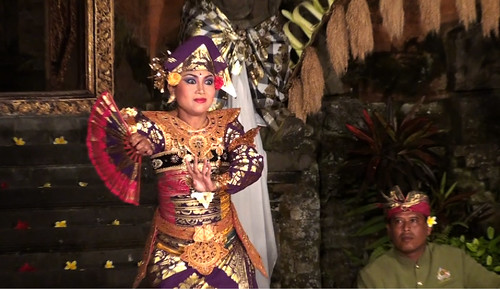
Taruna Jaya Dance Performance at Ubud Royal Palace, Bali.


Taruna Jaya Dance Performance


"Taruna Jaya (The energy of youth). I Gede Manik was a student of Pan Wandres and in 1952 (1) he choreographed Taruna Jaya ("Victorius youth") out of Kebyar Legong. At that time, it was danced by two women, but today it is usually done as a solo. This dance requires immense energy for the numerous changes in speed, dynamics and mood that the dancer must capture.

"Taruna jaya describes many moods of a youth: coyness, bashfulness, irritability, sweetness, and of course, energy. Strong eye movements are a prominent feature, and often include nelik (a wide eyed stare). At one point, the dancer flings her extended kain to the side and sidles up to the drummer to flirt with him. He may either resist her advances or play along. The costume (usually dark purple) uses a headcloth with a unique shape, a log-sleeved tunic and a kain pleated on the left side with the end dangling. There are many moments when the dancer picks up the end of the cloth to emphasize a musical point or mood. She also uses a fan to its greatest advantage."(2)

The version I saw at the Ubud Royal Palace (last July 2009) is practically the same that Balinese usually see in their village religious events.

It was impossible to record more than a few seconds of video and only the photographs can show what it has been described before. I added two more videos (from Youtube), a solo and a two-women version, to give a wider appreciation of this dance.


(1) That's why I don't mention Miguel Covarrubias in this post. This dance wasn't born yet. Covarrubias' last travel to Bali was in 1932.
(2) "Balinese Dance, Drama and Music. A Guide to the Performing Arts of Bali" by I Wayan Dibia and Rucina Ballinger. Page 90.


Sunday, December 27, 2009

Photographs of Wei Family Shadows Opera Theatre Troupe Performance in 2007


Two years ago I published a post on a performance I saw at South Gate Space in Dashanzi 798, in Beijing, a performance by Wei Family Shadows Opera Theatre Troupe (1). It was a very interesting example of traditional Chinese Shadows Puppet Theatre; today, after the problem I had with Youtube, re-uploading all my videos, I took advantage of the situation and extracted some still images from those videos and I got a nice group of photographs of the performance. Hope you enjoy.

Slideshow of Photographs


Thursday, May 21, 2009

Marionettes and Rod Puppet from Guangdong and Fujian at Macao Museum


Another short post, this time about a visit I realized to the Macao Museum in Macao, Southeast China in January 31st, 2006. An interesting museum where we can learn about Tea's origins (did you know the word "tea" comes from Fujianese and not from Mandarin?) and Macao history of course, but also about Chinese performing arts and specially puppet theatre developed in the region.


Macao, an ancient Portuguese island in Asia, was mostly inhabited by Chinese from Guandong and Fujian provinces and many of their traditions are evidently from those regions. One of the sources of Chinese Puppet theatre is in Fujian province, and two cities are famous for it: Quanzhou because of its marionettes and Zhangzhou because of its glove puppets; but also an important source of the so called "rod puppets" is Guangdong province. It is believed that Quanzhou marionettes and Guangdong rod puppets were first introduced to Macao and then known in Europe through the Portuguese during 16th Century.

Some of these marionettes and puppets are in exhibition at Macao Museum.


Monday, January 12, 2009

Tuesday, December 23, 2008

Pingyao Tea House Theater (3): Three scenes of Shanxi Opera

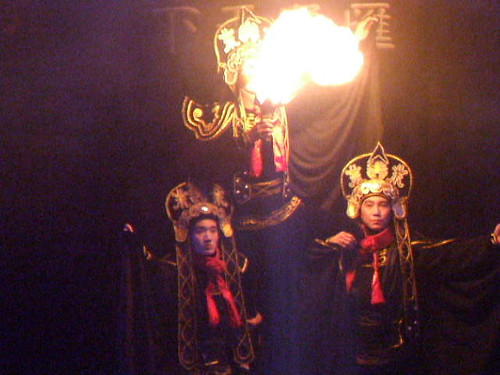
Shanxi Opera (晋剧) Scenes performance: Changing Masks


Following my series of "Pingyao Tea House Theater" (1), this last part presents three scenes performed during the same spectacle for tourists I have been talking in part 1: one acrobatic scene, one comic scene and one quick-changing masks scene.

Even the spectacle that night were not only of Shanxi Opera it was an unique opportunity to see a company specialized on it playing some characteristic scenes of that kind of Chinese theatre. Shanxi Opera performances are not as easy to find than Peking Opera performances; there are no much companies and their seasons are rare, usually they give some isolated performances in very special occasions.

The acrobatic scene did not show to me anything special, being very similar to other kind of Chinese operas I have seen before, I only corroborated my appreciation of those amazing actors-acrobats always working to perfection (even in spectacles like this).

The Comic scene was an interesting surprise; it was the first time I heard singing like that, not only comically but with a very special use of the rhythm. This Shanxi Opera song showed to me a very fresh way to sing in traditional Chinese theatre, codification was still there but the difference with Peking Opera (the opera I have seen the most) seemed huge.


I couldn't miss a quick-changing Mask scene; people from all over the world come to the South of China to see these actors doing that amazing switch of masks. It was a pity they did not do that inside a real opera scene, instead of it they performed those changes like an act of Magic. Not bad but it seemed to me more Las Vegas-kind spectacle than a Shanxi Opera one.


(1) "Pingyao Tea House Theater (1): Shanxi Opera Scenes Murals.", and
"Pingyao Tea House Theater (2): Seeing today Chinese spectators as an anthropological experience?"


Texts, photographs and videos in this Blog are all author's property, except when marked. All rights reserved by Gustavo Thomas. If you have any interest in using any text, photograph or video from this Blog, for commercial use or not, please contact Gustavo Thomas at gustavothomastheatre@gmail.com.


Monday, September 15, 2008

Temple-Theatres of Pingyao Ancient City


There is a common idea in Chinese culture that is almost impossible to find (literally) in the North of the country, the idea of theatre and religion as one architectonic entity. Theatre in China is not any more something sacred but many of its subjects came from religious stories; it is said some theatre buildings are built where used to be temples (1) , but at least in Beijing (and other cities on the North) you don't see anyone where people worship and see theatre.

So, last July 2008 when I visited the ancient city of Pingyao in Shanxi province (one hour-flight from Beijing) I was very surprised of finding three theatre buildings not where used to be a temple but built inside the temple itself!, and temples where people keep worshiping.

Every temple (taoist temples) in Pingyao has its own stage, usually the same stage than any other Chinese Opera theatre, but not with the same style Court Qing dynasty theatres have (2); many Pingyao's temple-theatres where built during Ming dynasty when Pingyao was an important financial city in China. Details from Ming and Qing style can be seen in any of them.


Pingyao is a very important sight because it is a place almost entirely preserved as an early 18-19th Century Chinese city was, with a big wall surrounded it and houses, palaces, temples, and shops inside. Built around 1200 A.D. its glory was during last years of Ming Dynasty (around 1600 A.D.). In early 19th Century, when the ancient financial system failed in China, (due to the incursion of Western banks in the country), Pingyao was literally abandoned, and during more than hundred years there weren't significantly changes in the city. It was after the 90's of 20th Century, that UNESCO and other organizations took part in the preservation of this treasure.

The city now have one modern theatre and one Tea house-style (3) where usually are performances for tourists of local dances, songs and local opera (Shanxi Opera), but those theatre-temples I'm talking about are unused most of the time.


One curious singularity of this stage buildings are their main entrance, down stage; people, priests and anyone entered to the temple square through a tunnel situated exactly down the stage.


Chenghuang Temple-Theatre in Pingyao

Chinese Opera Theatre Stage at Chenghuang Temple (Pingyao) from Gustavo Thomas on Vimeo.


Caishen Temple-Theatre in Pingyao

Caishen Temple-Theatre in Pingyao Ancient City from Gustavo Thomas on Vimeo.


Cuohou Temple-Theatres in Pingyao

Cuohou Temple-Theatres in Pingyao Ancient City from Gustavo Thomas on Vimeo.


(1) Zhenyici theatre in Hepingmen (in Peking's downtown) is one of them. Today totally rebuilt.
(2) See my post of 24/April/2007: "China:Court Theatres in the Qing Dynasty"
(3) I have a special post for the performance I saw in one of this tea house-theatre.


Saturday, July 19, 2008

Tamasaburo performing in Beijing, a second part.


Some impressions come with time...

It’s more than a month since Tamasaburo’s performance of Mudanting, The Peony Pavillion, and I think it is a good time to recall and then express new impressions if they are any.


Tamasaburo in Beijing, "Mudanting"


Again, intelligence.
Tamasaburo’s version of Mudanting started with a Japanese style introduction, and actually not with "Mudanting" instead he introduced himself performing a portrayal of a famous chinese character, Yang Guifei the concubine, only for this first scene. Tamasaburo’s version then is constructed from the kind of ritual entrance of any Kabuki Classic performance: a chorus chanting, the main character doing her entrance very slow, getting all the public’s attention through her first movements. I was recording video but I was watching only Tamasaburo’s movements, listening to the music and to the choir; when someone from the staff asked me to turn off my camera I was surprised I was still recording it.

This kind of ritual was a very clever introduction; it showed the Chinese spectators that the actor on the stage was a Japanese figure, performing in his own style and introducing himself to all of us with the humility of an outsider and with respect. After that he could perform Kunqu because he didn’t appear as someone “coming to teach”; he, talking with actions, had come to be a cultural diplomat, to share his artistic skills with the finest and most magnificent performing Art in China. He knew very well the Chinese spectator.

I also remember how Tamasaburo shared the main role, Du Linang, with two other Chinese actors, they were younger and very well trained. We could see and even compare movements, voices and beauty. Tamasaburo is a star, but he was performing the role as any other young player. That was an opportunity for enjoying this kind of role (an actor performing a female character) for the first time in my life; I enjoyed those three different ways of performing (as they were three) with their voices, with their movements and their beauty.

Beyond any technical skill or talent, a glimpse of intelligence can become the origin of success.


While I was spying him, he stopped talking and looked at me.


I wanted to say sorry because of the video issue (though you may not believe me, in China there is no problem to take photographs during a performance of any Chinese Opera, wherever you are), but I didn’t find the guy of the staff inside the theatre, so I went out and looked for him in one of the beautiful courtyards. Then, while I was talking with the guy, I noticed that there was a big fabric screen dividing the courtyard. Soon I was alone I went through to discover that it was the part the theatre prepared for the cast to refresh themselves, to smoke or to receive people. And that was what Tamasaburo was doing. I saw him talking with a group of Chinese, kind of bored, respectful, listening to them and using a translator to keep the conversation.

The man was there, without costume or makeup, only with a tiny shirt and that white foundation used by any female makeup designer.


He was talking with the group of Chinese, neither him nor anyone else noticed I was there, so I concentrated on his figure and gestures. I’ve always loved the idea of seeing any genius as a human being, a real human being, and that evening I had the chance to do it again. I remember how feminine his figure was: thin, tall and solemn. And then, my brain instantly started recalling any transvestites I had seen in my life; how silly of me! But the white face, the net covering his hair and his attitude, everything reminded me of those people. I had to put my thoughts in order and relocated his image on the stage on a first plane in my memory, and recalled those videos of him I had seen.

In the middle of this absurd game of unconscious comparisons, while I was spying him, he stopped talking and looked at me; it was only for a second (maybe less), but he stopped and looked at me. All I could perceive in his eyes was tranquility and, of course, seriousness. Then everything returned to normalcy, he was talking again with the help of the translator.

I didn’t use my camera, I simply couldn’t do it; if he were performing on the stage..., but no, he wasn’t. I was there without any permission, it seemed embarrassing, no, impolite, rude of me. It was a very private moment, like a naked man trying to rest after a busy day. It was nonsense.


Helping to build the myth


A Japanese friend commented to me about Tamasaburo’s life and how some Japanese see this artist. She told me Tamasaburo wasn’t part of any Kabuki family, so he wasn’t part of Kabuki’s tradition. What did this mean? Well, I looked at some internet pages and some books and it seems that Japanese respected him more because he had to work harder than others to reach the place he enjoys today. Kabuki actors who belong to a certain lineage of families are heirs to the style and work of their fathers, they have “the blood”, so a big part of the way ahead is already prepared, they only have the obligation to work with persistece to be part of the Kabuki tradition. Actors like Tamasaburo have to convince others with work, with talent, with professionalism and, of course, with their artistic values.

She also told me that Tamasaburo had a poliomyelitis problem in his left hand, so his work for getting such skills as a Kabuki actor was even harder! He broke the myth people usually have about the impossibility of becoming an actor or dancer (Kabuki onnagata players are both) if the aspirant has such physical problems.

I can’t assure the veracity of her comments, but I must accept that I want to play the game of helping to construct a myth (or destroying one?). I have enjoyed so much as a spectator of Tamasaburo’s work on stage that I am sure he is walking rapidly through the way of myths even without my help.


*


Creation in my life has always been linked to the pleasure of being a spectator. If I have created something in my life it has been thanks to seeing or listening to something extraordinary before. I am not looking for imitation of the biggest, I am enjoying what some people call “inspiration” but by the biggest, and I love it. After seeing them perform, after crying, trembling, laughing or getting deep in my own self I can write or picture anything I want, without them my artistic life would be unbearable.

Thursday, January 3, 2008

A little bit of Kunqu (Northern style).

Last December 19th I saw my second performance of Kunqu, considered the finest kind of Chinese Operas, a theatrical form with 600 years of tradition.

Some "stars" from the Northern Style of Kunqu performed highlights of many operas, at Chang'An Theatre (you already know about it).

The best way to enjoy this Opera or any other Performing Art is trying to be spectator of it, so I recorded one aria and I'm sharing it. Enjoy.


Kunqu (Northern Style) at Chang'An Theatre, Beijing. (Dec 19th, 2007)


Note:
The main difference with Peking Opera (Beijing Opera) you can find here is the style of singing; you will noticed that Kunqu is much more melodic and easy to listen.


Thursday, August 30, 2007

Tan Dun: The Map and Paper Concert in Singapore.

Tan Dun is a Performing creator, musical composer, orchestra director, and he is Chinese. Born in Hunan, and today inhabitant and distinguished member of the New York artistic community, Tan Dun is a contemporary musician, media explorer, a seeker and a “schematic/structural madman”).

During the nineties, even while having great commercial success (even producing opera or music for film) and, motivated by another famous oriental musician (Yo-yo Ma) he tried to recover as much as possible of the living musical sources that nourished him in his childhood.

He remembers hearing a “stone-man”, a folk musician who made music with stones, music that explained the universe and was a medium to communicate with it. When he returned to talk with him, the stone-man had passed away.

Then he started to walk alone and his steps took him to draw what he called “a map”; once more his hearing drove him through memory towards small and remote Chinese villages he knew were traditional music sources, places which, at that moment, were hidden behind the “new Chinese emerging power” screen. (1) He knew there were rivers and lakes, which, in combination with human work, could sing and could make music as well.


With an ordinary video camera he filmed precious scenes of performances by traditional musicians, dancers and singers in their usual surroundings; but he was a creator, and didn’t want to store that information in a museum or an archive, he knew those videos were living music and they could take part of his new musical piece, The Map.

Tan Dun’s memories brought back to life the stone-man music; with this musical background he wrote a musical piece in the usual way, and then he mixed everything in a sublime composition with those videos he took in his natal rural China.


The Map


I first watched on TV that marvelous documentary about the creation process of The Map and the special performance in Fenghuang when I was living in Lebanon. I was fascinated by the melodies and musical pieces Tan Dun explored. I thought he was looking for ghosts, souls who through singing and music offered secrets to anyone who wanted to listen, and he listened.


Some time after that experience I bought the video and had the chance to observe carefully every aspect of this “musical act”, enjoying it completely. I memorized how he achieved that moment (the performance in Fenghuang); how he united the highest technology with his most ancient China; I memorized how he brought that overpowering media technology where there wasn’t even electricity. Hundreds of special guests from the central government, bureaucrats, intellectuals, etc. came to Fenghuang and mixed with those unimportant people from Chinese minorities; Television broadcasted live united them with the world. I memorized also how those traditional musicians and singers, now spectators, watched themselves in those videos, at the concert, becoming part of Tan Dun’s piece.

When living in China and planning my trip to Singapore for the Singapore Arts Festival 2007, I saw The Map and Paper Concerto was among the special events and I was shocked: would I miss it?

Before that special concert I could see some others performances, like “Optical Identity” by T’ang Quartet and Theatre Cryptic and “Dreaming of Kuanyin Meeting Madonna” by Mark Chan and Arts Fission. Then on July the 3rd, Tan Dun and the Singapore Philharmonic Orchestra performed at the Esplanade.

The Esplanade Concert Hall is one of the most important theaters of the world, because of its superb architecture and the quality of anything performed there. Tan Dun did very little to change the usual stage: the orchestra, the orchestra director’s place and soloist’s place were at the usual area; two middle sized video screens hanging over the stage; two large paper strips, hanging at both sides of the stage; and part of the lateral box on the second floor had special seats for around 6 musicians. The Concert Hall was almost full to capacity with expectant spectators. It seemed that many of them knew about this famous composer. Applauses, silence, and then, music.

The Map’s premiere was in Boston in February 2003, but it had its first memorable performance in November of the same year in Fenghuang Ancient Village, Xiangxi, China (the video I talked about was made during that performance). This work, from my point of view, reached its highest value for being a concert performed in that place (the Chinese village), at that moment (2003) and for that people (the spectators of that evening); there, it was an event totally full of life and it was enormous. It was overpowering in all senses. But the same “musical piece” in that concert at the Esplanade in Singapore in June 2007, without those spectators, without the place itself, was only a “strange piece” of bits of traditional Chinese music mixed with Western music in an interesting balance, at moments nice, at moments alive. That evening, we, the spectators, were only that, some western educated people honoring a great Chinese composer and having fun with his famous and rare musical work. We were helping to rescue the Chinese tradition, as in a museum.

That evening at the Esplanade, technology didn’t go to an inhospitable village to create a media fantasy; this time, it was some data in video format, coming from remote China, performed in the middle of a technological kingdom. As spectators we were enthusiastic, as was expected from people who attended a great concert of a great figure in a great art festival. But that evening something was missing.

I firmly believe that the worth of The Map lies in its being a “contemporary performative musical piece”, which only achieves its highest value as a temporary “Performing Media Art” and with the support of its creative process: that concert in Fenghuang in 2003 was not a simple concert, it was a “performative act” including Tan Dun’s musical piece, but also using Tan Dun’s spatial and theatrical concept.

In Singapore I was seated listening to a musical concert; then, I decided to listen the music. I’m not a musical connoisseur, I only enjoy listening, and this work was enjoyable but nothing else.


Paper Concerto


The Paper Concerto came after several other explorations by Tan Dun with his Chinese sources (among others, traditional music in The Map, and music of the elements in the Water Concerto). Now, he literally made music with paper.

The concept of paper is linked to the relationship between China and the world; in China, paper is linked with the sound it has and its expressiveness; Chinese life has listened to its paper for centuries. Tan Dun, as a good Chinese artist, was open to listening to it, he assimilated that sound, he sublimated it and then he created a “western style” concert in 4 movements.

The Paper Concerto was written for that kind of stage where we listened to it (and where we saw it): a common concert hall stage; and it worked perfectly on it. It reached, from my point of view, the magnitude of epic music.

Where others would make (and have made) sounds manipulating paper or cardboard and just using rhythms and jugglery, Tan Dun makes a really high musical work, a well done concert, and a real act of movement. Tan Dun is a great musician but he is also an important performing artist, I have no doubts about it. (2)


Long white paper strips, Chinese paper, to touch, to beat, and bits of paper to crumple and whistle; paper which is seen and is heard; sound that makes us vibrate and then arrives to our hearing as sublime.

Tan Dun worked with the whole western musical background he has acquired, and then mixed it with that paper sound held in his memories; then, that western music (now old) was renovated and refreshed, it got life and power. That music was also visual. Those three percussionists danced, they were living a musical body action.


Tan Dun made moving music on the stage, however his western musicians didn’t move from their seats. (3)

The Paper Concerto in Singapore was a successful performance, it was a high value artistic act and was absolutely enjoyable. Its creator, Tan Dun, has now in me a respectful admirer.

Note:
There is no recorded material about this event. The Singapore Festival didn’t permit taking photographs inside or outside the concert hall. Even when Tan Dun was giving autographs security officers were stopping any attempts to take video or photos, even though it was in front of the cafeteria!

I found some links to Tan Dun’s official Web site and one video uploaded in Youtube.


Tan Dun’s Web site: www.tandunonline.com


(1) Since the eighties China has lived an astounding transformation, as well as a massive destruction of its reservoirs of traditional customs. Those remote and forgotten villages now live surrounded by concrete, pollution and “progress”, some of them have been converted into tourist sights where life has been annihilated and only money leads. The Han people, the majority of Chinese but also those who manage China, see Chinese minorities only as a touristic interest, as conquerors visiting those places as part of their conquest, looking for a showcase-moment of different customs. The central government has catalogued every minority, every village, every custom, every costume, every traditional performing art, and put them on touristic sale; that has only served to draw them out of their natural context: people sang while working, now they sing because tourists pay for it; who performed a ritual theatre now has a permanent stage and a schedule of performances with little care about the traditional ritual schedule; ancient villages full of life are rebuilt (which is good, of course) and villagers relocated to the outskirts, some of them being employed as “traditional villagers” doing the “traditional works” they used to do before the relocation. Chinese from big cities love visiting theme parks that reproduce world architecture and customs, some with reproductions of Venice or Paris or of the Mexican pyramids, so, these remote villages are just one extension of those Chinese theme parks.
(2)
Tan Dun studied and worked as a Beijing Opera actor during the Cultural Revolution years.
(3)
Perhaps T’ang Quartet and Cryptic Theatre could understand more about his exploration if they watched carefully the work of this Chinese artist.

If you are interested in using any text, image or video from this Blog, please contact the author writing your e-mail and information in comments. (comments are private)
Gustavo Thomas. Get yours at bighugelabs.com