Showing posts with label American Theatre. Show all posts

Monday, June 18, 2012

Robert Wilson, Lucinda Childs and Philip Glass talk about Einstein on the Beach (Toronto. 2012)

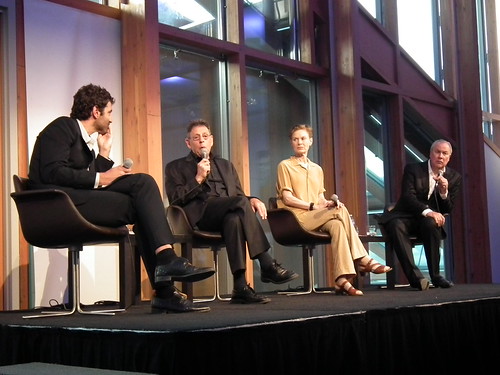
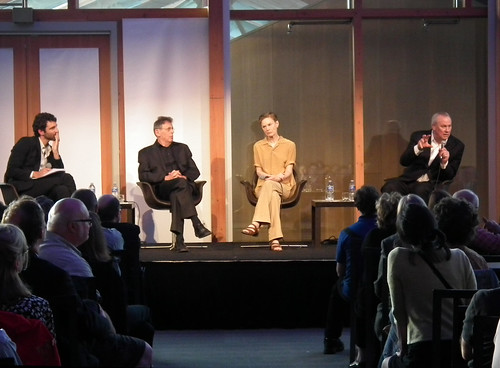
Philip Glass, Robert Wilson and Lucinda Childs. Contemporary Opera's Big Bang discussion at AGO. Luminato 2012 (Toronto)
Robert Wilson, Lucinda Childs and Philip Glass talk about Einstein on the Beach. AGO. (By Gustavo Thomas. 2012)

Last Wednesday June 6th, 2012, at AGO (Toronto), the three gods of American Performing Arts talked about their creation of Einstein on the Beach, premiered in 1976. It was an amazing two hours discussion, not only because they talked about this mythic masterpiece of the performing arts but because they were there, alive, in front of us, 35 years later of the creation of it.

I got some interesting quotations (could not be entirely accurate, I wrote them while listening to them):

- Philip Glass: "Einstein of the Beach is unique because there was no, and there is no, other creation like this. There is no references, simple."

- Philip Glass and Robert Wilson: "We didn't know what kind of piece this was, but when it was performed in France, French critics called it "a contemporary Opera", and we thought it was right. It was an opera in the sense of opus, a work."

- Bob Wilson: "Form is boring, what's important is how you feel inside that form."

- Bob Wilson: "You don't have to get anything, just experimenting the piece."


- Bob Wilson: "Einstein on the Beach has a classic structure, but each of us created their own piece inside that structure."


- Bob Wilson: "All the actors, singers and dancers are dressed with the style of clothes Einstein used to wear. All of them are one part of Einstein."


- Bob Wilson: "I worked the stage direction and illumination designed with the three ways of seeing in painting: the hand (close up), the body and the landscape."


Philip Glass, Robert Wilson and Lucinda Childs. Contemporary Opera's Big Bang discussion at AGO. Luminato 2012 (Toronto)
Robert Wilson, Lucinda Childs and Philip Glass talk about Einstein on the Beach. AGO. (By Gustavo Thomas. 2012)

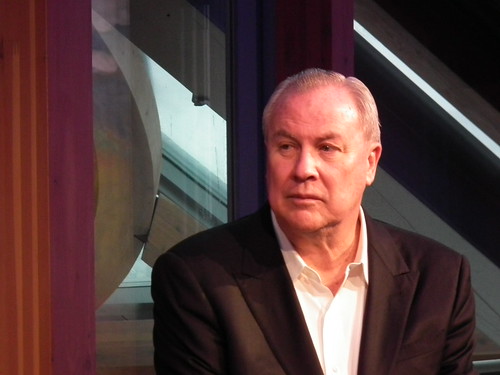
Robert Wilson. Contemporary Opera's Big Bang discussion at AGO. Luminato 2012 (Toronto)
Robert Wilson talks Einstein on the Beach. AGO. (By Gustavo Thomas. 2012)

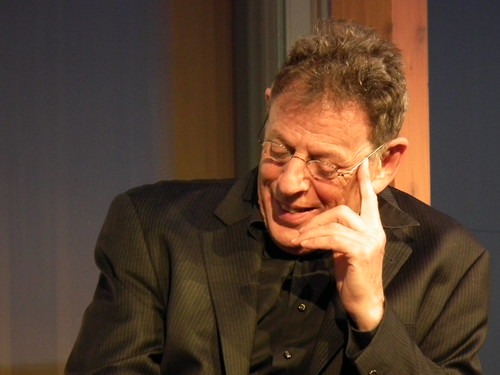
Philip Glass. Contemporary Opera's Big Bang discussion at AGO. Luminato 2012 (Toronto)
Philip Glass talks about Einstein on the Beach. AGO. (By Gustavo Thomas. 2012)

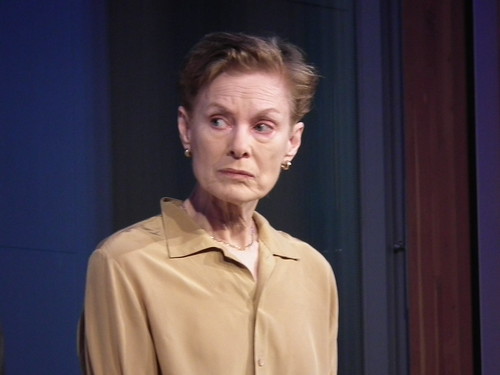
Lucinda Childs. Contemporary Opera's Big Bang discussion at AGO. Luminato 2012 (Toronto)
Lucinda Childs talks about Einstein on the Beach. AGO. (By Gustavo Thomas. 2012)

Philip Glass, Robert Wilson and Lucinda Childs. Contemporary Opera's Big Bang discussion at AGO. Luminato 2012 (Toronto)
Robert Wilson, Lucinda Childs and Philip Glass talk about Einstein on the Beach. AGO. (By Gustavo Thomas. 2012)


Texts, photographs and videos in this Blog are all author's property, except when marked. All rights reserved by Gustavo Thomas. If you have any interest in using any text, photograph or video from this Blog, for commercial use or not, please contact Gustavo Thomas at gustavothomastheatre@gmail.com.


Saturday, March 26, 2011

Behind The Bullseye, A Performance by The Ontological-Hysteric Theatre Incubator in New York (2010)


I have no idea why, one year ago, I forgot to publish a post about "Behind the Bullseye", a performance by one of the young companies which have worked with The Ontological-Hysteric Theatre, the mythic Richard Foreman's lab and studio in New York. Whatever has been the cause I am here now writing about it.

I wasn't really impressed (theatrically) by this work but more by its energy and idea of theatre. This kind of groups keep American experimental theatre alive, they has been (and they are) an important source of experimentation and new ways to do things and, the most important, they are absolutely open to expose on stage problems of our society, of our bodies and our minds, without those economic worries of any other theatre, two blocks from there, about ticket sales, stars cast, and thinks alike.


Program of "Behind The Bullseye" by The Ontological-Hysteric Theatre Incubator.


This is what The Ontological-Hysteric Theatre's page says about its Incubator:

"Beginning in 1993, the Ontological-Hysteric Theater, in addition to its primary support of the work of Richard Foreman, opened its doors to emerging, independent artists. Since 1993 the emerging artists program at the Ontological took many forms, including the Obie-winning Blueprint Series for emerging directors. In 2005, the OHT reorganized the programs under the name INCUBATOR, creating a series of linked programs to provide young theater artists with resources and support to develop process-oriented, original theatrical productions. By 2010, the program had quadrupled in size, involving a range of artists and increased support. The programs included the centerpiece Residency program for premieres, two annual music festivals, a regular concert series, a serial work-in-progress program called Short Form, and roundtables and salons aimed at keeping Incubator artists involved year-round. In May, 2010, the Incubator received an OBIE grant."

Poster at The Ontological-Hysteric Theatre Incubator. (By Gustavo Thomas. New York, 2010)


And this is what the same page says about "Behind the Bullseye":

"BEHIND THE BULLSEYE is an original interdisciplinary theatre work; fusing elements of theatre, film, journalism and installation art to examine the shopping habits of Brooklyn residents. The Target store at Atlantic Terminal Mall (Brooklyn) is used as a focal point around which to explore what lies beneath the collective shopping experiences of consumers across diverse ethnic and class backgrounds. This Target store has emerged as a defining location where residents from various neighborhoods converge to obtain their basic necessities. With the advent of gentrification across various neighborhoods bordering this location, the Target store itself has evolved into an engine of displacement for neighborhood stores. This latest work from Sponsored By Nobody is a chamber play for the American consumer – or – how we are able to buy what we want when we want.
SPONSORED BY NOBODY is a Brooklyn-based theatre company committed to developing original work that is relevant to contemporary America. Founded in 2005, SBN has established a reputation in New York for presenting abrasive, engaging theatre while refusing to relinquish the idea of art as a catalyst for social change. While rooted in theatre, SBN incorporates multiple disciplines in its work -- borrowing from dance, film, music and installation art -- while employing both found-texts and original writing."


"Behind The Bullseye" by The Ontological-Hysteric Theatre Incubator.
(By Gustavo Thomas. New York, 2010)


"Behind The Bullseye" by The Ontological-Hysteric Theatre Incubator.
(By Gustavo Thomas. New York, 2010)


After watching the play I took some isolated notes:

- Me, spectator: I am a consumer, I know it, and they know it.

- They talk about all of us as consumers. 

- The Sellers: Our life is in their hands, as employees, as consumers. 

- Our life is in sale, but it's worth nothing. 

- A supermarket universe could be a metaphor of our life itself, of our own universe. 

- Our chaos is a play by the big merchandisers, our life is a game by them as well; but we don't know them and nobody wants to know them; all of us live in the same chaos, selling, bargaining, dreaming about sales, about new acquisitions during sales. 

- We are only consumers, we know it and we can not do anything to avoid it.

- Packages are object of entertainment, fulfilling our simple life; packages give to us color and shapes.

- We don't have our life anymore, we don't remember how we lost it inside a supermarket.

- A supermarket employee is a Shakespearian character: he has the power but "the wheel of power" is working there, tomorrow it will come the next and he will be out.

- Working at a supermarket really really sucks!

I saw "Behind the Bullseye" during a short trip to New York in January 2010, at its former venue (till end of 2010) 'The Onthological-Hysteric Theatre Incubator' inside St. Mark's Church in the East Village.


I'd like to add a curious detail of that evening: among the 50 spectators (more or less) it was Peter Brook, the English stage director. Short as he is and with those unmistakable eyes of him, it seemed he was looking once again for the avant-guard in the young generation of theatre outsiders. Good for him.


BEHIND THE BULLSEYE -- 2009/2010 promo trailer from Kevin Doyle on Vimeo.

Wednesday, November 17, 2010

"Mindflux": Richard Foreman and the American Experimental Theatre of our Times.


I really want to share these short videos around a new film about Richard Foreman's life work, Mindflux (http://mindfluxfilm.com/), but also some videos that talk about the experimental theatre in USA, where, saying the truth, there is almost no place for it.

Richard Foreman has been a myth without head in my educational life, kind of confusing information coming from his work in theatre, and little by little I've found clues about his legacy. I've never seen a Foreman's work live, but I've seen some productions at his Ontological-Hysteric Theatre venue in New York. 

These videos and what those people in there tell about Foreman's work and theatre making, help me to understand the sourness of American experimental theatre since 1970.


Video Trailer: Mindflux. A Film about Richard Foreman
mindFLUX Teaser from mindFLUX on Vimeo.


Exclusive bonus video from mindFLUX: "On Experimental Theater" from mindFLUX on Vimeo.
Eric Bogosian reflects upon the challenges of being in theater and the importance of knowing your audience.


Exclusive bonus video from mindFLUX: "Authentic Genius" from mindFLUX on Vimeo.
Academy Award winning actor F. Murray Abraham relays the significance of working with experimental playwright, director and designer Richard Foreman.


Exclusive bonus video from mindFLUX: Dafoe on Foreman from mindFLUX on Vimeo.
Actor Willem Dafoe, interviewed here in November 2009, describes working with Foreman in the 1980's.


Exclusive bonus video from mindFLUX: "What Did He See?" from mindFLUX on Vimeo.
Lili Taylor describes moving to NYC in the 1970's and tells of her first experience acting in a Richard Foreman play.


Saturday, March 6, 2010

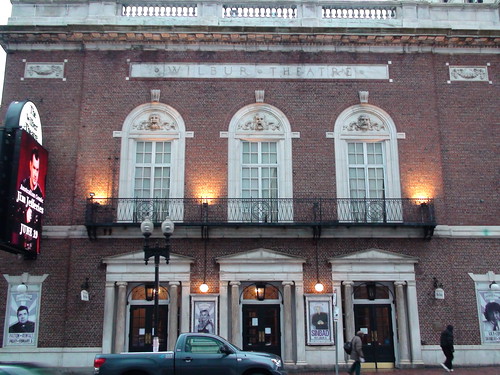
The Legendary Wilbur Theatre in Boston


Wilbur Theatre, a legendary theatre in Boston


"Ye Wilbur Theatre" was its first name when opened in 1914 (Today only called Wilbur Theatre). Situated in the middle of Boston Historic Center on Tremor street, it was designed by famous theatre architect Clarence Blackhal at the top of the Bostonian Theatrical Age. Its architecture is inspired by American styles, specially by Federal Revival style and not by European style as was usual in that epoch.

You will be surprised to know the plays which have had their world premieres in this theatre: "Our Town" by Thornton Wilder, "A Streetcar Named Desire" by Tennessee Williams, "Long Day's Journey Into Night" by Eugene O'Neill, among others.

Today works as a comedy and music venue.

Here the photographs I took during my visit to Boston in January 2010.

Slideshow: Photographs of Wilbur Theatre (Boston, January 2010)


Thursday, March 5, 2009

Theatre and Early American Films Part 3: Dance. (Visual Documents about Lost Ways to Perform in Theatre)

Introduction*

As I talked in my post "Sarah Bernhardt and Eleonora Duse, Audiovisual Documents on the Net and An Extinct Way of Playing", early silent films are real documents about what we considered extinct ways of acting (and in this case of dancing). I was greatly surprised when I found in an US State Department site a big collection of early American films, most of them simple transposition of short stage performances (or parts of them): comedy, acrobatics, dance, "melodramas", and even some kind of tragedies.

The difference with other early cinema shorts filmed by Edison or Meliès (documentary images or camera tricks, even stories made especially for cinema) was that these I am showing here were chosen because were interesting "stage performances" for the eye, workable and practical for the new only visual Media, Cinematography, but also because were common and successful theatre performances at the time; some of them based in play but staged on cinema set, so the change was in place but not in style. The American Mutoscope & Biograph Company changed its simple style of doing things when DW Griffith entered to direct the company and when Edison's company joined (buying a big part of Mutoscope) to make a big Cinema Enterprise.

So, we have here some real documents about physical movement and performances on theatre from the end of 19th century and beginning of 20th. These are not playing by the best of the time nor even the stars but for common actors, dancers and performers.

We can quietly and calmly watch positions, chains of actions, gestures, even tempo and rhythms utilized on American stage more than one century ago. Once more, and that has been my own objective publishing, we can see this film-documents as one different point of reference for a new appreciation to what we have called "good playing" and "bad playing" during the "dictatorship of Realism" in the 20th century.


Dance Films


This is what The Library of Congress site says about its Dance films collection:

"Dance

The selections in the dance category reflect the wide variety of dance styles that were performed on the variety stage during this period. It appears that many of the performers used in these films actually performed on the vaudeville stage. The Franchonetti Sisters, advertised by the American Mutoscope & Biograph Company as a "popular team of vaudeville artists," perform the French quadrille dance. Fougere, "the famous Parisian chanteuse," performs her ragtime cakewalk, "Hello, Ma Baby." The cakewalk dance, popular in minstrel shows, is performed in these motion pictures by a professional troupe from New York ("Cake Walk" and "Comedy Cake Walk"). Crissie Sheridan performs a skirt dance similar to those done by the popular Annabelle. Versatile dancer Ella Lola performs two dances, a period-style belly dance (Turkish Dance, Ella Lola) and one based on the "Trilby" craze. (In the play "Trilby" by George Louis Palmella Busson du Maurier, an artist's model named Trilby falls under the influence of the hypnotist Svengali.) Kid Foley and Sailor Lil provide a vivid example of a Bowery dance reminiscent of the Parisian "Apache dance." Cathrina Bartho performs her Speedway dance in "A Nymph of the Waves" that takes advantage of film tricks to make it appear as if she is dancing on waves. Ameta , a specialist in "novel" and "elaborate" dances, according to The New York Clipper, creates a swirling funnel from huge pieces of cloth in a variation on the skirt dance. (The comedy and burlesque sections also contain dance performances including "The Boys Think They Have One on Foxy Grandpa, but He Fools Them," "Karina," "Princess Rajah Dance," and "Turkish Dance, Ella Lola.")"


*
I repeat the same introduction I wrote for the first part of this series of entries on early American films.


Saturday, February 28, 2009

Theatre and Early American Films Part 2: Comedy. (Visual Documents About Lost ways to Perform in Theatre)


Introduction *

As I said in my post "Sarah Bernhardt and Eleonora Duse, Audiovisual Documents on the Net and An Extinct Way of Playing", early silent films are real documents about what we considered extinct ways of acting. I was greatly surprised when I found in the Library of Congress site a big collection of early American films, most of them simple transposition of short stage performances or dramatic excerpts: comedy, acrobatics, dance, "melodramas", and even some kind of tragedies.

The difference with other early cinema shorts filmed by Edison or Meliès (documentary images or camera tricks, even stories made especially for cinema) was that these I am showing here were chosen because were interesting "stage performances" for the eye, workable and practical for the new only visual Media, Cinematography, but also because were common and successful theatre performances at the time; some of them based in plays but staged on cinema set and, of course avoiding text or voice (some of the comedy sketch possibly), but the change was in place but not in style. The American Mutoscope & Biograph Company changed its simple style of doing things when DW Griffith entered to direct the company and when Edison's company joined (buying a big part of Mutoscope) to make a big Cinema Enterprise.

So, we have here some real documents about physical movement and performances on theatre from the end of 19th century and beginning of 20th. These are not playing by the best of the time nor even the stars but for common actors and performers.

We can quietly and calmly watch positions, chains of actions, gestures, even tempo and rhythms utilized on American stage more than one century ago. Once more, and that has been my own objective publishing, we can se"e this film-documents as one different point of reference for a new appreciation to what we have called "good playing" and "bad playing" during the "dictatorship of Realism" in the 20th century.


Comedy Films


This is what The Library of Congress site says about its comedy films:

Comedy acts in various forms--including monologists, two-person acts with a straight man/woman and a comic foil--and broad farcical sketches were dominant forms of variety stage entertainment. When these comic sketches were translated to silent film, however, the important element of dialogue was omitted. The examples found in this collection, therefore, largely feature non-verbal humor that could be easily understood in screen.

While these examples are certainly typical of vaudeville humor, there is unfortunately no way of knowing whether these particular skits were actually performed on the stage. It is possible that some skits were adapted for use in these motion pictures or that only the less verbal parts of the acts were used. These motion pictures did, however, use typical vaudeville sets, humor, and stereotypical characters from the vaudeville stage.

Some of the acts featured in this collection were based on characters from comic strips, including Alphonse and Gaston, the Happy Hooligan , and Foxy Grandpa. These characters were also used in stage shows. (...)"


Alphonse and Gaston, a comedy sketch filmed in 1903


* I repeat the same introduction I wrote for the first part of this series of entries on early American films.

Monday, August 11, 2008

“Salesman in Beijing”, a book by Arthur Miller, 24 years later.


I hadn’t got to even the first half of “Salesman in Beijing”, the book Arthur Miller wrote after his second visit to China in 1984, when he was invited to stage his own “Death of a Salesman”, when my hands were already reaching for the keyboard to type about every sentence I had been reading.

Miller’s text is a whole document on an era of Beijing and on theatre in general, but at the same time it revealed the experiences I’ve had in Beijing after 3 years of living here. I didn’t come to do theatre, I came to China to live it, to explore it, and to write about it and its performing arts, to get to know it; I came to learn Taijiquan and to find myself in the strange idleness of the start of my maturity; I haven’t written nor done any theatre since I’ve been here, so I’ve become another spectator of Asian performing arts and, in this case, another reader of Miller’s book.

The first impression the text gave me was one of surprising freedom with which people back then would talk about the Cultural Revolution, which nowadays is a completely taboo subject in China; actors, writers, ordinary people shared their opinions on what had happened, who they’d lived through it, and what damage it had caused while, today, in 2008, starting a conversation on the subject would only provoke complete silence, and maybe deeply intellectual sentences that would try to steer the subject away.

Even though the subject is fascinating, especially during the time it was written, reading about it sounds somewhat outdated and only seems to be of value to those interested in the China that existed during the 80’s. That China doesn’t exist anymore, and is now living the results of its change; now it’s rich and powerful, tells the world what to do, economically invades Africa and Latin-america in search for resources for its expansion. There aren’t many studies that review this transition stage, and maybe that’s reveals the importance of the kind of comments from the heirs to the revolution, comments that Miller brings to us, a revolution that extinguished Chinese cultural life for a decade.

The description of a world outside the theatre and a world within the theatre of that China from the spring of 1984 is at times delicious, an enjoyable read and full of pleasant moments and simple but deep disquisitions. What he describes about life outside the theatre is so interesting (and unique) that I remembered the documentary Antonioni made during the cultural revolution: “Chun Kuo Cina”. Chinese style service, hygiene, the ordinary Chinese spectator, the twists of language, intellectuals and food. Miller is a professional narrator of ordinary life and a spokesperson for the bewilderment of Westerners confronted by Chinese customs.

As for what he describes about life within the theatre, it’s fascinating for someone who’s done theatre or who’s lived it. I consider it a theatrical document because in this text I see direct information on how a sincere representative of the empire of realism (1), in an honest and sincere way, tries to conquer a world that does not handle realism yet (even 100 years after its birth). It’s a document because of the way is presented, it’s a work diary and travel impressions; it’s a document because of its way of presenting the staging of the play, because of its reflections and its means to reach its goal. It’s not just a document about theatre in China, but about how Americans in the end of 20th Century viewed the requirements for their theatre through one of their most important representatives.

The play, which at the time was already almost 40 years old, was going to have its premiere in the recently opened up China. In the years where theatrical postmodernism teared realistic discourse apart in Western World, Miller was trying to “teach” a new way to Chinese actors. But the realism that was being destroyed, leaving behind new forms, inevitably remained (and remains still) with its imposing commercial presence in those post-modern Western cities.


Miller was at the same time a salesman, American theatrical realism with its own “need” for Stanislavski and the ‘interiorisation’ of the actor was being sold where their was no knowledge about it. And I remembered that tale (or real-life story) where a fridge salesman becomes rich in the North Pole selling fridges as boxes for keeping food. I have witnessed, by reading Arthur Miller’s book, how he sold his “Salesman” with the currency of personality, intellectuality, cultural exchange, and the values of non-fiction. At the end, it would seem he’s victorious, that he makes the sale, but, as it happens with the main character of his play, the former successful salesman, he fails.

More than 20 years after that text was written and after that experience, we know that the revolution in the acting of modern Chinese actors was not won by Miller’s realism, it was won by cinema and TV, the bastard or next-of-kin product of realism, realist melodrama (much more suitable to Chinese tradition). Theatre in 2008 is, in China, just a handful of stupid musicals, trite comedies with TV stars and remakes of Chinese classics from the 50’s. The ever present Chinese Opera has found its new place as an adaptation through “national pride” and gets its income from touristic interests; big directors make their modern versions of traditional opera, cause scandal in the country, go abroad and are applauded as innovators and modernisers of China’s new and burgeoning market economy. But the theatre Miller came to revolutionise, the theatre of the word, of characters, of real and deep characters, a theatre of ideas (even if he denies it), that theatre remains empty, it was killed by TV and cinema, it was killed by commerce, it was killed by Tian’anmen and Falungong.

In Beijing’s theatres I’ve seen Ibsen’s, Strindberg’s and Laoshe’s (China’s “modern” author par excellence) plays, and I don’t want to see more. Modern authors have not plays to stage or don’t want to write for theatre, the theatrical spaces (those allowed by the government) are few, the public does not exist, the government reviews (censors?) and adapts every text, foreign stars (who inherited the theatre of Miller and his co-revolutionaries) are not invited to come anymore. There’s something in our way of doing theatre that makes the managers of Chinese culture nervous, “something” about words and ideas, about “reality”. How I wish I could see one of Heiner Müller’s plays in Chinese! Müller is no realist, yet none of his plays are staged.

Then, maybe there’s nothing against realism, but against truth in one of its artistic expressions.


I found the book in London, in October 2007, but I didn’t read it until I came back to Beijing, with the required state of mind to enjoy it. I was never an unconditional fan of Miller, and I think I’ve made that clear, but I must accept that the adventure he narrates is marvelous and that his text is a true treasure.


(1) You can call it 'Realism" or 'Naturalism", it doesn't matter here.
If you are interested in using any text, image or video from this Blog, please contact the author writing your e-mail and information in comments. (comments are private)
Gustavo Thomas. Get yours at bighugelabs.com