Showing posts with label Indonesia. Show all posts

Tuesday, July 26, 2011

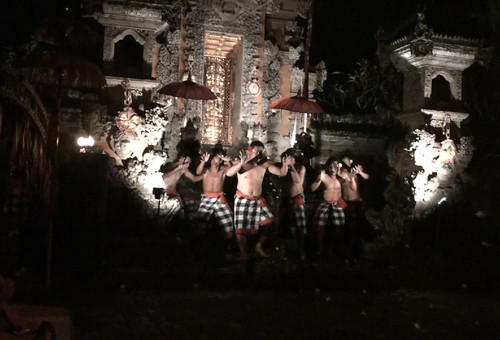
Sanghyang Djaran (Trance Dance) Performance at Pura Dalem Taman Kaja, Bali.

Sanghyang Djaran (Horse Trance Dance). Ubud, Bali. (By Gustavo Thomas. 2009)

"The word Sanghyang means celestial and refers to trance dance rituals whereby the performers enter an altered state of consciousness called kerawuhan (descent or arrival) or nadi (becoming).  ...  The purpose is to restore order back to the village and to exorcise spirits of chaos." (1)

After reading the last quotation you can suppose that in these days trance dances are rare in Bali (and elsewhere in the world).

What I saw in Ubud after the Kecak performance at Pura Dalem Taman Kaja, the Sanghyang Djaran (or horse trance dance), in July 2009, was a performance for tourists; yes, the dancer was "acting" the trance. For us, ignorants about Balinese rituals, there is almost no difference, but for those who know and appreciate Balinese rituals there are.

So, what's the point of publishing here? Simple: this is a Blog about theatre and performing arts, and I'm sure, this "trance dance for tourists" I saw that evening in Ubud was both of them.

Even though there wasn't a real trance it was a very a good "external" example of it and, indeed, a very interesting one, specially in visual terms. Usually in these kind of works with religious origin Balinese performing artists keep the general and basic structure of the original ritual, and we can see example of it all over Bali.

So, from my point of view, this video is worth to watch, but mostly I think this is another good opportunity to see for first time and enjoy one more of those fantastic and special Balinese performing arts.

Video: Sanghyang Djaran (Horse Trance Dance). Ubud, Bali. (By Gustavo Thomas. 2009)

Sanghyang Djaran, A Balinese Trance Dance Performance at Pura Dalem Taman Kaja, Bali (2009) from Gustavo Thomas on Vimeo.
Sanghyang Djaran, A Balinese Trance Dance Performance at Pura Dalem Taman Kaja, Bali (2009)


(1) Balinese Dance, Drama and Music. A Guide to the Performing Arts of Bali. I Wayan Dibia and Rucina Ballinger. Perilus. Singapore, 2004.

Texts, photographs and videos in this Blog are all author's property, except when marked. All rights reserved by Gustavo Thomas. If you have any interest in using any text, photograph or video from this Blog, for commercial use or not, please contact Gustavo Thomas at gustavothomastheatre@gmail.com.

Tuesday, July 5, 2011

Kecak Performance at Pura Dalem Taman Kaja, in Bali (2009)

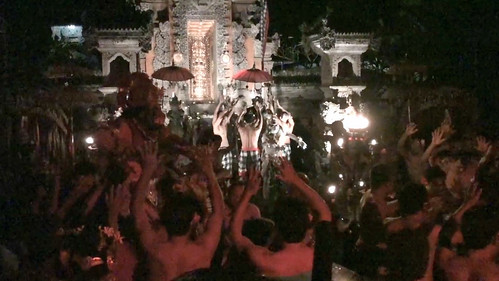
Kecak Performance at Pura Dalem Taman Kaja (Bali, 2009)
(Photograph by Gustavo Thomas. 2009)

Kecak (called also Cak) is one of the best known Balinese Performing Arts, a mix between a religious choral piece, a theatre play and a choreographed dance, based on a choir of local men. It is not an old form, it was created from some ancient Sanghyang (trance) forms during the 1930s, adding a theatrical story. Some give the credit to German visitor Walter Spies, while others give it to two Balinese masters, I Gusti Lanang Oka and I Nengah Murdaya.

Miguel Covarrubias (who was there around 1930) didn't know about Kecak, but did know about Sanghyang and the use of the word "kecak" in its chants as an accompaniment of the trance dance. Kecak developed into a theatrical form when it was separated of the trance and stories, wether from the Ramayana or from other Hindu epics, added to it. 

Even when Kecak is the theatrical form without trance, its performance is completed with a short trance piece, the "Sanghyang Djaran" or Trance Dance of the Horse, a piece about which I'm going to talk about in the next post of these Bali performing arts series.

Kecak Performance at Pura Dalem Taman Kaja (Bali, 2009)
(Photograph by Gustavo Thomas. 2009)


To talk about the rhythms in Kecak I'm quoting the book "Balinese Dance, Drama and Music"(1):

"The polyrhythmic vocal chanting that makes up most of the performance is sung in interlocking parts. Most chorus members know at least four different rhythmic patterns: syncopated cak telu (three syllables), cak lima (five), cak nem (six) and the simple non-syncopated pattern cak ocel (three and seven syllables). There is also improvised panyelah (five syllables). Syncopated rhythms require three voices: polos (down beat), sangsih (upbeat) and sanglot (in between). The interlocking patterns of three and six strokes are chanted within one gong cycle and are marked in the melody by a gong-like sound, sirrrrr. The five-stroke and non-syncopated pattern are freer. All patterns are laid over the kajar and the melody. The kajar is the time-keeping gong, vocalized in Kecak with a pung sound. The melody is chanted as yanger yangur yanger yanger yang sir."

What I saw that night at Pura Dalem Taman Kaja in Ubud was a performance by Taman Kaja Community. Most of the members of that group, as its name says, were from the same neighbour (called Desa), in this case Desa Pakraman Taman Kaja. 

That was a powerful and energetic performance, full of life and interesting images, visual and vocal images. Yes, the voice of those a hundred men chanting is still in my memory today, their sound provoked to my whole body a vibration difficult to forget. It was a very unique experience watching this also very unique theatrical form. 

Luckily I was able to record almost the whole performance, so you can see photographs and video of it. You have to understand that night it was raining and the visibility was poor, plus my seat was very close to the stage.

Program of Kecak performance at Pura Dalem Taman Kaja, Ubud (2009)

This is what the program says about the story to see (original redaction):

The story is a fragment from the Ramayana, the hindu epic. (...)
Prince Rama, heir to the throne of the kingdom of Ayodya, and his wife Sita have been banished from the kingdom by King Dasarata as a result of trickery by Rama's stepmother. The story begins with the arrival of Rama and Sita accompanied by Rama's brother Laksmana in the forest of Dandaka.
The trio have been observed by the demon Rajwana, King of Alengka, who lusts after the beautiful Sita. Rahwana sends his prime minister Marica to try to isolate Sita so that Rahwana can kidnap her. Marica's magical powers turn him into a golden deer and he enters the forest and when Sita sees the golden deer she is so enchanted by it that she asks Rama to capture it for her. Rama chases after the deer leaving his brother Laksmana behind with strict instructions to protect Sita. When Sita thinks she hears a cry for help from Rama she forces Lasmana to go after Rama by accusing him of cowardice and he goes off to help Rama with great reluctance after drawing a magic circle on the ground and telling Sita that she should not under any circumstance step outside the circle.
Sita, left alone in the forest becomes an easy prey to the trickery of Rahwana who has disguised himself as an old priest and begs Sita for some food as he is cold and hungry. Sita falls for his trick, she steps outside the circle to give the old priest some food and Rahwana grabs her and takes her to his palace.
Once back in his palace in Alengka Rahwana tries everything he can to seduce Sita without any luck.
In the meantime Hanoman, the white monkey, a good friend of Rama, is searching everywhere for Sita.
In the palace of Alengka Sita pours out her heart about her cruel fate to Rahwana's niece Trijata, who had come to love Sita, when Hanoman appears telling her that he is Rama's envoy and proving it by showing her Rama's ring. Sita gives Hanoman a hairpin to show that she is still alive and sends him back to Rama with a message to come to her rescue.
In the meantime Rama and Laksmana are wandering in the forest looking for Sita when Meganada, Rahwana's son, appears and engages Rama and Laksmana in battle. Meganada uses his magic powers and shoots of an arrow which magically turns into a dragon which overpowers rama and Laksmana and they are trussed up in ropes.
The bird Garuda, King of all the birds, a good friend of King Dasarata, has observed the trouble Rama is in from high up in the sky and comes to the rescue freeing hte brothers from the ropes.
Rama and Laksmana continue on their way to rescue Sita and are joined by Sugriwa, King of the monkeys, and his monkey army.
This fragment of the Ramayana comes to an end with the battle between Sugriwa and his monkey army and Meganada and his demon army which ends with the defeat of Meganada.


Kecak Performance at Pura Dalem Taman Kaja, Bali (2009) from Gustavo Thomas on Vimeo.


(1) Balinese Dance, Drama and Music. By I Wayan Dibia and Rucina Ballinger. Periplus Editions, Singapore, 2004.


Texts, photographs and videos in this Blog are all author's property, except when marked. All rights reserved by Gustavo Thomas. If you have any interest in using any text, photograph or video from this Blog, for commercial use or not, please contact Gustavo Thomas at gustavothomastheatre@gmail.com.


Tuesday, June 15, 2010

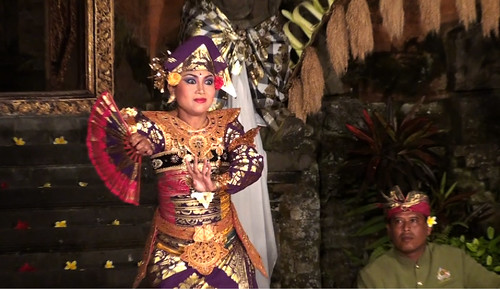
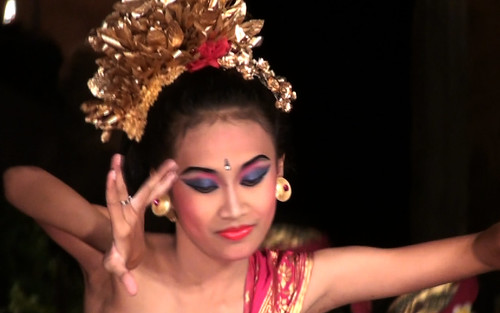
Taruna Jaya Dance Performance at Ubud Royal Palace, Bali.


Taruna Jaya Dance Performance


"Taruna Jaya (The energy of youth). I Gede Manik was a student of Pan Wandres and in 1952 (1) he choreographed Taruna Jaya ("Victorius youth") out of Kebyar Legong. At that time, it was danced by two women, but today it is usually done as a solo. This dance requires immense energy for the numerous changes in speed, dynamics and mood that the dancer must capture.

"Taruna jaya describes many moods of a youth: coyness, bashfulness, irritability, sweetness, and of course, energy. Strong eye movements are a prominent feature, and often include nelik (a wide eyed stare). At one point, the dancer flings her extended kain to the side and sidles up to the drummer to flirt with him. He may either resist her advances or play along. The costume (usually dark purple) uses a headcloth with a unique shape, a log-sleeved tunic and a kain pleated on the left side with the end dangling. There are many moments when the dancer picks up the end of the cloth to emphasize a musical point or mood. She also uses a fan to its greatest advantage."(2)

The version I saw at the Ubud Royal Palace (last July 2009) is practically the same that Balinese usually see in their village religious events.

It was impossible to record more than a few seconds of video and only the photographs can show what it has been described before. I added two more videos (from Youtube), a solo and a two-women version, to give a wider appreciation of this dance.


(1) That's why I don't mention Miguel Covarrubias in this post. This dance wasn't born yet. Covarrubias' last travel to Bali was in 1932.
(2) "Balinese Dance, Drama and Music. A Guide to the Performing Arts of Bali" by I Wayan Dibia and Rucina Ballinger. Page 90.


Sunday, May 2, 2010

Legong Dance. Documents from 1930's and a modern performance in Ubud, Bali.


"As the archetype of the delicate and feminine, the legong is the finest of Balinese dances. Connoisseurs discuss the comparative excellence of various legongs as intensely as we discuss our dancers, and I have heard solemn arguments among princes as to wether the group of Bedulu was finer than that of Saba, or the school of Sukawati superior to that of Badung"

Miguel Covarrubias.(1)


No doubt, legong is the most famous of all Balinese dances. Although not the most spectacular or dramatic, it is the most beautiful and most prominent for the fineness of its movements and has become the representative image of Bali and its performing arts: the image of the little beautiful graceful dancer wearing a dramatic headdress, her body twisting and seemingly about to fall, while her gaze is turned sideways and her hands' fingers making movements impossible to imitate.

Balinese historians already identify it as a recognizable style since 1811. According to some mythical Balinese stories legong dance was born as a prototype of dance and music, that is, it was with it that these arts were created. (2)

When Covarrubias visited Bali in the 1930's, legong had already quite established itself as the first Balinese dance, and our Mexican explorer never failed to express his wonder about what he saw in it; he explores, moreover, its origin, and also tells us that the structure and movements of legong may originate in shadow theater, the Wayang kulit, as an attempt by humans to imitate the way stories were told with puppets in shadows (3). If this theory were true then Balinese dance would have the same origin than Chinese traditional theater or Chinese opera (4).

Covarrubias does a descriptive study of the costume and headdress of legong dancers, plus a full plate of the basic positions of the choreography.


Illustraded notes about the costume and headdress of the legong dancer in M. Covarrubias's diary. (5)

Plate with illustrations of body postures in legong dance. M. Covarrubias. (6)


Some of the most beautiful paintings by Covarrubias were inspired on legong dance; the beauty of the figure of the dancer was more than fascinating and he translated it into ink and watercolor (I can not say whether into oil as well).

"Legong Performance under Bayan Tree" painting by Miguel Covarrubias.

"Legong Dancer" watercolour by Miguel Covarrubias.

"Kneeling Legong Dancer with Headdress" watercolour by Miguel Covarrubias.

And, of course, Miguel also left us a filmed document of the dance itself in performance. The extract published here is part of an edition of early 2000, narrated in English with texts extracted from Covarrubias's book Island of Bali:


Rose Covarrubias, wife of the Mexican artist and a dancer herself, in turn devoted herself to photographically document the different types of legong dance and, thanks to her, we have dozens of photographs on the subject during that period (1930-1932). Here I show some which were published in Island of Bali. These photographs (and of course the film footage) are fantastic examples of how tradition keeps movements and postures almost intact during the years.

(Please, notice that you can click on each photograph and see it in a larger size.)

Legong dance photos, by Rose Covarrubias.


Finally, I share what I saw at the performance at Ubud Royal Palace in July 2009, Legong Kraton (or Keraton). The photographs are very interesting, showing some of the physical postures and various stills of eye and hand movements; I think they portray the strength of the projection of the dancers on stage. The video, however, is very short, I had problems with the camera and recorded only a few moments, but it's worth watching.


(1) Island of Bali. Miguel Covarrubias.
(2) Balinese Dance, Drama and Music. A Guide to the Performing Arts of Bali. I Wayan Dibia and Rucina Ballinger.
(3) Island of Bali. Miguel Covarrubias. Page 228.
(4) See my post on Chinese funerary puppets and the origin of traditional Chinese theatre:
http://gustavothomastheatre.blogspot.com/2010/02/approaching-to-origin-of-chinese.html
(5) Covarrubias in Bali. Adriana Williams and Yu-Chee Chong. EDM, Singapore. Pages 130, 131.
(6) Island of Bali. Miguel Covarrubias. Illustration.

Thursday, April 22, 2010

A Baris Tunggal Dance Performance at Ubud Royal Palace, Bali.


For more information on Balinese baris dances, see my previous post on the subject:


We have no description by Covarrubias about this type of baris dance because it was not until the mid-twentieth century (Covarrubias visited Bali in the 1930s) that baris tunggal started being danced. The Baris tunggal dance is a deployment of skills and artistic brilliance, it uses all Balinese war dances' codified movements and develops them into a solo performance where the dancer exposes them in as an impressive as the codes of the dance allow. That is why this dance is one of the most beloved in the repertoire of the Balinese and is never lacking in performances for tourists and presentations abroad.


The performance of the tunggal baris dance was part of the dance event (with 8 different dances in total) I saw at the Ubud Royal Palace on July 2, 2009.

Seeing a very young dancer (sometimes the women dance, but this time it was a man) of relatively short stature grow before my eyes during the course of the choreography and project a strength and weight that would be considered proper of mature dancers made me remember (as always in any eastern theater performance) the principles of Theatre Anthropology and in particular the very interesting study by Patricia Carmona "La percepción del espectador": movements and postures based on anthropological principles of the scene, where the body acquires a measure beyond the ordinary and overcomes all its limitations when it begins its creative activity, doing something which for the viewer is "extra-ordinary" and remaining that way forever in spectator's memory.


Like all warrior dances, baris tunggal has some primitive structure that can be recognized in a kind of marking of territory and the exhibition of power through the enlargement of the body-warrior figure-dancer, enlargement that is achieved through the managing of clothing, arms and feet.


On the other hand, the baris tunggal has a unique characteristic, a degree of improvisation, an improvisation in a clear oriental style, where the movements are physical actions that the dancer links as a chain of actions ( an individual montage) depending on the situation or on his creative state. In this sense there is a close relationship between the musicians playing the drum, the ugal (the Balinese xylophone) and the dancer: the musicians watch the movements and changes in the choreography and which the dancer flags with precise signals. They are phrases that the music makes together with movements and, prompted by the change indicated by the dancer so do the phrases (music and choreography) change and are thus recognized by all participants.


A video is probably not the best way to experience it, but it is the closest to share it to those who couldn’t be there. In any case I should clarify that when I see the performance anew through the video, I felt a loss in power of what I would call energy bursts and which the spectator perceives through a movement of the eyes or through a surprise impulse in the movement of the dancer's body, a dramatic projection which, nevertheless, a keen eye recognizes because they are clearly marked in the choreography.

I do not know the name of the dancer and he's probably not one of the stars of Balinese theatre, but the technique of his movement and his mastery offer what I call "assured stage quality”, something that is intrinsic to most of the traditional codified eastern theatre and even to western codified techniques such as ballet (through the body) and opera (through voice): it is watching a performance with actors (dancers or singers) who have been trained for years to make these movements on stage exactly as they must be done; it's an assurance of technical quality.

It’s 9 minutes long, I hope you enjoy it as much as I did.


Wednesday, March 17, 2010

Baris Gede Dance and Baris Bedil Dancers During a Religious Ceremony in Bangli Village, Bali


In 1930's Miguel Covarrubias wrote about the warrior dance called Baris Gede:


"An indispensable part of the ritual feast of the old villages is the baris gedé, a stately war dance in which ten or twelve middle-aged warriors with their heads covered with flowers, wearing magic scarves, and carrying long spears tipped with peacock feathers, dance in double line, grimacing and striking heroic poses until the music becomes violent, when they enact a sham battle with their black and silver spears.
(...)
The music for the baris, played by a gamelan gong, consist of striking standard melodies with contrasting interludes that indicate the steps and the moods portrayed by the dancer. Every part of his body, from his toes to the tips of his fingers, is in action during the dance. Every muscle of his face is controlled at will to render the storm of passions expressed by the quick tempered warrior;expression of admiration and wonder at an invisible magic world all around him, surprise and rage at imaginary enemies, pleasure, tenderness, and love. But as the music grows more violent, the dancer becomes more and more tense, raising himself on his toes until he gives the impression of growing in height; his eyes seem ready to jump from their sockets, his whole body trembles, making the flowers of his head shake violently. So raised on his toes and with his whole body at high nervous tension, he slaps his tight and points an accusing finger at his enemy, as with wild yells of "Wah!" "Adoh, adoh!" he draws his kris and struts aggressively towards his foe, who comes forward at the same moment; before they meet, the dancer stop defiantly, cursing each other, and when the clash comes, with tiger-like grace they perform a stylized duel of music, in which the routing of one of the characters indicates the end of the dance." (1)

With the same intention but in the different way he tried to depict in drawings each of the main movements of the dance (click on the image to see it in a big size). Notice the attention he had to show those tensions of the dancer's shoulders and fingers and the singular physical posture of the body during the dance:


The next video is what Covarrubias filmed of a Baris Gede performance (the footage is without sound, music was added in 2004 and the narrator is reading words from Covarrubias's book, Island of Bali):


During my travel to Bali in July 2009 I missed the opportunity to see a performance of Baris Bedil (a variation of Gede); we arrived late to a religious festivity (a Market Ceremony) at Malangting Temple, in Bangli Village, and I only could take video and photographs of the dancers and musicians at the end of the festivity (when the final procession was starting); at least you can see a big part of the procession with our dancers in costumes (interesting and beautifully coloured) and compare them with what you saw in Covarrubias's film. Notice that in Baris Bedil in bangli Village wooden riffles are used instead of spears (2):


Now you can see a video (recorded just one month before my visit to Bali) of a Baris Gede performance in Klungkung Village; after 80 years it is pretty much the same choreography:


Video: Baris Gede Dance performance. Klungkung, Bali. June, 2009.


Covarrubias in his book mentions 4 kinds of Baris Warrior Dance: Baris Gede (ritual), Baris Pendét (secular), Baris Tumbak (ritual) and Baris Tekok (ritual). Today in Bali we can find around 30 different kinds of this dance, most of them ritual dances, but one variation of Baris Pandét, the secular style, has become very known around the world; it is a solo dance called Baris Tunggal, and that is what I saw at Ubud Royal Palace.

In my next post I'll show a video of the Baris Tunggal performance in Ubud and I'll try to find why Baris Tunggal is the most known and why is the most technically detailed of all of them.


(1) "Island of Bali" by Miguel Covarrubias.
(2) In this photo by Garrett Kam (Balinese Dance, Drama and Music. A Guide to the Performing Arts of Bali) you can see very well how the Baris Bedil dancers work with a wooden riffle:

Thursday, February 25, 2010

Gabor Dance Performance at Ubud Royal Palace, Bali.

Gabor Dance Performance

A presentation dance, a welcoming dance, an offering dance... All of this can be a Balinese Gabor Dance.


Covarrubias didn't mention it in his book Island of Bali, and it seems that the dance was added to commercial performances, festivities and rituals after Covarrubias' presence in the island. Today it is usually performed by 6 young women at the beginning of any spectacle of Balinese dances for tourists (as it was my case the 20th of July 2009 at Ubud Royal Palace Stage), and it is continually used as a offering ritual dance in temples festivities.


The performance at Ubud Royal Palace Stage, presented by Sadha Budaya Troupe, had 9 different dances, with Legong as main dance (that night the production was named "Legong Dance"), and the Gabor dance was the first performed.


You should be aware that Balinese Dance's hands and eyes movement and postures you will see in the next photographs and videos don't "speak a language", as a Balinese writer says:


"Balinese hand gestures movements are not storytelling movements as in East Indian dance; rather they embellish the expression of the body." (1)


Hand gestures also can emphasize emotions, and postures of the body come from basic aesthetic principles of body movement and work for increasing its image projection on the stage. In this sense, Balinese dance is similar to our Ballet, with the exception that Balinese Performing Arts are almost always linked to religious ceremonies.


What is important is the special quality of the performer which can transport the audience to a different sphere, the Balinese term known as taksu or spiritual charisma. We'll keep talking about these topics and more, especially with our post of Legong Dance and the postures Covarrubias drew about its choreographies. (2)


Slideshow of Gabor Dance Performance at Ubud Royal Palace (2009)


This is what the program said about our first dance:


"Gabor / Welcome Dance


Panyembrahma is the presentation of an offering in the form of a ritual dance. The dance symbolizes the joyful reception of the Gods who attend a temple festival. Recently, Panyembrahma has been used to open the Legong Dance. It is performed by a group of young girls making identical movements. Toward the end of the dance the dancers make praying gestures and throw flowers to the audience as a welcome and a blessing."


It is a 10-minute choreography, so you can enjoy the video in one sitting in front of the screen.


Gabor dance performance at Ubud Royal Place (2009)


(1) Wayang Dibia and Rucina Ballinger. Balinese Dance, Drama and Music. Periplus Editions. Singapore, 2004.

(2) Miguel Covarrubias. Island of Bali. Periplus Classics. Periplus Editions. Singapore, 2007.


Saturday, January 30, 2010

Wayang Kulit Balinese Shadows Puppet Theater (2): "The Sacrifice of Bima" (The Performance)


Wayang Kulit Performance: The Sacrifice of Bima.
Wayang Kulit (By Gustavo Thomas © 2012. All Rights Reserved)


Once having explained (with help of a Balinese master, of course) the details of both the Wayang Kulit and the performance I witnessed at the Oka Kartini Gallery on July 19th 2009 (see my Blog post about it: http://gustavothomastheatre.blogspot.ca/2009/12/wayang-kulit-balinese-shadows-puppet.html), we can go on to the filmed material of the performance (which lasted approximately 20 minutes) and my experience there.

Evidently, ancient Balinese and Sanskrit were incomprehensible to me, but not so the sound of the singing (or reciting) and the music, nor the aesthetic visual aspect and the actions (I think in the video you will be able to appreciate it quite well in a manner similar to how I I lived it). Yet, there are some comments that I would like to share with you:


Kayonan


In addition to the characters that were presented in the video in the previous post, you will note the presence of a sort of leaf or butterfly (when it moves); it is a tree, "the tree of life" or Kayonan. It is one of the most important puppets and appears both at the beginning and at the end of each performance: it represents the centre, the life force, balance, which is why negative characters are placed on one side and the positive ones on the other one, with the Kayonan in the middle.


The length and public of the performance


The performance lasted a little over an hour and I noticed something that Covarrubias mentions in his book about public attitudes abroad (1): faced with a lack of understanding of the text and the lack of an ear educated to listen to the sounds of that language and music, they just started to get bored, but not so the Balinese public and some others (including me) that found an interest in them and struggled to keep from falling with the rest, but the common foreign public did fall into boredom. Some children went out to play, but others remained; in the end whole families were leaving the place before the end of the performance.


Covarrubias explains (2) it is not a children's theater, it is a religious drama featuring mythological epics that last 6 to 8 hours, full of beauty and codes that even the more stringent Balinese intellectuals enjoy (3); it is the case that the shadows, fire, song, and puppetry get the Balinese children's attention, but that's just a bonus. Hence its difficulty, hence the apparent lack of interest beyond a few minutes during the performance of almost a fifth of its normal length!

Unlike some Chinese shadow theater companies, the Balinese have not changed their themes and stagings for a child audience, nor do they show just excerpts so small only the fight scenes and acrobatics games are displayed (4). Moreover, Chinese puppets have an unparalleled movement while the Balinese ones may, in some cases, only move their arms (5)


Wayang Kulit (By Gustavo Thomas © 2012. All Rights Reserved)


The Dalang and improvisation


The technique of the Dalang (the master manipulator) is, without any doubt, the same both for this performance as well as for the one he performs inside a temple, and the only fault, if I can call it that, are some comments in English ( "Hello, How are you? Do you speak English?, etc.). that, nevertheless, belongs to improvised moments of comedy that exist in long for-Balinese-only performances too; that comedy is contemporary (with up-to-date jokes), improvised and, as I mentioned, part of the tradition of representing the Wayang Kulit.


The Dalang and battles


As expected, the battle scenes have the most movement and dramatic power of representation, and at some point we lose the awareness that this whole movement is performed by a single person behind the screen, the Dalang.


The puppets and their material behind the screen


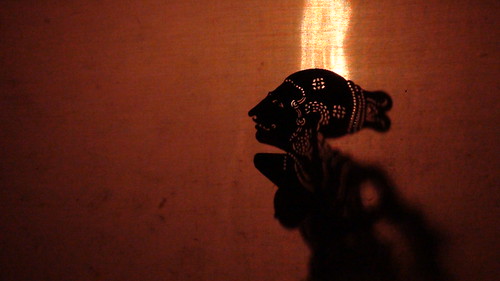
When you see the puppets of the Balinese shadow theatre in the windows of the shops or even in a stack while carried by the company's aides, one cannot perceive the beauty they achieve when they become shadows with help of the lit oil lamp, literally giving them the energy that the Dalang then activates to achieve the movement of life. I had had such an experience in Cambodia, in Siem Reap (6) with this same type of puppets, but that performance was done by children who had developed their technique and who somehow didn't make us see their puppets in the best way possible; but here, with a Dalang (an expert), the images remained in my memory and I remember especially the light passing through the holes carved on the doll as truly spectacular moments.


I personally enjoyed the continuous image of the tree, even more so when it "flies" like a butterfly and goes away and comes back again with the flame of the lamp in the center; in the same manner, the sound of the small Gamelan orchestra (bieng the first time I listened to it beyond restaurants' or shops' background) made me enjoy the show a lot.


About the videos


The performance was about an hour and half long with no intermissions; the numbering of the videos is due to the fact that Youtube does not allow posting more than 10 minutes of material, so I split the performance into three parts (5 if I count the two extras videos, the introduction one and the one of the shots from behind the screen).


Video: Wayang Kulit "The Sacrifice of Bima" (Third part)


(1) Covarrubias "Island of Bali" page 237.
(2) Covarrubias "Island of Bali" pages 234-237
(3) Certain types of stories are performed only for the deity, as is the case with the theater and dance from India.
(4)
My post on a shadow theater performance in Wuzhen, China, is a perfect example of such only-for-kids performances: Wuzhen (II) A Chinese Shadow Theatre Experience.
(5) Some of the puppets from Java's shadow puppet theater can move the jaw.
(6) See my post on three performances of shadow theater in Siem Reap, Cambodia:
Three Shadows Puppet Theatre Plays in Siem Reap, Cambodia.


Texts, photographs and videos in this Blog are all author's property, except when marked. All rights reserved by Gustavo Thomas. If you have any interest in using any text, photograph or video from this Blog, for commercial use or not, please contact Gustavo Thomas at gustavothomastheatre@gmail.com.


If you are interested in using any text, image or video from this Blog, please contact the author writing your e-mail and information in comments. (comments are private)
Gustavo Thomas. Get yours at bighugelabs.com