Showing posts with label Kazuo Ohno. Show all posts

Monday, August 27, 2012

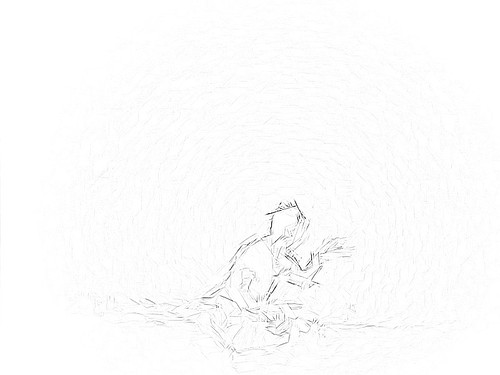
Delicacy Of The Aged. Three pieces of digital work over photographs. (From My Butoh Blog. 2012)


Delicacy of the Aged 1 (From my Butoh Vlog. Digital Work Over Photograph. 2011)
Delicacy of the Aged 1: The Source (By Gustavo Thomas. 2012)


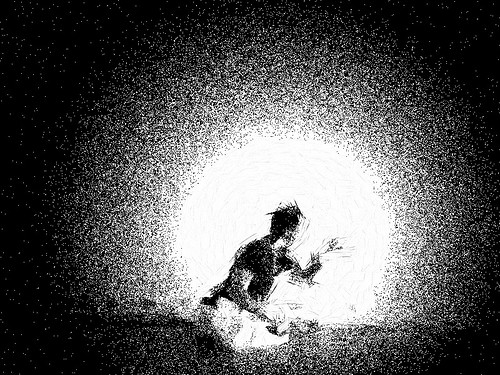
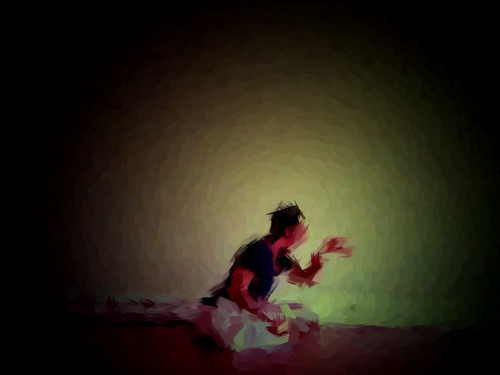
Three images, digitally worked, extracted from my Butoh Vlog. The inspiration came to me from a sentence said by Kazuo Ohno during one of his workshops in his studio, in Yokohama, about the idea of moving with the 'delicacy of the aged". Working with that proposition I've transformed the sentence in my experience of enjoying being aged.

A wrote a poem about the same subject, it will be the subject of other post.


Delicacy of the Aged 2 (From my Butoh Vlog. Digital Work Over Photograph. 2011)
Delicacy of the Aged 2: The Recovered Matter (By Gustavo Thomas. 2012)

Delicacy of the Aged 3, The essence (From my Butoh Vlog. Digital Work Over Photograph. 2012)
Delicacy of the Aged 3: The Essence (By Gustavo Thomas. 2012)


Texts, photographs and videos in this Blog are all author's property, except when marked. All rights reserved by Gustavo Thomas. If you have any interest in using any text, photograph or video from this Blog, for commercial use or not, please contact Gustavo Thomas at gustavothomastheatre@gmail.com.


Thursday, December 15, 2011

Butoh Workshop With Jocelyne Montpetit in Montreal, Québec.

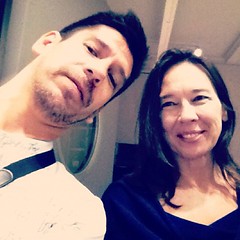
After my last Butoh workshop session with Jocelyne Montpetit (Gustavo Thomas. 2011)
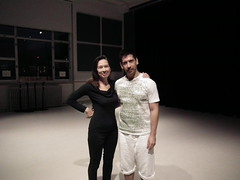
Gustavo Thomas and Jocelyne Montpetit. Montreal, Québec. 2011.


The decision to travel to Montreal was clear: Yoshito Ohno would perform at L’Agora de la Danse and I wanted to see him on stage; as I knew Jocelyne Montpetit lived there, I hoped that she could give one of her workshops during the period that master Ohno would be performing.  And so it was, as part of a 4 weekend workshop, I took 4 very productive sessions (two weekends).

It is known that if one does not work with a teacher (whether it be Jocelyne Montpetit or Yoshito Ohno) a longer time, like at his/her studio every day, for example, there is a danger that each of those "short" workshops that one is taking in this or that place could be the same as others you have already taken before. I did not consider it such a big problem in my case. I'm still in the very base of the pedagogical work of Butoh and a renewal of what I had taken with Montpetit would be a reinforcement, or at least one good review.

I'll do a simple (but not hollow) description of the 4 sessions, because I wanted to include them all in this post:

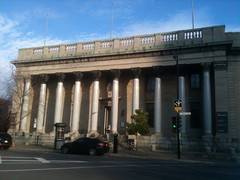
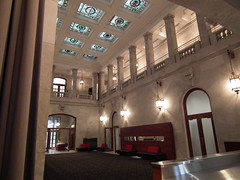
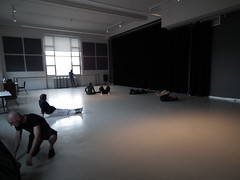
The sessions were conducted in an imposing building, the old library of Montreal city, today the offices of the National Arts Council, in one of several studios or rehearsal rooms that are very well adapted for performing arts works.
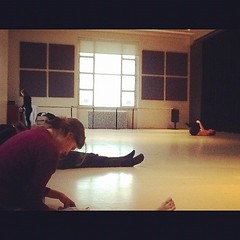
Butoh Workshop With Jocelyne Montpetit (Montreal. 2011)
Ancient Montreal Library. 2011.

Butoh Workshop With Jocelyne Montpetit (Montreal. 2011)
Ancient Montreal Library. 2011.


Jocelyne Montpetit was usually there before our sessions, rehearsing or working with others students. Close before 3 pm she would come to greet us and invite us to enter to the classroom.

Each session lasted 2 hours, from 3PM to 5 PM and there was always music to work.  Jocelyne usually gave an indication with a very small theoretical framework or story according to the objective of the exercise to come. Her comments after each exercise were always general (perhaps another story concerning the purpose of the exercise), and only in very special cases were there comments directed at a specific person.


Session 1: Golden threads, wind blows and eyes on the forearms.


- Walking with the image of golden threads which pull from the center of the body and arms (a thread in each finger) to the sky and, once we are at the highest point, on the verge of crashing down, the same golden threads pull us down, taking all our body (and fingers) to the ground.

- Walking while the wind hits parts of our body. We would have to open the body itself to the wind, as if there was a hole in our torso where the wind could pass. This was an idea of Kazuo Ohno: "open the body."

- Walking as if blind: our eyes in the head do not work anymore, our eyes are now in the forearms, and they lead our walking. We move towards where our eyes in the forearms look. Jocelyne asks us to walk in different levels, to the sky and to the ground. Our movement is slow, careful, gentle. For the first time I have a much more sensitive perspective of Maeterlinck's play "Les aveugles".

The exercises are long, a long time is dedicated to each one of them. Jocelyne, during the exercise, approaches and sometimes gives directions, sometimes touching parts of our body and provoking a different movement, more directed at what she believes is the purpose of the exercise. Sometimes, very rarely, someone in the group speaks or even complains about an indication, but that is exceptional, generally all our work is silent.

The music is varied and uniquely beautiful, profound and inspiring: Arvo Pärt, Maria Callas, Jessy Norman, some pieces of Latin Blues, Fado, and so on.

Jocelyne likes to work in groups.  The same exercise is repeated in small groups, dividing the whole group in two, or all together with a final indication of movement, as if she were directing a choreography.


Butoh Workshop with Jocelyne Montpetit
Butoh workshop with Jocelyne Montpetit. Montreal. 2011.

Session 2: A sheet of silk in the hands, a soap bubble that should not be broken, the blind and the wind blows again.
 

- Moving with a sheet of silk in our hands, an imaginary sheet of silk with a small bubble in the middle. Our feet are as soft as the silk in our hands. Jocelyne talks about Noh theater and tells us about that child that had to learn to walk smoothly for years to make his debut, coming and going unnoticed for an entire 5-hour performance.

- Walking with a large soap bubble in the hands, a continuous movement with that bubble in different levels of high. Attention to the other soap bubbles, some are already on the ground and we should avoid breaking them. There should be an exaggerated attention to the whole space, the space itself is a soap bubble, we must avoid breaking the space.

Jocelyne recalls how in Japan, waiting for an appointment with an blind acupuncturist, there was a child playing quietly in the middle of the waiting room; when the blind acupuncturist opened the door and came forward, he gently stopped when he felt the child playing on the floor, then continued walking around the boy... With that attention we should move throughout the space.

- Walking as if blind with our eyes on the forearms again: we did it alone, in small groups, with the entire group split in two.

- Walking with the wind hitting us. Again we work in small groups, different levels of wind force hitting us; at times the wind pushes a particular part (the shoulder, for example), then the whole torso, sometimes we fall to the ground because of the power of the wind blowing; when we come back to walk, we do it facing it, its force against us.
Butoh Workshop With Jocelyne Montpetit (Montreal. 2011)
Butoh workshop with Jocelyne Montpetit. Montreal. 2011.

Session 3: Bones movement, a carp moving inside our body, a million small flowers on the ground, and Ophelia with long hair, moved by the river flow.
 

- All movement start where our joints begin. Hijikata called it "movement of the bones". One special way to move, a way of being fully present during the movement. The idea of moving from the joints is not a technical idea, it is not a doll or robot that moves, we would have to find the soul of the movement of the bones.

As to being present while moving, Jocelyne recalls that Kazuo repeated the same question to his students during the improvisations: "Where are you? Where are you?”.

- Being moved by a carp swimming in our body. This is another story of Kazuo’s: when Kazuo’s mother was dying, she told him she felt something like a carp moving inside throughout her body; without thinking about it, she had taught Kazuo a new way of moving on stage. A carp should lead our movement.

- As we move we have to avoid crushing a million tiny flowers in the ground, we should be delicate and light. It is an image by Hijikata, to silence the movement of the body.

- Walking mixing the inner movement of the carp, and avoiding crashing that million tiny flowers.

The music, as usual, is deep, sensitive, charming. The energy is perceived in all of us; my walking is very delicate and sensitive, emotions run freely.

The difficulty of working with these two images is part of the challenge of the Butoh conceived by Hijikata: Multiple images provoking different movements simultaneously. Jocelyne remembers that one of Hijikata’s collaborators was able to manage up to 60 images in one sequence.

Jocelyne speaks about images and mixes that word with "visions"; sometimes images are visions, sometimes visions are images.

- We are Ophelia, Shakespeare’s Ophelia (even though our images inevitably are mixed with those by the painters who have also recreated the character). In the river, inside the water our immensely long hair is pulled by the river flow. There is no acting, but living the image. The music by Arvo Pärt, so beautiful, creates a blast of emotion, mixed with the strength of Shakespeare’s scene.

Jocelyne splits the group in two, women and men; one group watches the other. She loves how our movements look.


Butoh Workshop With Jocelyne Montpetit (Montreal. 2011)
Gustavo Thomas. Butoh workshop with Jocelyne Montpetit. Montreal. 2011.
.


Session 4: A "Dandelion", moving bones, the carp, a million flowers, and Ophelia who dies again.
 

- We have to become a dandelion and use the onomatopoeia "Puff!" as an idea of expanding the body, exactly as dandelion expands when the natural time comes. A long exercise, with enough time to feel the flower, its characteristics, giving time for dilatation, for “expansion”, for that "Puff!".

- Moving the bones, leaving the bones move the body; lightening the body while walking.

Hijikata said that a butohka’s body should be like a corpse, a dead body that gets its life on the move.

- The carp moves us, swimming within our body; and walking on those millions of tiny flowers that we do not want to crush.

Repeating the same exercise, but never repeating it, each time we have to search for the life of the movement, feeling the carp once and a thousand times.

I remembered watching and enjoying some carps swimming at a little pond inside  a restaurant in Kyoto, and also, during my movement I recalled another carp, at the beautiful pond of the Imperial Palace in Tokyo, drawing a curved line in the water before coming to me and opening its mouth asking me for food.

Jocelyne talks about images, visions, about different ways of seeing life. She recalled another myth about Hijikata: he used to chose his collaborators depending on their poetic vision of the world; he showed them a bowl of miso soup and asked what they saw there, and depending of their response he worked with them or not; if they saw a bowl of soup, they were rejected, if they saw images or symbols, they were accepted. A myth, explains Montpetit, but a myth that exemplifies the need for a poetic vision in the Butoh artist.

- Ophelia turned out to be an exercise of almost a whole hour. Her long hair was hit by the current and carried as far as possible. As this was the second time doing it, we could spend more energy in the movement of the river flow over our long hair. A very sensitive exercise, but long, tedious at times, perhaps an endless movement. Tabula Rasa by Arvo Pärt made it feel epic, tragic.

Jocelyne again insisted on splitting the group in men and women, watching each other; then all together but in a certain position. Was she already staging something or only doing something for her personal enjoyment? I don’t know and I didn’t ask her.

That was the final exercise, and it a very good end.


Butoh Workshop With Jocelyne Montpetit (Montreal. 2011)
Jocelyne Montpetit and Gustavo Thomas at the end of the
Butoh workshop. Montreal. 2011.

I returned to Toronto with the idea of retaking my daily training with all that I could assimilate during those 10 days in Montreal, but it wasn’t possible: the Ophelia exercise left a physical sequel in me, an neck injury that has lasted more than a month (with several visits to the doctor). No problem, I’ve been waiting for many years to be free and create through Butoh, now I can spend some holidays resting and thinking about everything. In Spanish we say:  “Esos son los gajes del oficio”. (*)


(*) Which translates literally as “Those are the perks of the trade”, although it’s meaning is closer to “It comes with the job”.


Texts, photographs and videos in this Blog are all author's property, except when marked. All rights reserved by Gustavo Thomas. If you have any interest in using any text, photograph or video from this Blog, for commercial use or not, please contact Gustavo Thomas at gustavothomastheatre@gmail.com.


Sunday, July 17, 2011

“If you feel that the flower is beautiful, then you are beautiful.” (Learning Butoh with Yoshito Ohno)

(Translated by Tadeo Berjon)


Being a flower. Yoshito Ohno studio. (By Gustavo Thomas. Yokohama 2011.)

Yoshito tells us that Hijikata used to say: “Your body possesses everything within, you just have to find it” and he would add that the way in which Kazuo Ohno and Hijikata did that was through Butoh.  Moving every day, each moment of their lives, every moment of doubt, of inspiration, of relaxation, of crisis; moving every moment of discipline and work, of dreaming, of pain, of remembrance.  And it’s true, that attitude is completely logical:  else, how could we find the all within our bodies if we don’t immerse ourselves totally in it, rummaging in every detail of our unknown interior?
The search is done initially by walking, and the slow pace would seem a premise.  In our slow walking we discover that the experience is risky too:  if our body contains all, then, besides life and prayer and love, it also contains death itself and its ghosts, that which others suffer and others ask themselves, violence and grudges, fears and anguish, mental labyrinths and hells... everything.
In those games of the logic of being congruent with our Butoh, Yoshito adds other words from Hijikata:  “the dead body always walks risking life.”
Nothing in the studio of master Ohno is compulsory; a proposal for movement is not an order, nobody is forced to search for their hates, their fears or their violence; everything is simple, soft; something is commented, something is told, something is proposed, and then we must move.  The risk appears because it finds you when you move, like a sunlight or a mother that cradles her baby. 
So, while moving in that search of the all within, I could write at the end of my second session:  “I’ve just arrived from my work with Yoshito Ohno.  Today, dancing, I was a three-day flower, a blossoming peach tree that died in the wind, a prayer, and a child’s heart.”
Our body contains everything and can transform itself into anything.  The proposal was always “be”, “you are...”
“If you feel that the flower is beautiful, then you are beautiful” would tell us Kazuo Ohno through the voice of his son,  Yoshito.
Tens of photos, both of Kazuo Ohno and of Tatsumi Hijikata, show them “being” that which they imagined while moving.  I remember them and learn too.
Hijikata being earth. Photo by Eikoh Hosoe. (book Kamaitachi)

Kazuo Ohno, a pond. Book cover of Hidden Body, The World of Kazuo Ohno.


And in that studio, for various sessions, we were dozens of flowers, under different circumstances and conditions; we were silk, and with it we learned the softness and strength of our bodies, by being the characteristics of silk, by touching silk, we discovered in movement the characteristics of our bodies; and we were bamboo too, and with bamboo in our hands, we explored the strength of our exterior and the emptiness of our interior, the hollowness of our physicality.


Silk. Yoshito Ohno studio. (Photo by Gustavo Thomas. Yokohama, 2011)
We were all if we found it in movement.  There are no fixed structures but each session some patterns repeated themselves:  Yoshito talks, shows, demonstrates, exposes, asks us to move based on that, we always do it with music, after some 5 minutes he stops, continues talking about the same subject or changes to a new one.  And so for two hours every session.  At the end, some tea and snacks while we talked about the petty details of life.
How happy I was because I was never judged on whether I really was the flower, silk, bamboo, the sea or the wave!  That’s right, I was never judged, nor were the others: we were invited to be and to move while being, and just that.
Looking at pictures of Rodin’s sculptures we learnt that he, like Butoh, was revolutionary because they didn’t imitate the movement of the body, but were simply the body that was expressed in itself, it was a kiss or a hug or a pride.  We learnt that impressionist painters, like Butoh, were revolutionary because they offered life from other angles, and that those impressionists got their inspiration to discover those angles from Hokusai and, in particular, his piece “The Wave.”
And then we moved being water, being the sea, being waves, being the force of gravity, the moon itself, and the wave again.  We were, in the line of the water (and not always in the same session), the feminine and the moon; we danced to a piece by Chopin, we remembered the mother, the bosom of the mother; we lived the night and retook the sea.
With a piece of cloth we discovered the intensity of our interior:  by stretching it or squeezing it the intensity was bigger; by relaxing its stretching our interior diminished its intensity.  We played with emotions without knowing which ones they were; it was my mind that associated to some, to my past, to my inventions, to my hidden desires, it responded to what the cloth itself was, my body in contact with the force applied to that piece of cloth. 

Working at Yoshito Ohno Workshop. (By Gustavo Thomas. Yokohama, 2011)


Yoshito tells us about the “remnants of emotion”, that which remains after squeezing the cloth of our emotions, that which remains and weighs and drags within.  While he commented he moved, his walking was slow, tense, heavy.  He talked about the difficulty of expressing those remnants on stage, of the so called “forte pianissimo” and he also moved with great intensity but in an extremely soft way: - “forte pianissimo” - he repeated while moving, and invited us to try.  “This is a challenge to face, every day” - he would explain.  Kazuo Ohno was a master of that “forte pianissimo”.
In the line of emotions we made them body and voice:  on a single occasion (and explaining that he did it specially because I was an actor), he asked me to say a sentence on the heaviness of life, in my language, and to say it while walking.  We were all charged with the search for the forte pianissimo.  Then he asked one of the participants to climb on my back and let his weigh drop on me; I was supposed to continue repeating the sentence during all my walking. That night we didn’t talk more.
I felt the flower was beautiful, then I was beautiful...
Yes, that night we didn’t talk more; but some other days we sang...


Texts, photographs and videos in this Blog are all author's property, except when marked. All rights reserved by Gustavo Thomas. If you have any interest in using any text, photograph or video from this Blog, for commercial use or not, please contact Gustavo Thomas at gustavothomastheatre@gmail.com.


Friday, June 24, 2011

A Secret (Learning Butoh with Yoshito Ohno)

Yoshito Ohno drinking tea at his studio. Yokohama. (By Gustavo Thomas. 2011)


-As you pray (while we pray in motion) gather your hands .-

And the hands lead us, thinking about what we are praying, seeing it, dancing.

Yoshito stops and, approaching us, says: - A secret! -

He takes the page of a large photo book and shows it to us:

-Nara, a beautiful city, a very old and important Japanese city. There are many Buddhas there but one of them is special; this Buddha is special, look...-

Then he brings the photo of the Buddha closer to us... What's special about it?

Cover of Buddha of Nara Photo Book. Yoshito Ohno studio. (By Gustavo Thomas, 2011)

- Look at his hands ... They don't come together; there is a minimal separation in between, barely a rice-paper fits in between them.  There is not another one like it in all Nara. That makes it very special. Everything is compressed between his hands; it is powerful. Kazuo Ohno knew that; it is a secret ... 

He looks at us, smiling and thoughtful, at each and every one of us around ...

-Pray with your hands together and feel a separation the width of rice-paper.-

And our hands worked with that separation, and we moved with Maria Callas and Anthony singing in the background. In later sessions we used a handkerchief. That separation could be not only in our hands, but between our knees, as a young and caring woman, and you could also feel that paper between the arms and trunk, between the feet and the ground as the walk of a Japanese Noh master.

Yoshito Ohno shows all while speaking: he is the Buddha of Nara, he is the beautiful and shy teen who walks with a minimal separation between her knees, he is Kazuo Ohno when he performed a woman and his arms barely touched the flanks of his trunk and he is also a walker on rice paper.  He continually separates from us and takes a few steps with his hands almost joined together and raising them to heaven. He doesn't pretend to be a role model, it is just that he must inevitably move as he speaks.

Yoshito Ohno and the rice-paper between his hands. Yokohama. (By Gustavo Thomas, 2011)


Yes, his sessions are full of little and big secrets about Butoh, on how to achieve the inner strength of our movement:

- pay attention to your back, as if it spoke;
- a direct encounter with the whole of the space, with its corners, the front, the back, the up and down; thanking the space...
- know where to land your gaze while walking; if you look down you always seems sad, it is better to look neutrally forward, openly.

We "move" every secret, we explore every secret, we practice, without further instructions, without judgement.

The examples to reveal the secrets each are given, as always happens in his workshop, with the remembrance of passages from the two great masters of Butoh, Kazuo Ohno and Tatsumi Hijikata, but also with simple drawings: geometric patterns to discover the different displacements of our body in space, or Chinese characters (Japanese writing originated in, and retains the use of, Chinese characters) on the body, on man, on day. He talks while drawing, he shows us each drawing he makes, he lets us touch it and review it.

The showing of a palpable example when mentioning every secret functions as an inspiration pivot, as a guide beyond than words or formal instructing; at the end every secret comes to us through an internal image that is created from listening to him, seeing him move, looking at a picture or touching an object. We did it, as I'll talk about in the next post, touching flowers, silk, bamboo, balls...

Zen circle image at Yoshito Ohno studio. Yokohama. (By Gustavo Thomas, 2011)

That painting, so simple, known as the "Zen circle" is one of the biggest inspirations for the discovery of the body in motion as a circle, as a whole, as philosophy on scene. Yoshito tells us that his father was also a philosopher and that he philosophized on stage through Butoh, and that one of the inspirations for philosophizing while moving was that image of the circle drawn by a Zen monk, a circle that clearly doesn't close but which we know includes everything. Kazuo Ohno was not Buddhist but he was a sensitive, religious man, wherever he found inspiration he stopped and moved.

That circle is explored everywhere, be it in the space, be it inside and outside the body, be it with our hands. The hands that emanate from the circle itself, those hands that he tells as waterfalls of force surging from Hijikata. Hands are the holders of the circle that is a sphere, the moon. Yoshito asks us to look at the moon, to feel the moon and see it as a manifestation of that zen circle, and the sphere. Our hands can touch the moon, take it, split it into two, move with it, with its strength, with its attraction, with its poetry.

Moving with the spheres on each hand. Yokohama. (By Gustavo Thomas, 2011)


Several sessions with a number of spheres; inner images that move us, and that make us philosophize without thinking, while moving ... How can one philosophize without thinking? I never asked myself that question while working ... Perhaps there was also another secret.

Those secrets and that philosophizing cause a change in others, teacher Yoshito Ohno tells us. For years people around the world came to the workshop of his father, they listened to him speak, watched him move, moved with him and then something happened, they changed, their life changed. Kazuo Ohno had the force to change others through their own secrets unveiled at each session (secrets that no one could decipher or explain), explored through the philosophical or poetic or surreal movement of Butoh. 
After a few sessions, those visitors changed the paths of their creativity and, in many cases, their very lives.


Texts, photographs and videos in this Blog are all author's property, except when marked. All rights reserved by Gustavo Thomas. If you have any interest in using any text, photograph or video from this Blog, for commercial use or not, please contact Gustavo Thomas at gustavothomastheatre@gmail.com.
Saturday, May 14, 2011

Kazuo Ohno Dance Studio in Yokohama: The Place and its Objects.

Kazuo Ohno Dance Studio (Yokohama, 2011)


The first step is the place, the space: no one can imagine dance without a space.
My dream to visit, step into and and learn at the study of Kazuo Ohno in Yokohama must then begin by a small account of the space.
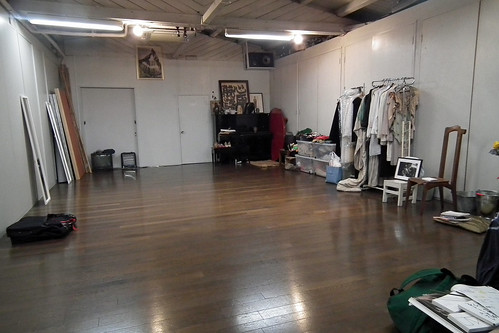
Kazuo Ohno built his studio, back in the 60's, next to his home on the hills of Kamihoshikawa, part of Yokohama's metropolitan region, less than an hour by train from central Tokyo. It was, and still is, a humble studio, simple but very functional: it has a wooden floor, a piano, several closets, a bathroom, a kitchenette, lounge chairs, a television, a glass cupboard, a sound system, a small illumination system; it's built from wood and metal sheets, with a group of supports that, when it rains, keep the studio from flooding by water running down the hill; outside, there is a shelf for shoes and a basket for umbrellas . From the entrance one can see the dining room and part of the kitchen of Ohno's house, and one feels ashamed to enter into the privacy of the home and prefers to look away.
Getting to the studio is a journey, is not easy, and everyone gets lost their first time, be they foreigners or Japanese - it's not a matter of language. And that's because, being in a hilly area where alleys and labyrinthine stairs are the only ways, one can not find the one alley and stair leading to the studio. For about 35 minutes I went up and down the hill several times, took several stairs, asked passers-by, checked the map a dozen times; exhausted and with so tired my legs were shaking, in the end I decided to take the first alleyway off the road and follow its roundabout path and there, after a turn which was not visible from the main road, the sight of the stairs that would finally lead to the study.
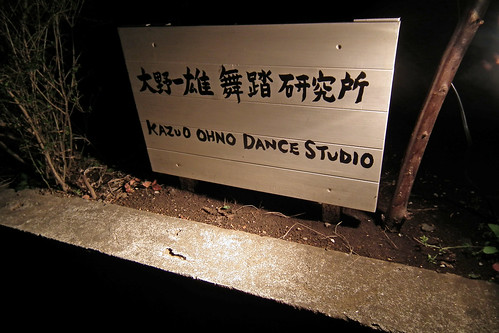
Mid-way up the hill you discover a wooden sign that reads, in Japanese and English, "Kazuo Ohno Dance Studio."
Sign entrance at Kazuo Ohno Dance Studio (Yokohama, 2011)


I was finally in front of that sign, a highpoint in my life as a student: I was there after that weary journey to find the place, after a month of uncertainty due to the earthquake in the north of the country and problems at the Fukushima nuclear power plant, after a year of studying and discovering Butoh dance with several teachers in Canada, and after a little more than 20 years after first seeing the figures of Kazuo and Yoshito Ohno on stage, setting their work as an example before all my students, my colleagues and myself. There was I, in front of that sign, and I stood there for several minutes.
It was night already, some wind was blowing lightly, you could hear the trains passing in the distance,  you could also hear some crickets, and nothing else.
Before meeting master Yoshito Ohno I got to know the studio, I could see his objects exactly as Kazuo Ohno used them (Yoshito Ohno has respected in full the arrangement of things and nothing has changed place): his chair, his music, his dolls, puppets and masks, his books, his costumes, the shoes of his female characters, his hats, the floor.
As is the usual Japanese (and Eastern) custom, you leave your shoes at the entrance and enter barefoot, that way you can go around the premises with the confidence that you won't damage anything nor will bother anyone the noise of your walking. And so I did, I entered like that, barefoot, and so I stepped where Kazuo and Yoshito stepped and danced together, where sometime they stepped and danced along with Hijikata, where now, by himself, Yoshito Ohno steps and dances, as the heir that is .
I remembered some pantomime class that I had taken in my university years, where for the first time in my life I heard the idea that the workspace was a sacred place, that you should greet it and ask it for permission to enter. I thought of the feet of the teachers, of their bodies falling and rolling, and to those images, as my mother used to say, I "entrusted myself"
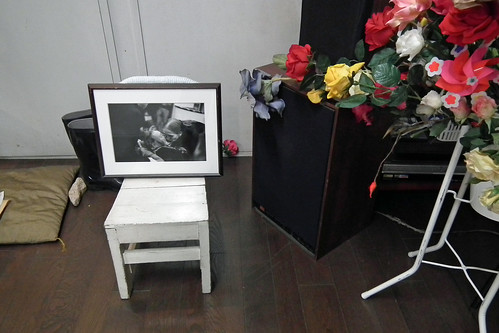
In my stepping I checked all of the space and my eyes fell on a picture on a tiny wooden chair: was the moment when Pina Bausch visited an ailing Kazuo and gave him a kiss; a really beautiful photograph, a very hard one, which made me tremble. Strange paradoxes of life, Pina visited the ailing, and perhaps dying Kazuo, but she would die a year before him.


Kazuo Ohno Dance Studio (Yokohama, 2011)

I know some of you, artists or not, understand my dwelling on this first step into the workspace of the studio of master Ohno, my devoting a blog entry to this account of the place where one has dreamed of being and of learning in.  I know some of you have dreamed of stepping into a place you really felt was sacred; it is you I'm addressing and for whom I write these texts, I took these photos and this video that illustrates that first step in my visit to the dance studio of master Kazuo Ohno in Yokohama, last April 20th 2011.


Texts, photographs and videos in this Blog are all author's property, except when marked. All rights reserved by Gustavo Thomas.
If you have any interest in using any text, photograph or video from this Blog, for commercial use or not, please contact Gustavo Thomas at gustavothomastheatre@gmail.com.


Sunday, August 19, 2007

Tamasaburo Bando: "Sagi Musume" 坂東玉三郎


I want to share my experience (til now limited to videos) with this wonderful "onnagata" performer, Tamasaburo, considered an artistic jewel in Japan, showing his dance performance of "Sago Musume" (坂東玉三郎), a Kabuki Theatre piece. These three videos are not mine, of course, they are part of one of Tamasaburo's admirer’s collection posted in Youtube (tiffenakou).

The first time I saw him (and every time afterwards) I had the same impression of beauty, perfection and quality I had when I first saw Kazuo Ono, one of the creators of Butoh dance, who has left a mark in my memory forever and who, now along with Tamasaburo, has become a reference point for what I consider the highest artistic level for a dramatic scene.

I’ve seen Kabuki on a few occasions, but I’ve never been as impressed as with Tamasaburo’s work on stage (yes, even having only seen his work on video); I can recognise the beauty and developed technique of the onnagata actors I’ve seen, but there is a latent difference between the idea of the sublime in art and the idea of a highly developed technique.

Kabuki itself, or Japanese theatre in general, may or may not be to your personal liking, but what I’m talking about is projection, capacity and talent, energy, presence and mastery.

In a couple of weeks I’ll get to see two Kabuki Theatre pieces in Beijing; the shows are advertised with the presence of an onnagata actor (whose name I don't know yet) who’s considered a living treasure of Japan. I’m impatiently waiting for the performance. It will be practically impossible to take video at the performance because of the theatre’s regulations, but I’ll share my experience through words.


Tamasaburo "Sagi Musume" 坂東玉三郎


Tamasaburo: video I "Sagi Musume" 坂東玉三郎


Tamasaburo: video II "Sagi Musume" 坂東玉三郎


Tamasaburo: video III "Sagi Musume" 坂東玉三郎

Tamasaburo’s official website is: http://tamasaburo.org

Wednesday, July 18, 2007

Cloud Gate Dance Theatre (Taiwan): 水月 (Moon Water)


(This is a translation by Tadeo Berjon from my post in Spanish)


I’m just back from seeing “Moon Water”, a masterpiece by this Taiwanese modern dance group, and my mind’s ready for writing…

For 70 minutes, my spectator’s mind lived a numbing process similar to the meditation process a newbie goes through: I started by experiencing total beauty, a feeling of purification, certain expectation for what was to come; then, a waiting, no more beauty (or beauty simply remains still), there’s repetition (like with breathing, like with mantras), and there’s confusion, distraction, the feeling of wanting to stop the experience, to cut it short, to change to a different mood or state of mind (there is a struggle); then, just before the explosion (which doesn’t come because I remain there, seated, waiting), there is enlightenment, a feeling of freshness where my spectator mind enters a new stage, letting itself go, and I realize my senses have become numb too, that my mind doesn’t struggle anymore (has it been vanquished?), I see (maybe I should say “I contemplate”) and listen without watching or listening, I’m empty and the image I contemplate fills the void. Unarguably, I’ve entered a meditative state that’s broken by the dark ending, by applause.

Did I watch a performance? Definitively. Did I contemplate a spiritual experience. Definitively.

I once heard or read about someone who had experienced “spiritual liberation” by watching his master in some process. Many, many speak about the spiritual experience of watching a taichi master performing forms for hours. The spectator is not a participant and yet the contemplating of the practitioner causes a revealing experience.

Then, I get lost in the experience, I get lost in the narrative.


Is this the metaphysical theatre that Grotowski was supposedly trying to achieve? The metaphysics where the spectator may or may not be present, where he contemplates the creative processes on stage, the transformation, the ritual dismemberment of the actor and, in turn, is also created, transformed, dismembered?

I don’t know, I never saw any of Grotowski’s last performances, I only have second-hand information about them. My experience has taken me to watch other failed, lost, almost worthless experiments. Today, the performance at the Poly Theatre was different. I wasn’t expecting any performance of this kind and, while it was happening, I didn’t recognize it, and when it was over, I wasn’t quite sure of what I had seen.

I saw taichi (the group has been practicing it for years), I saw breathing techniques and a process of movement meditation (meditation has been part of their training), I saw a dancing technique of highest quality (the best modern dance technique and a formidable training, all evident on stage). But my emotions were eliminated, my reasoning was broken… there was only contemplation.


I also saw how the individuality of the dancers became lost, how they merged on stage, how they became movement, fluidity, image: one, five, twenty dancers, they became a moving mass of spiritual beauty (beauty that even got lost, at some point, due to its repetition, its slowness and fluidity). I accept that, afterwards, I found it scary (since I’m an artist too) that I couldn’t recognize any single dancer as the best one, or as the worst one, I couldn’t remember who was who, they became fused arms, torsos, water, light, Bach’s cello suite. And still, I never forget the image of the director (Li Hwai-min), on the contrary, it’s strengthened. We applauded the company, we love them, but we acclaimed the director, we waited for his words.


Is there some deceit here? Is there a group sacrifice in honour of the director’s genius? Is there, once more, a divine seducer-creator who’s capable of erasing others to put his sublime ideas on stage.

There is a peculiar turn to the idea of the performance itself (that it’s not a normal performance, that it doesn’t tell anything, that it’s an “experience”) but, in the end, that tricky turn, in which we so fervently believe at the end of the performance, is it simply proof of the egotistical ability of the director to erase bodies and minds to achieve his artistic goal?

Then, what did I see?

During my liberating catharsis I remember Butoh and Kazuo Ohno in particular, my body trembles with the memory, my emotion flows full of tenderness and compassion, of love, nostalgia, I can’t remember the choreography or even whether he was the choreographer or it was someone else’s piece. The difference, then, is evident. With Kazuo Ohno and Butoh I see only the modern Orient, modern Japan. With Water Moon I see the choreography of Lin Hwai-min, I see China and I see the fluidity of what I can understand as Tao. Differences… could they be comparisons?

“Moon Water” is a wonderful dance piece, which will remain not in my spectator’s memory, but in my body memory, just like a meditation experience. I can’t remember any one particular meditation, but I can remember the general feeling of meditating, a great meditation is everything; I can remember this great piece of dance-theatre as the fundamental experience of all the pieces of its kind.

Can all this be taken as speaking well of a performance? I don’t know. In the slightest. It’s speaking, simply put.


“Moon Water” by Cloud Gate Dance Theatre of Taiwan performed on Saturday July 13th 2007 at Beijing’s (China) Poly Theatre. Some 20 dancers performed on stage under the direction of Lin Hwai-min. The music for the performance was some Bach's cello suites.
If you are interested in using any text, image or video from this Blog, please contact the author writing your e-mail and information in comments. (comments are private)
Gustavo Thomas. Get yours at bighugelabs.com