I've just found that China Daily published an interview with Mei Baojiu, the son of Mei Lanfang, the greatest artist in Chinese Opera (including Beijing Opera, of course). Mei Baojiu is also an important Chinese Opera actor but he has lived with his strong father's image all his life, and it seems he has assumed it very well.
I thought this interview would be of interest for many who follow this Blog; it is not a deep approach to Mei Lanfang's work but it works as an introduction to his life and work from the perspective of an important Mei's family member.
You will notice at the end of the video that appears a photograph of a Time magazine's cover with Mei Lanfang on it, supposedly from September 1934 (or maybe 1931 it is not clare) ; I must say that I made a research inside Time's archives looking for covers from 1920 to 1940 and I did not find any cover with Mei Lanfang on it (only articles and critics). What can I say? Chinese usually do that (transforming history) but I hope (really I do) that this is a simple misunderstanding and he did appear in a special number I missed... (*)
I can not embed the video to see it in this page but here is the link to the China Daily page it was published. Enjoy it!
(*) I wrote my doubts as a comment in the page of this China daily's article and they replied to me (also as a comment) saying that I was right, it was a mistake publishing that cover without have confirmed the source of it.
In November 2007 the Mei Lanfang Grand Theatre (1) was opened to the public, just a few meters from the so called Financial Street, where Chinese richest financial institutions have their luxurious offices, surrounded by not less luxurious hotels and fantastic malls.
During the day the theatre building seems a simple steel structure with enormous windows, only differentiated from other buildings around by a very shiny wall painted in red with decorative motives in gold (probably only plastic), Chinese preferred colours. But the same theatre at night, with lights inside and outside the building, changes up to turning in a futuristic comic space shift-style building.
Its five storeys contain three cafeterias, two souvenirs shops, a bookshop and a luxurious boutique selling a very special collection of Peking Opera dolls and jewellery. On the fifht level there are a gallery showing around 30 traditional costumes of the main roles in Peking Opera.
The Theatre is not specialized in Peking Opera only, it hosts many kind of operas from all over China and also Western-style musicals. That evening I saw an opera called "Zouxikou" 走西口 from Shanxi province. Nothing special for me; kind of traditional masses performance played in the worst realistic style. I took some photographs that illustrate my lack of comment about it. (See the Spanish version of this Blog)
(1) A rare event, Chinese theatres usually have names coming from the area they are located or some nice sentences from litetature or poetry; a individual's name means that the man is very very important, as Mei Lanfang is.
During my first six months living in Beijing I was trying to buy any Chinese book about Beijing Opera translated to English, specially about Mei Lanfang work, but my finding was limited to some simple books aimed to foreign common readers for a better understanding of Beijing Opera. Of course I found several books in Chinese, impossible to read (my Chinese was and is awful) but with marvelous pictures and illustrations.
It was in February 2006 when I found at the Foreign Languages Book Store in Wangfujing street a bilingual collection-book called (in his English version) “A Collection of Illustrative Plates Of Beijing Opera Performed During Mei Lanfang’s Visit To The United States”. This was one of my happiest moments inside any Chinese bookshop, I had in my hands the first “readable” book written by a Chinese author with not only important information but with real documents about the way Mei Lanfang prepared and performed plays, in this case during the 1930-tour to USA.
This book also put on his real place Qi Rushan, researcher, theorician, dramaturgist, and stage director who side by side with Mei Lanfang transformed the face of Chinese traditional theatre and made a revolution from inside. Thanks to him Mei was able to reach the top of the world of big stars of beginnings of the 20th Century. (1)
But ¿what does this book has inside? And ¿why did this book put on his place the name of Qi Rushan ? I will answer these questions with a direct quote from (the editor) Wang Wenzhang’s preface (2):
“Mei Lanfang’s visiting performance in U.S. causes such an éclat that is certainly the fruit of his consummate artistic accomplishment which he persistenly pursues. The view is widely accepted to explain and evaluate the historic significance of the visiting performance in U.S. However, not a few people know the experience that Mei Lanfang and his companies had made a series of detailed and comprehensive designs and preparations before the visiting performance. Among these include Mr. Qi Rushan, the organizer and prmoter of the visiting performance to U.S., who is in charge of the introduction and publicity of Peking Opera.
Mr. Qi Rushan received well education on the traditional Chinese culture even as a child and made wide journey for business throughout Europe when he was young. He goes deep into Western drama due to the often visits to theatres. Mr. Qi Rushan assists Mei Lanfang to set up the art of Mei School (3) when he came back to China. He contributes his life to the research of Chinese traditional opera and makes the relevant work turn from so-called “vulgar” research to academic study with true significance.
Mr. Qi Rushan on the behalf of Nation Opera Association invites famous painters to draw everything able to be shown by paintings in relation to Peking Opera from Peking Opera costume, facial makeup, props, musical instruments, dancing shape and theatre, add introduction in both Chinese and English and finally make them scroll of paintings easy to hang up as to “diffuse the Nation Opera to abroad” and to make the American audience understand Peking Opera through a direct way at a greater depht. It is easy for the American audience to understand Peking Opera.
The total of 183 scroll of paintings and 1987 plates to some extent become an encyclopedia of peking Opera knowledge but also display vividly the aesthetic principle of Peking Opera performing art.(…)
“A Collection of Illustrative Plates Of Beijing Opera Performed During Mei Lanfang’s Visit To The United States collects and publishes the majority of Peking Opera paintings drwan before Mei Lanfang’s visiting performance in U.S. 70 years ago. The total of 1092 paintings is preserved by the Academy of Chinese Traditional Opera (forefather of the Art Academy of China). The rest of the paintings about theatre houses are lost before the founding of the People’s Republic of China in 1949 and hard to find. (…) ”
Yang Yuhuan, better known as Guifei (Imperial Concubine of the First Order), is the consort most favoured by Emperor Ming Huang (685-762 AD) of the Tang Dynasty. She is invited by the emperor to admire the flowers and have a drink at the Pavilion of One Hundred Flowers. As appointed, Guifen comes to the pavillion with her entourage of palace maids and eunuchs. She waits a long time but the emperor fails to appear. She finally gets word that Ming Huang has returned to the Western Place Court to visit Meifei, another concubine. Disappointed and resentful, she has no alternative but to drink alone. She becomes bitter when she recalls how she was doted on in her early days at the Palace. Wine aggravates her sadness and makes her quite drunk. She returns to her quarters, helped by the maids, cheerless and lonesome.
Inside the book we read:
note: It is a difficult text, it seems the translation was made by an inexpert translator, so, please, make an effort.
“It originates from Drunken Concubine Yang during the reign of Emeperor Qianlong of the Qing Dynasty and appears on the stage of Beijing Opera from Han Opera in the first years of Emeperor Guangxu. It is a one-act song and dance drama. There are many complicated postures such as holding a cup in the mouth(4), sleeping fish and drunken walk (5). The role has been played by military ‘dan’ (female role). In 1914, mei lanfang learnt the play from Lu Sanbao when he was at yowen troupe (6). With the accumulation of stage experience and thoughts, Mei Lanfang made many innivations in the traditional performing style of the play. He did away with performing on stilts and change ‘huashan’ role to play. He threw away vulgar and obscene performance and words(7)after concubine Yang and paid attention her depressed feeling in the forbidden palace. He enhanced techniques of song and dance. Each singing sentence was untited with postures and expressions in his eyes. It made the image of Concubine Yang dignified and appearing in all her glory. Since that, the Drunken beauty had a new meaning of thought. All the pictures depict main dance postures in Act One Drunken Beauty and Act Two.” (8)
(1) Now I’ve found some other fantastic books, in French and English (and even translated some articles from Chinese), which have given to me a deeper view of the importance of this interesting actor. Qi Rushan was hidden by Chinese art historians because during the revolution he decided to flee and to stay in Taiwan and not in the new Communist China. (2) It is a real direct quotations that could have some mistakes for those scrutinous of the language. Bilingual book doesn’t mean written in two languages, so written first in Chinese the book was translated by a Chinese translator with his skills on hand. (3) The Mei School in one of the “styles” of performing which made school in China after the success Mei Lanfang had during these years. (4) “holding the cup in the mouth” is a posture (chain of actions) which is easy recognizable in the full-version film. (5) “Drunken walk” is a posture (chain of actions) easy recognizable in the full-version film. (6) Photograph showing Mei Lanfang and his teacher Lu Sanbao:
(7) It seems that because of the nature of the subject, a drunken spiteful concubine, the play was, before Mei, performed as a parody of drunk women, and people used to go with the expectation of seeing obscene moments on the stage. (8) Page 320. “A Collection of Illustrative Plates Of Beijing Opera Performed During Mei Lanfang’s Visit To The United States” Collected by the Arts Academy of China. Wang Wenzhang, chief editor. Culture and Art Publishing House. Beijing, China. 2005.
Note: This entry is the first of two parts (or more, I don’t know yet), where I express my views and concrete facts (information, photos, videos) on “Mudanting" (牧丹亭) by Tamasaburo Bando and the Suzhou Kunqu opera company on May 14th 2008 at Huguang Theatre, in Beijing.
My intent after the performance was to write about my impressions as soon as I got home, but my mind was (and has been) in a state of confusion since that night and for two days already. Reading and dreaming has helped me clear things.
I observed with attention, calmness and rare pleasure the greatest feminine role specialist actor of our time, Tamasaburo Bando (坂東玉三郎).
I found out about Tamasaburo on the internet, through videos of his work, most of them exposed by a faithful fan of his (1), and I simply adored him. I saw and reviewed each and every one of those videos, I recognised in him not just his technique, but the creative greatness of one of art’s greatest phenomena. His presence held me like Kazuo Ohno's years ago, I anchored myself to him and his acting. On the night of the 14th I had him just metres away.
Huguang Guildhall (北京 湖广会馆), the oldest Chinese Opera theatre in Beijing, built in 1812 and rebuilt in the 1990’s, has been home to the work of many generations of great Chinese actors, it has seen the divine ones (2). This is one of those rare occasions in which it welcomes a foreign star with a classic Chinese piece like “Mudanting” or “The Peony Pavilion”.
Staging The Peony Pavilion in China is crazy, is artistic suicide, unless one is sure of what one’s doing, of what lies behind oneself. You can’t simply go to London and tell Britons how to do Hamlet!
China is Japan’s cultural mother, its only, main and basic source; China is also Japan’s biggest political rival: hate, envy, resentment and sorrow flow in the blood of the people; but China is also the challenge and the peak for the Japanese. Not to fear China is not to fear the force of tradition and the weight of great figures. Tamasaburo, being great, being a genius, being polite, is the adequate one for an encounter under such conditions.
Tamasaburo belongs to that great line of traditional oriental art actors who possess the spark of change and of the revolutionary; he knows his world, he does not challenge it up front but seduces it into change. In that sense, Tamasaburo is a divine reincarnation that, as it is perceived all over Orient, has subtly attracted the unrefined attention of the people that love him, and so promoting the support of the connoiseurs, and getting respect for his vision.
The stage entry at the Huguang Theatre was measured finely: with the surrounding frame of a beautiful Japanese style choral chant, the introduction to the history of the Peone Pavilion, in that mythical and delicious garden, lets us see little by little a Tamasaburo in a role that personifies what Chinese consider romantic and idealist love.
(This is a special note written after the publication of the post: I realized that this first scena wasn't Tamsaburo's performance of Du Liniang (from Mudanting), it was a special personal portrayal of Yang Guifei, the concubine. After that he performed Du Liniang the whole show. I strongly believe that this mistake doesn't change my points of view about his work that evening.)
With singular beauty, the creator chooses the golden details of his dress, with a subtle yellow backdrop for the base cloth, thus offering us the birth of the sun at dawn. Yes, Tamasaburo does not follow Kunqu’s dictates, but he introduces changes which deserve no negative criticism.
In order to present a different staging of Kunqu (and in order to be accepted in China), he had to work with an open but stable company, and so the choosing of the Suzhou Kunqu Company was perfect, as the company was renowned for its daring versions of this same piece (2) and other belonging to the same genre, with changes not only in the way of staging it but, what’s more difficult in China, in the way of singing it. They’re very famous for their scandalous plays and they’re opening the field to the outer world. Their singers are educated with the best techniques, they act with precision, they know how to be clear and subtle, they know how to be loved and, as young people growing and flowering, they have the way open for creating the new Chinese opera, an opera that can evolve following the Oriental tempo.(4)
Tonight I’ve seen a stage paradise, I’ve seen dreams and love; I’ve enjoyed singing like I hadn’t heard before, a difficult singing, to be honest, for a Japanese speaker. The then divine presence of Tamasaburo joined the beauty proper of this immense lyrical and poetic work from the 16th century.
In the very Oriental play of reincarnations I saw, in the work of Tamasaburo’s body, the mythical Mei Lanfang. At last I could break away from the horrible feeling of watching those videos left from the most important Chinese Opera female impersonator, acting during his last years, fat, slow, insecure and with a voice that was hard to enjoy. Mei Lanfang was divine from his adolescence until his forties, and afterwards he just lived on his success (5). The images of his acting during his glorious years remain in the memory of the spectators, not on recorded materials; there are many recordings of his voice and also photographs, just photographs, undoubtedly beautiful, and 5 minutes of silent material filmed by Einsenstein during the 1930’s. Tonight, May 14th, I could see him move on stage, I could see what Chinese who know about Chinese Opera see, the genealogy of teachers in the “doing” of the actor.
The singing, the dresses, the choreography and the acting (not the mimic). With deep knowledge about his own talent and of his creative personality, master of his eyes and column, Tamasaburo is a magnet, and possesses as well a fabulous control of his projecting: he knows where we should be looking and how.
Seeing him, then, is seeing the past in the present. Seeing him then is seeing the masters. Seeing him is also seeing the presence of the mythical Western starts of the 19th and early 20th centuries, masters of body techniques and of projection. I remembered Sarah Bernhardt and Eleonora Duse, I remembered their poses, their body control and, thanks to the recordings they’ve left, I also remembered their voice work. Tamasaburo’s acting is, I think, an example of how the acting of those divine actresses would have been perceived. As soon as got back home I looked again at pictures and images of these goddesses, I watched their eyes, I compared their written impressions, I was stupefied. “They use the same principles”, Eugenio Barba would probably say (6).
Tamasaburo is a modern actor that lives in the educated body of a Kabuki actor. By going beyond his tradition (as he’s done on previous occasions) he’s had to act like a serious Western actor would do when playing a role in a foreign context and with a complicated technique: observing each detail and working on it, imitating what’s necessary, recreating, searching for the character, using his personality and talent. Tamasaburo didn’t perform Kunqu, he recreated Kunqu. He gave warmth to a character that most Chinese actresses project perfectly thanks to the confidence that years of detailed technical work has given them; Tamasaburo endowed his character with subtleties (like those that Mei used himself), he acted in our Western conception of the verb “to act”, yet he never disrespected the technical bases of Kunqu; we never stopped watching and listening to “Mudanting”(7).
At the character’s death, as difficult as any other death on stage, I perceived an almost dangerously excessive use of gestures. The difference in his signing was audible but it didn’t damage his work, nevertheless in the last scene, for a second, I thought I saw the beauty of that mask, created for the character, break apart; I saw the imminent danger of the loss of tradition and the colapse into “realism” (why precisely he, an actor of Japanese tradition? I don’t know), there was a divergence with the specific detailed technical gestures; but it didn’t go too far. Great people do sometimes get close to tripping, and sometimes they do fall; this time and from my point of view, it was’t the case. I applauded with relief.
At the end, the divine Tamasaburo thanked a euphoric audience (8) with the same personification of dawn (as my memory now remembers it) that served as opening for the play at Huguang Guildhall.
(1) Youtube: http://www.youtube.com/user/tiffenakou Blogspot: http://botantei.blogspot.com (2) The story of the Huguang Guildhall is truly interesting, it’s the story of theatrical space in the world: first, a sort of shelter for travellers, then, an important gathering place for intellectuals travelling to Beijing to sit for their bureaucratic examinations, a tea house and restaurant, always with a special room that was continuously adapted for social events, ever more stylish, ever more specifically suited for the Opera that was performed there. Finally, rebuilt in the 1990’s, it became and has become a point of reference for many events concerning Peking Opera. Although not always with the best actors, and almost exclusively dedicated to shows for tourists, it still stands out as an architectural gem, without parallel in Beijing. When I heard that Tamasaburo had chosen exactly this space for his performance, it gave me great pleasure, and it confirmed in my mind the importance of this theatre for Chinese Opera (3) The company has created a “juvenile” version of Mudanting that became a real headache for Kunqu purists. (4) Breaking apart from the links that, in the West, have united dramatical processes for centuries is a battle few dare to fight, and many lose it and fall into rejection and oblivion; big personalities like Mei Lanfang were victorious by sticking to their own tradition, becoming its best performers, and then subtly changing, perfecting and, most importantly, creating new pieces with those new details; that evolution is what we call “schools” which can then become a “style”. We must not forget that Peking Opera itself is the result of 100 years of evolution that finished in the 19th century and reached its peak with the revolution of Mei Lanfang. The arrival of communism marked the death of his art. The chaos after the cultural revolution in China created a governmental barrier to everything revolutionary concerning traditional arts, now seen as intangible relics from the past, and few have been allowed access to the processes of renewal and change. (5) With the arrival of communism, Mei Lanfang dedicated himself to promoting Chinese Opera education, yet he became a sort of living museum; he wasn’t admired for his present work but for his past, and as he was losing his technical ability he gained in the creation of his own myth. Seeing him acting in those videos where he was 60 years old is, from my point of view, deplorable, given how great he was in his youth and middle age. Most of the actors that performed his roles had to retire before losing the abilities to remain great in the memories of the spectators. (6) This is a reason for not one, but many posts. (7) One of the characteristics of most of the Chinese stagings of his theatre is technical coldness; as Westerners we look for emotional energy, for which we have prepared for years as spectators as well as creators. The Chinese, knowing little of this kind of work, confuse it with the emotional demands of "melodrama" and imitate it till death. We see their theatre as cold, they see ours as an explosion of cheap emotions. Tamasaburo, I believe, creates or discovers a middle ground where voice, body and gesture techniques from Oriental tradition have their place next to the requirements from Western interior projection. It is the “soul” that only a few achieve in their performance, Zeami made it look as the most precious of achievements, a professional peak to become a divinity on the Japanese stage. It’s obvious that Tamasaburo is not a Western actor and neither has he been trained in a Western school to achieve that but, as we can find physical principles for a theatre work, I strongly believe that there are internal principles (psychological, mental, emotional principles) that can be practiced the same as physical principles. (8) The euphoria came mostly from the Japanese spectators, which filled half the theatre. The Chinese spectators, though happy, we’re more reserved. Tamasaburo has been praised in the Chinese press and by famous artists of this genre, but the qualifiers have not been excessive nor effusive, but rather reasoned and respectful.
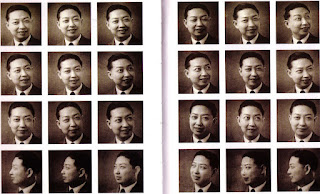
Being conscious about the importance of keeping alive his acting technique, Mei Lanfang, the biggest Chinese Opera star in history, left 48 photographs with his different eye expressions.
An invaluable document for next generations, not only of Beijing Opera actors, but for any conscious player coming from any theatrical tradition.
I saw these 48 photographs for the first time in one visit to Mei Lanfang Memorial House Museum in September 2005, and of course it was impossible taking off the photographs from their panels. So, it was until the beginning of this year when I bought the latest edition of the book with documents about the professional life of Mei Lanfang that contained these precious images.
I edited one slideshow with the whole set of photographs.
Here a new version of "Mei Lanfang hand gestures video"; this occasion only photographs of those amazing hands, without text in Chinese or motion images. I thought It was important posting this special slideshow just to appreciate on detail those hand gestures Mei Lanfang used to do on stage.
Every photograph is taken from Chinese books. Mei Lanfang, the great Chinese Opera actor had pictures taken of each of his gestures, even hands, face and eyes, looking for establishing a document record for future generations of actors. Many of these gestures were created by Mei Lanfang, including those for moments usually devoid of gesture, or where he dared (as, from the traditional Oriental point of view, it was viewed as daring) to change something that had been done by actors for generations.
Mei Lanfang was known thanks to his quality and his ability to perform with details. In the middle of a strong tradition he knew how to make changes, with details; hand gestures were among those changes.
My personal video edition of Mei Lanfang's hand gestures, from films and books I've found about this subject.
While living in Lebanon and without knowing I was going to live to China and become a spectator of its Beijing Opera (Peking Opera), I found, at a French Book Fair (1) in Summer 2004, a strange but interesting book published in 1926 by La librairie orientaliste Paul Geuthner: “Théâtre et Musique Modernes en Chine”. Written by the French Cultural Consul of France in Beijing,the book was an effort to depict the great theatrical moment China was living at that moment of its history, specially Chinese Opera.
In China, Mei Lanfang and other great Beijing Opera players were creating, since the end of the 19th century, a Theatrical Revolution, creating new ways to perform, new plays, and preparing the public for a new moment in Performing Arts; Chinese say they brought the acting technique to its highest level.
There were only few visitors back then, many of them tried to stay away from Chinese culture and, of course, their experience with Chinese opera was most of the time a disastrous one, misunderstanding everything they saw and listened. But people like Soulié de Morant, a real lover of Chinese culture, looked for different ways to make Chinese art understandable to western audiences: translations of many operas in text and music, brilliant descriptions of performances and their stars, and of course putting spectators as an important character for the success of this kind of theatre.
Beijing Opera Musicians (1926)
The Book I want to talk about is a jewel, I believe. Aside from having interesting descriptive texts by a real connoisseur of Chinese Performing Arts, many photographs from the beginning of the 20th century show the boiling-point Beijing’s theatrical ambiance was living: theatres, posters, performances, spectators, street players, musicians, their instruments; and we can read (in French, of course) parts of some Beijing Opera scripts. At the end of the book there is a special chapter about Music for Opera and many music scripts translated into western notation for piano (absolutely understandable if we remember that Chinese music and its notation came from different sources that western music).
Every time I see and read this book it’s a new experience and I get continuously surprised with new details of the photographs, descriptions or comments on them. This is, as usual, a very simple way to share it.
(1) Lebanon, which was a French colony, is considered a French speaking country. A big percentage of the population speaks and lives in French. Many of its schools and universities work totally in the French language. So, it is not strange to find a French Book Fair in this Middle Eastern country. Note: Photographs were scanned by me, and the slideshow video was produced and edited by me too.
They say when in 1935 Mei Lanfang performed in the former USSR he changed the theatrical point of view of the most important creators of that land. Einsenstein, among those creators amazed by this Chinese Star and crazy about excentric moments and people in history, decided to take advantage of Mei Lanfang visit and asked him for a special session of filming on March 29th, 1935; the result was 5 minutes of film Mei Lanfang performing his Beijing Opera new style; although the film projected by Einsentein never was finished, it is an invaluable visual material. (1)
I found a short part of this film and I love to share it (2).
(1) George Banu wrote his version of that visit: "Eisenstein qui le rencontre dès le 12 mars lui propose de le filmer. Et le 29 mars, juste à la fin des représentations, une longue séance de tournage aura lieu, mais sans que le film projeté soit réalisé. Par ailleurs Eisenstein écrit la fameuse étude A l’enchanteur du jardin des poiriers, qu’il va reprendre trois fois dans la période 1935-38, et il offre à Mei son article, paru en anglais, The Principle of Film Form, avec une dédicace lourde de significations à l’heure du « réalisme socialiste » : « A M. Mei Lanfang, le plus grand maître de la forme, mon article essentiel sur la question »" (Mei Lanfang : procès et utopie de la scène occidentale, by Georges Banu) (2) Film extracted from a Chinese documentary.
Mei LanFang (梅兰芳) is the icon of chinese theatre; of course the Chinese stage has got big figures, great players, wonderful masters but nobody compares to the fascination the Chinese government and the Chinese people feel for Mei LanFang. You can’t talk about Chinese theatre without talking about him. Mei LanFang brought Beijing Opera (京剧 jingju) (1) to an international level; he was the first to do international tours and, most importantly, the first to develop relationships and exchange ideas with the greatest scenic artists of his time: Gorky, Stanislavsky, Nemirovich-Danchenko, Eisenstein, Meyerhold, Chaplin, Bernard Shaw, Gordon Craig, Brecht, Tadashi Aoki, Enosuke Ichikawa and many others, who strongly influenced him, and who were in turn influenced by him.(2)
Mei LanFang was a revolutionary and even a creator of new styles and views inside the Chinese theatre, specially Beijing Opera; he created a different style of acting well known in China today as one of the more remarkable, fine and original schools. Even without those contributions, Mei LanFang was simply a genious on the stage; specialized in Dan feminine roles from his adolescence (3), he was the prototype of good acting, discipline and perseverance; his figure and chanting were applauded, his dance and playing surprised anyone because of its beauty and perfection; ordinary people simply loved him, as did many in power. He seems to have been a man who knew how to keep good relations with the powerful, but that doesn’t mean that the changes in China didn’t touch him. As a legendary figure, he was lucky to pass away in 1961, a few years before The Cultural Revolution, and not witness how most of his legacy in Chinese theatre and his own image were trampled and erased from the map of Chinese history for almost ten years, accused of being a remnant from Capitalist and Aristocratic times before the Communist Revolution. It was not until the end of the 70’s that Mei LanFang and all of those destined to die in that Mao’s wrong social experiment that they retake a preponderant place in the Chinese History of Art and, even more so, our man is raised to the level of a real hero. Visiting his memorial house becomes a patriotic experience.
Mei LanFang’s memorial house is located in the middle of a famous Hutong (4) in the Xicheng district of northwest Beijing. That traditional building, with a courtyard and rooms around it was his home for only the last 12 years of his life (1949 to 1961), when he enjoyed fame and success, long after the world recognized for the fist time his greatness in the 20’s and 30’s; but the place is worth the visit only because he lived there, because you can know about him and reflect on his legacy. It is a museum, ¿what is left to be found in a traditional Beijing house when the past Cultural Revolution burnt and destroyed everything? (5) It seems that the high status of Mei LanFang’s family gave them the opportunity to keep some of Mei LangFang’s possessions: paintings, books, furniture on exhibit in the house rooms (visible from the windows in the walls); many photographs (no originals), videos of some performances (6), recordings of his voice, and some costumes, that kind of marvelous costumes so characteristic of Chinese Opera and China itself.
Between the curiosities one can see there is a big poster showing dozens of photographs of Mei LanFang’s hand gestures and finger postures that he redesigned or created new for the young lady role (Dan), as well as body postures for seating down, moving tables, carrying chairs, etc.
At the end of my visit I went to the small souvenir shop full of dusty glass cabinets selling fans, card decks with images from Chinese Opera, post cards, and some books; one in particular caught my attention: Mei Lanfang's hidden book of historical drama images. The employee repeated: -Zheige henhao! Henpiaoliang!- ( This a good one, very beautiful!) I wanted to look and I asked for it; while I looked amazed at the pages and illustrations, the shop-keeper told to me that some years ago this book had won in Germany the prize to the most beautiful book in the world; Chinese people usually make up stories to sell anything to foreigners , but this time I was beginning to believe the story; I could notice that many of the illustrations were reproductions from ancient paints, depicting different characters, roles and makeup patterns; I also noticed a special Chinese way of binding luxury or important books, where books are split in two parts inside a very beautiful cover and are stitched with very noticeable strings; the text was impossible for me to read, written as it was in traditional Chinese characters, such a shame! (though some would say not being able to read it doesn’t really matter, since it’s a Chinese contemporary writing).
I thought a little bit before buying it; but that book was really beautiful, in my point of view a piece of art.
Now, holding it while I’m writing, I smile: ¿Why not play with the idea that I really bought, inside Mei LanFang’s house, the most beautiful book in the world?
(1) Peking Opera, now known as Beijing Opera; though in mandarin or putonghua it’s called Theatre of the Capital or Jingju 京剧。 This is not the time to want to change things, but I always think about Chinese Opera as a Traditional Chinese Theatre, the word “Opera” puts an emphasis on singing, but Jingju can’t possibly exist in the basence of many others elements: choreography, acting, acrobatics and voice as speech. Mei LanFang, for instance, possessed a great voice, difficult to imitate, but his legacy also includes a way to look at roles, movements, choreographies, as well as the details of his corporal work on the stage. (2) There is an article, published on internet, in the Théàtre du Soleil’s site, which could clarify the influence of Mei LanFang in Western performing arts: “Mei Lanfang : procès et utopie de la scène occidentale” by Georges Banu. (3) “Farewell my Concubine”(霸王别姬 bawangbieji) is one of his most important performances. (4) Hutong (胡同) literally means alley, but the word remits to a whole traditional neighbourhood that may contain countless small alleys. (5) The main part of chinese art pieces had already been taken away by the Chinese nationalists and are currently on exhibit in the museums of Taipei, Taiwan. Many others were trafficked away. Most of the theatrical pieces left are costumes and musical instruments of dubious origin. (6) The video I watched on that occasion was precisely “Farewell my Concubine” (霸王别姬 bawangbieji), with the scene where the concubine (MeiLanFang) performs the sword dance, killing herself at the end of it. Mei lanFang was more than 60 years old at the time. The video I post is the same I saw in the Mei LanFang's Memorial House, just a few seconds from a documentary gotten in Beijing.
If you are interested in using any text, image or video from this Blog, please contact the author writing your e-mail and information in comments. (comments are private)


 Plate 3: 惊鸿 (Jinghong) Frightened Swan.

 Plate 5: 羽集 (Yuji) Congregated Birds.

 Plate 7: 指蓬 (Zhipeng) Pointing to Penglai the fairy Mountain.