Showing posts with label Balinese Performing Arts. Show all posts

Tuesday, July 26, 2011

Sanghyang Djaran (Trance Dance) Performance at Pura Dalem Taman Kaja, Bali.

Sanghyang Djaran (Horse Trance Dance). Ubud, Bali. (By Gustavo Thomas. 2009)

"The word Sanghyang means celestial and refers to trance dance rituals whereby the performers enter an altered state of consciousness called kerawuhan (descent or arrival) or nadi (becoming).  ...  The purpose is to restore order back to the village and to exorcise spirits of chaos." (1)

After reading the last quotation you can suppose that in these days trance dances are rare in Bali (and elsewhere in the world).

What I saw in Ubud after the Kecak performance at Pura Dalem Taman Kaja, the Sanghyang Djaran (or horse trance dance), in July 2009, was a performance for tourists; yes, the dancer was "acting" the trance. For us, ignorants about Balinese rituals, there is almost no difference, but for those who know and appreciate Balinese rituals there are.

So, what's the point of publishing here? Simple: this is a Blog about theatre and performing arts, and I'm sure, this "trance dance for tourists" I saw that evening in Ubud was both of them.

Even though there wasn't a real trance it was a very a good "external" example of it and, indeed, a very interesting one, specially in visual terms. Usually in these kind of works with religious origin Balinese performing artists keep the general and basic structure of the original ritual, and we can see example of it all over Bali.

So, from my point of view, this video is worth to watch, but mostly I think this is another good opportunity to see for first time and enjoy one more of those fantastic and special Balinese performing arts.

Video: Sanghyang Djaran (Horse Trance Dance). Ubud, Bali. (By Gustavo Thomas. 2009)

Sanghyang Djaran, A Balinese Trance Dance Performance at Pura Dalem Taman Kaja, Bali (2009) from Gustavo Thomas on Vimeo.
Sanghyang Djaran, A Balinese Trance Dance Performance at Pura Dalem Taman Kaja, Bali (2009)


(1) Balinese Dance, Drama and Music. A Guide to the Performing Arts of Bali. I Wayan Dibia and Rucina Ballinger. Perilus. Singapore, 2004.

Texts, photographs and videos in this Blog are all author's property, except when marked. All rights reserved by Gustavo Thomas. If you have any interest in using any text, photograph or video from this Blog, for commercial use or not, please contact Gustavo Thomas at gustavothomastheatre@gmail.com.

Tuesday, July 5, 2011

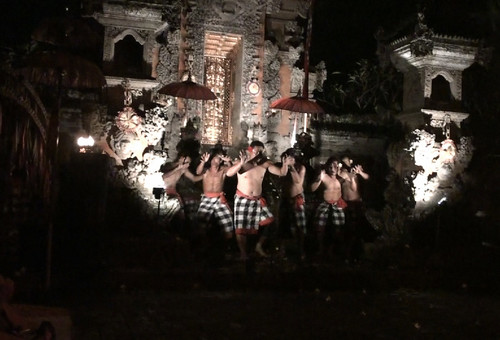
Kecak Performance at Pura Dalem Taman Kaja, in Bali (2009)

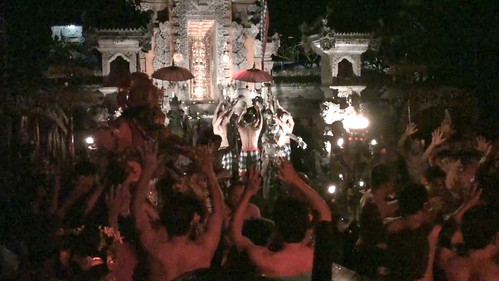
Kecak Performance at Pura Dalem Taman Kaja (Bali, 2009)
(Photograph by Gustavo Thomas. 2009)

Kecak (called also Cak) is one of the best known Balinese Performing Arts, a mix between a religious choral piece, a theatre play and a choreographed dance, based on a choir of local men. It is not an old form, it was created from some ancient Sanghyang (trance) forms during the 1930s, adding a theatrical story. Some give the credit to German visitor Walter Spies, while others give it to two Balinese masters, I Gusti Lanang Oka and I Nengah Murdaya.

Miguel Covarrubias (who was there around 1930) didn't know about Kecak, but did know about Sanghyang and the use of the word "kecak" in its chants as an accompaniment of the trance dance. Kecak developed into a theatrical form when it was separated of the trance and stories, wether from the Ramayana or from other Hindu epics, added to it. 

Even when Kecak is the theatrical form without trance, its performance is completed with a short trance piece, the "Sanghyang Djaran" or Trance Dance of the Horse, a piece about which I'm going to talk about in the next post of these Bali performing arts series.

Kecak Performance at Pura Dalem Taman Kaja (Bali, 2009)
(Photograph by Gustavo Thomas. 2009)


To talk about the rhythms in Kecak I'm quoting the book "Balinese Dance, Drama and Music"(1):

"The polyrhythmic vocal chanting that makes up most of the performance is sung in interlocking parts. Most chorus members know at least four different rhythmic patterns: syncopated cak telu (three syllables), cak lima (five), cak nem (six) and the simple non-syncopated pattern cak ocel (three and seven syllables). There is also improvised panyelah (five syllables). Syncopated rhythms require three voices: polos (down beat), sangsih (upbeat) and sanglot (in between). The interlocking patterns of three and six strokes are chanted within one gong cycle and are marked in the melody by a gong-like sound, sirrrrr. The five-stroke and non-syncopated pattern are freer. All patterns are laid over the kajar and the melody. The kajar is the time-keeping gong, vocalized in Kecak with a pung sound. The melody is chanted as yanger yangur yanger yanger yang sir."

What I saw that night at Pura Dalem Taman Kaja in Ubud was a performance by Taman Kaja Community. Most of the members of that group, as its name says, were from the same neighbour (called Desa), in this case Desa Pakraman Taman Kaja. 

That was a powerful and energetic performance, full of life and interesting images, visual and vocal images. Yes, the voice of those a hundred men chanting is still in my memory today, their sound provoked to my whole body a vibration difficult to forget. It was a very unique experience watching this also very unique theatrical form. 

Luckily I was able to record almost the whole performance, so you can see photographs and video of it. You have to understand that night it was raining and the visibility was poor, plus my seat was very close to the stage.

Program of Kecak performance at Pura Dalem Taman Kaja, Ubud (2009)

This is what the program says about the story to see (original redaction):

The story is a fragment from the Ramayana, the hindu epic. (...)
Prince Rama, heir to the throne of the kingdom of Ayodya, and his wife Sita have been banished from the kingdom by King Dasarata as a result of trickery by Rama's stepmother. The story begins with the arrival of Rama and Sita accompanied by Rama's brother Laksmana in the forest of Dandaka.
The trio have been observed by the demon Rajwana, King of Alengka, who lusts after the beautiful Sita. Rahwana sends his prime minister Marica to try to isolate Sita so that Rahwana can kidnap her. Marica's magical powers turn him into a golden deer and he enters the forest and when Sita sees the golden deer she is so enchanted by it that she asks Rama to capture it for her. Rama chases after the deer leaving his brother Laksmana behind with strict instructions to protect Sita. When Sita thinks she hears a cry for help from Rama she forces Lasmana to go after Rama by accusing him of cowardice and he goes off to help Rama with great reluctance after drawing a magic circle on the ground and telling Sita that she should not under any circumstance step outside the circle.
Sita, left alone in the forest becomes an easy prey to the trickery of Rahwana who has disguised himself as an old priest and begs Sita for some food as he is cold and hungry. Sita falls for his trick, she steps outside the circle to give the old priest some food and Rahwana grabs her and takes her to his palace.
Once back in his palace in Alengka Rahwana tries everything he can to seduce Sita without any luck.
In the meantime Hanoman, the white monkey, a good friend of Rama, is searching everywhere for Sita.
In the palace of Alengka Sita pours out her heart about her cruel fate to Rahwana's niece Trijata, who had come to love Sita, when Hanoman appears telling her that he is Rama's envoy and proving it by showing her Rama's ring. Sita gives Hanoman a hairpin to show that she is still alive and sends him back to Rama with a message to come to her rescue.
In the meantime Rama and Laksmana are wandering in the forest looking for Sita when Meganada, Rahwana's son, appears and engages Rama and Laksmana in battle. Meganada uses his magic powers and shoots of an arrow which magically turns into a dragon which overpowers rama and Laksmana and they are trussed up in ropes.
The bird Garuda, King of all the birds, a good friend of King Dasarata, has observed the trouble Rama is in from high up in the sky and comes to the rescue freeing hte brothers from the ropes.
Rama and Laksmana continue on their way to rescue Sita and are joined by Sugriwa, King of the monkeys, and his monkey army.
This fragment of the Ramayana comes to an end with the battle between Sugriwa and his monkey army and Meganada and his demon army which ends with the defeat of Meganada.


Kecak Performance at Pura Dalem Taman Kaja, Bali (2009) from Gustavo Thomas on Vimeo.


(1) Balinese Dance, Drama and Music. By I Wayan Dibia and Rucina Ballinger. Periplus Editions, Singapore, 2004.


Texts, photographs and videos in this Blog are all author's property, except when marked. All rights reserved by Gustavo Thomas. If you have any interest in using any text, photograph or video from this Blog, for commercial use or not, please contact Gustavo Thomas at gustavothomastheatre@gmail.com.


Saturday, March 19, 2011

Barong and Keris Theatre Performance (2009), and some original documents of the 1930's by Rose and Miguel Covarrubias.

Barong performance (By Gustavo Thomas. Bali, 2009)

In the summer of 2009 I recorded several performances of a large variety of Balinese Performing Arts.  Since then I've been publishing many of those videos linked with some documents, recorded in the 1930's, by Mexican Researcher Miguel Covarrubias. Today I want to retake 'the Balinese subject' with a very attractive and in some way very impressive performance of Balinese theatre: Barong, and Keris.  

I called it 'Barong and Keris theatre performance' instead of 'dance performance' because they are actually a mix (as we Westerners see Performing arts) between dance and a theatre play, which are usually not differentiated in Balinese performing arts.

The Barong is a character of Hindu-Balinese mythology, the name of a mythic Balinese lion, a divine monster. It is a very recognizable figure everywhere in Bali because of its costume, so impressive and spectacular, with its long body (similar to that of the traditional Chinese festivity lion) made with different types of palm threads, its vivid and horrid mask, and its decoration with gold and mirrors (see Covarrubias's description bellow). Every visitor to any temple or palace in Bali feels the inevitable need to stop and observe that impressive Barong costume hanging in its pedestal over the Gamelan instruments, waiting for the evening performance.

Barong costume at Ubud Royal Palace (By Gustavo Thomas. Bali, 2009)


Keris (kris or kriss), meaning 'knife' or 'dagger'  is the name of a trance dance, famous for its dancers hurting themselves with a 'keris" while they are in trance. One of the most striking photographs of a Balinese performer is that of a Keris dancer performing, published in "A Dictionary of Theatre Anthropology" by Nicola Savarese.


Keris performer (A Dictionary of Theatre Anthropology. Nicola Savarese Archive.)


MIGUEL COVARRUBIAS

In the 1930's Covarrubias filmed one of many versions of Barong performed during a temple festivity. Here are the only 50 seconds that are known to remain from of those recordings (the voice is not part of the original):


Covarrubias also wrote in his book "Island of Bali" a comprehensive description of Barong, the character, and of its dance, including the final "Keris", a description I'd like to share with you as an introduction of the performance you are going to see:

"The witch has a contender for supremacy in a fantastic animal, a mythical "lion" called Barong. Because of an ancient feud with Rangda, he sides with human beings to thwart her evil plans, and the Balinese say that without his help humanity would be destroyed. While Rangda is a female, the magic of the "left", the Barong is the "right", the male. Rangda is the night, the darkness from which emanate illness and death. The Barong is the sun, the light, medicine, the antidote of evil.
Every community owns a set of the costumes and masks of both characters. These masks have great power in themselves and are keep out of sight in a special shed in the death temple of the village. They are put away in a basket, wrapped in a magic cloth that insulates their evil vibrations, and are uncovered only when actually in use, when the performer-medium is in trance and under control of a priest, and not before offering have been made to prevent harm to the participants. At the feasts of the death temples their masks are uncovered and exhibited in one of the shrines. It is good precaution to sprinkle these masks with holy water when someone is sick in the village.
Like the Rangda, the Barong is treated with great respect and the Balinese address him by titles such as Banaspati Radja, "Lord of the jungle", or as Djeró Gedé, "The Big One", rather than as Barong, which is only a generic name for his sort of monster.
Despite his demoniac character, the Barong materializes in a trance play in which he is made to act foolishly and to dance for the amusement of the crowd. His costume consists of a great frame covered with long hair, with a sagging back of golden scales set with little mirrors. A beautifully arched gold tail sticks out of his rump and from it hang a square mirror, a bunch of peacock feathers, and a cluster of little bells that jingle at every move. Under a high gilt crown is his red mask, too small for his body, with bulging eyes and snapping jaws. The power of the Barong is concentrated in his beard, a tuft of human hair decorated with flowers. The Barong is animated by two specially trained men who form the front and hind quarters of the animal, the man in front operating the mask with his hands.
In Penetjutan the Barong play began with a performance of djauk, a group of boys wearing grinning white masks, who danced to the delicate tunes of a legong orchestra called in this case bebarongan. After the dance the two Barong performers went under the costume that lay inanimate on two poles, the mask covered  by a white cloth. Like a circus prop-horse, the Barong danced, wiggling his hind quarters, lying down, contracting and expanding like an accordion, snapping his jaws, and in general behaving in a comic, rather than undignified manner for his awesome character. After his gay outburst of animal spirits, he began a long dance, staring around as if astounded by magic visions that filled the air. He was constantly on the alert of invisible enemies, growing more and more alarmed, clicking his teeth like castanets as the tempo of the music increased. Firecrackers began to explode at the far end of the arena, startling the Barong, and when the smoke cleared, the figure of Rangda appeared, yelling curses at the Barong, who appeared humiliated by her insults. But eventually he reacted and they usually rushed at each other, fighting and rolling on the ground until the Barong was made to bit the dust.
In the meantime a group of half-naked men sitting on a mat went into a trance. They were assistants of the Barong against Rangda. A priest consecrated some water by dipping the Barong's beard in it, and sprinkled the men, who shook al over as if an epileptic fit. With their eyes glued on the Rangda, they got up, drawing their krisses, advancing like fidgety automatons towards the witch, who awaited them ready with her white cloth, her weapon, ready in her raised hand. Suddenly she ran after them, but just then one of the priests on watch noticed something unusual in her behaviour and passed the word the she was out of control. She was caught by a group os strong men and led away, but not before she had put a spell on the entranced men by joining the thumbs of her outstretched hands and yelling a curse.
By the spell, the krisses on the hands of the men turned against them, but the magic of the Barong hardened their flesh so that, although they pushed the sharp points of the daggers with all their might against their naked chest, they were not even hurt. (...) Some leaped wildly or rolled in the dust, pressing the krisses against their breasts and crying like children, tears streaming from their eyes. Most showed dark marks where the point of the dagger bruised the skin without cutting it, but blood began to flow from the breast of one, the signal for the watchmen to disarm him by force.
(...) To take the men out of the trance, they were led, one by one, to where the Barong stood; someone sucked the bleeding chest of the wounded man and stuck a red flower in the cut. The pemangku wiped the face of each man with the beard of the Barong dipped in holy water, and gradually the hysterical men came out of the trance, dazed, simply walking away as if they did know what had happened to them."


ROSE COVARRUBIAS


Now, some photographs of Barong and Keris by Rose Covarrubias (Miguel's wife) taken during their travel to Bali in the 1930's. You can notice part of the 'process' of the trance in the Keris performers:

Barong and Keris Performance (By Rose Covarrubias)

Barong and Keris Performance (By Rose Covarrubias)


THE PURA KLONCING PERFORMANCE

What I saw in July 2009 at Kloncing Temple (Pura Kloncing) in Ubud was undoubtedly Barong and Keris, but with a change in their original motor as a religious work, now performed like any other theatre play addressed to tourists, even though its original structure remains almost intact (as you will see it if you compare my recordings with Covarrubias's description), resulting in a spectacular and surprising performance. 


This is what the performance's program says about the story to see (some parts of it were illegible):

"The drama performed by the Truna Suka Duka troupe is drawn from an early story in the Mahabarata epic, though the opening scene of the Barong and the monkey serves only as an introduction.
The story begins once the Sisian dancers appear. The Kurowa brothers, who are the antagonist in the Mahabarata, have petitioned the goddess Durga to spread disease and destruction in Indra Pasta, the kingdom of the five heroic Pandawa brothers. The Sisian, as Durga's servants, fulfill the Kurowa's request.
Meanwhile, in the palace of the kingdom of Indra Prasta, the Pandawas are meeting to decide how to respond to the disruption of the family temple ceremony by the Sisian. (...) Kunti, the mother of the Pandawa brothers becomes possessed by one of Durga's demons and in a fit of rage demands that the Primer Minister sacrifices Sahadewa to Durga. Initially, the Prime Minister resists, but he becomes possessed and attacks Sahadewa.
Sahadewa faints while being beaten and tied up by the Prime Minister, but is visited by a High Priest while unconscious. The priest is an emanation of the god Siwa and has been sent to empower Sahadewa so Durga cannot kill him.
Durga arrives in the middle of the night, accompanied by her Buta Kala demons, intent on killing and eating Sahadewa. When Durga discovers that she cannot kill Sahadewa, she recognizes that he was blessed by her husband, the god Siwa. She then asks Sahadewa to free her from her earthly physical form so that she can be reunited with Siwa.
(...)
After killing Durga, and while on his way back to the palace, Sahadewa meets Durga's servant Kalika on the road. Kalika also requests a purifying death as a way of entering heaven, but Sahadeva refuses, knowing that Kalika's responsibility is as the guardian of the graveyard and the king of the Buta Kala demons.
Enraged Kalika challenges Sahadewa to battle, but it is not strong enough to win and turn to flee. He turns himself into a pig and the a Garuda bird to escape, but Sahadewa still pursues him. Finally, he transforms himslef into Rangda, who is an emanation of Durga. When Sahadewa becomes the Barong, an emanation of Siwa, the forces of chaos and order are rebalanced and the story concludes.
The closing event of the drama is the emotionally charged Kris trance, during which the Barong and Ragda, as representatives of Siwa and his consort Durga, reestablish equilibrium. (...)"


PHOTOGRAPHS OF THE PERFORMANCE


The following slideshow offers a comprehending view of the performance (you can see each of the 113 photographs on my flickr page, just click the link). Thanks to the possibility of taking still photographs from the video, and adding those images I couldn't take with my camera, I was able to reconstruct almost the entire line of the events of the performance.


VIDEO OF THE PERFORMANCE

I split the whole recording in three parts, specially to avoid making it a strenuous watching (I know real life is not the same in video), and I also cut a short musical introduction and a 5-minute offering dance, but the whole performance is there, I didn't edit anything as it was possible to record it all from the beginning to the end. The first two videos are only short looks of what happened before the performance. Take your time and enjoy it little by little:

2009-07-22th Bali Ubud Pengtegal Baris Dance Introduction from Gustavo Thomas on Vimeo.


Indonesia and Bali: Barong Performance from Gustavo Thomas on Vimeo.


Keris Dance Performance in Ubud, Bali from Gustavo Thomas on Vimeo.

Thursday, March 17, 2011

"Bali. Art, Ritual and Performance" at the Asian Art Museum of San Francisco (2011)


Happy to see that, little by little, my theatre photo-document work is being recognized: one of my photos of a Wayang Kulit performance (Balinese Puppet Shadow Theatre) was chosen to be on all the programs, flyers and posters of the new Asian Art Museum of San Francisco exhibition: "Bali. Art, Ritual, Performance."

The exhibition is running from February 25th till September 11th, 2011.


Monday, July 26, 2010

Topeng Tua Dance Performance at Ubud Royal Palace, Bali


Topeng Tua Dance is part of a group of mask dance-dramas in Bali named Topeng, which literally means "to close or press against the face"(in reference to the use of a mask, of course). Covarrubias depicts these dances as "masked actors playing local historical plays (babad); mostly pantomime, but with dialogue by the comic characters"(1) 


According to I Wayan Dibia and Rucina Ballinger "Topeng is done for Odalan (temple festivals) and a myriad of other rituals. In a traditional performance, five men play all the roles (called Topeng Panca, meaning "five dancers") simply by changing masks and headdresses. The drama begins with the panglembar or introductory characters who pave the way for the entrance of the king. The dancer show off his virtuosity through pure dance movements. The three most popular masks are Topeng Keras, a strong primer minister character with red or brown face denoting strength and courage; Topeng Keras Bues, strong yet goofy with bulbous eyes and large, humorous movements; and the beloved Topeng Tua, an old man who remembers his youth. He stumbles, wipes the sweat off his brow, breathes heavily with exertion and blows his nose"(2) It is a long ritual dance-drama festivity where these three characters, the king and clowns interact with the people in a rather comic way.


That evening at Ubud Royal Palace's stage, in July 2009, I only had the opportunity to see the Topeng Tua Dance, the dance of the old men remembering his youth, a short choreography (6 minutes) among the 9 other dance performances, so it was only a small bite of the Topeng dances. From my point of view it wasn't the best choreography of that night, especially after have seen the Legong Kraton and the Baris Tunggal dances, but it kept my attention very well and I enjoyed it.


You will see in the video I recorded how the old character, Topen Tua, as they said (I Wayan Dibia and Rucina Ballinger) "stumbles, wipes the sweat of his brow, breathes heavily with exertion and blows his nose", but also how he picks up a head lice from his white long hair, kills it with his finger nails and then shakes it off his fingers only to come back to his hair and pick another one. I have no information about weather this was a change of the original dance or simply our writers didn't want to embarrass anyone mentioning it as a part of the choreography. I can remember the same kind of actions missing in narrations of Chinese Theatre by Chinese writers in reference to spitting. 

What it is remarkable in the technique of this dance is the continuous use of codified movements and series of physical actions with a minimum of improvisation, what it seems to be one of the secrets of its every night success.


Tuesday, June 22, 2010

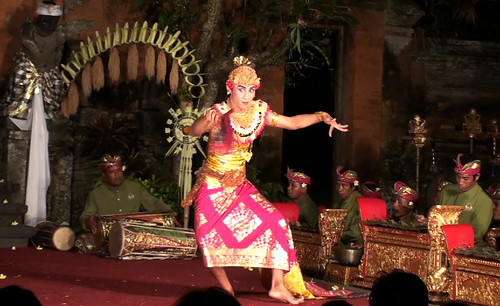
Oleg Tambulilingan, A Dance Performance At Ubud Royal Palace, Bali.


Oleg Tangulilingan, or Bumblebee Dance, is a dance that belongs to a style named Kebyar (Taruna Jaya, the dance I talked about in my previous post, is a Kebyar dance as well). Kebyar dances are characterized by abrupt movements, radical changes in tempo and the requirement of a great ability of expression and energy in the dancer. The Kebyar style emerged in the twentieth century, during and after the golden age of the 1920’s in Bali, when the island became an international spot and foreigner visitors had a decisive influence which resulted in an explosion of creativity among Balinese performing artists .


Ole Tambulilingan was created and choreographed by I Ketut Mario (whom I have mentioned in other posts about Bali (1)), considered one of the pillars of twentieth-century Balinese dance.


Mario dancing Kebyar Duduk (1930's)

According to I Wayan Tibia and Rucina Ballinger (2), Mario created this dance for two young dancers (and later masters) from Peliatan village, I Gusti Raka and I Wayan Rasmin Sampih, when their company was preparing a tour to Europe and the United States in 1952.


Oleg Tambulilingan is a recreation of the bumblebees’s seduction dance. from their entrance to a garden until their final embrace. Within the conventions of Balinese dance the choreography broke with certain established rules, for example, when the woman dancer (it is a male-female couple dance) as a bumblebee “raises her wings” she does it by raising her arms over the shoulders showing her underarms, and no one before had done it.


I’m publishing here a group of photographs (where you can observe very well those dancers’ postures and gestures of hands and eyes), and a video (3 minutes), all from the performance I saw at Ubud Royal Palace in July, 2009.


As a spectator I had a great visual and aesthetic pleasure, both from the the dance and from the music, but that ritual-like feeling I was almost used to when watching performances in Bali wasn’t present; the Kebyar style, in the end, are dances, which recreate parts of Balinese life, through great technical skills and only for the appreciation of the artist.


(1) A special post dedicated to this Balinese master is coming soon..
(2) Balinese Dance, Drama and Music. A Guide to the performing Arts of Bali. I Wayan Dibia and Rucina Ballinger. Periplus Editions. Singapore, 2004.

Tuesday, June 15, 2010

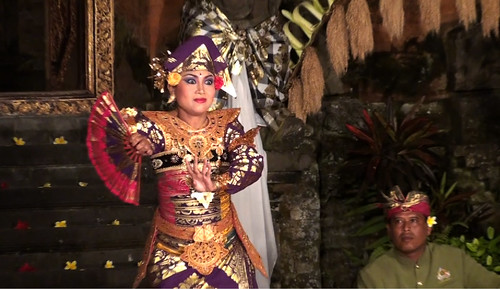
Taruna Jaya Dance Performance at Ubud Royal Palace, Bali.


Taruna Jaya Dance Performance


"Taruna Jaya (The energy of youth). I Gede Manik was a student of Pan Wandres and in 1952 (1) he choreographed Taruna Jaya ("Victorius youth") out of Kebyar Legong. At that time, it was danced by two women, but today it is usually done as a solo. This dance requires immense energy for the numerous changes in speed, dynamics and mood that the dancer must capture.

"Taruna jaya describes many moods of a youth: coyness, bashfulness, irritability, sweetness, and of course, energy. Strong eye movements are a prominent feature, and often include nelik (a wide eyed stare). At one point, the dancer flings her extended kain to the side and sidles up to the drummer to flirt with him. He may either resist her advances or play along. The costume (usually dark purple) uses a headcloth with a unique shape, a log-sleeved tunic and a kain pleated on the left side with the end dangling. There are many moments when the dancer picks up the end of the cloth to emphasize a musical point or mood. She also uses a fan to its greatest advantage."(2)

The version I saw at the Ubud Royal Palace (last July 2009) is practically the same that Balinese usually see in their village religious events.

It was impossible to record more than a few seconds of video and only the photographs can show what it has been described before. I added two more videos (from Youtube), a solo and a two-women version, to give a wider appreciation of this dance.


(1) That's why I don't mention Miguel Covarrubias in this post. This dance wasn't born yet. Covarrubias' last travel to Bali was in 1932.
(2) "Balinese Dance, Drama and Music. A Guide to the Performing Arts of Bali" by I Wayan Dibia and Rucina Ballinger. Page 90.


Thursday, April 22, 2010

A Baris Tunggal Dance Performance at Ubud Royal Palace, Bali.


For more information on Balinese baris dances, see my previous post on the subject:


We have no description by Covarrubias about this type of baris dance because it was not until the mid-twentieth century (Covarrubias visited Bali in the 1930s) that baris tunggal started being danced. The Baris tunggal dance is a deployment of skills and artistic brilliance, it uses all Balinese war dances' codified movements and develops them into a solo performance where the dancer exposes them in as an impressive as the codes of the dance allow. That is why this dance is one of the most beloved in the repertoire of the Balinese and is never lacking in performances for tourists and presentations abroad.


The performance of the tunggal baris dance was part of the dance event (with 8 different dances in total) I saw at the Ubud Royal Palace on July 2, 2009.

Seeing a very young dancer (sometimes the women dance, but this time it was a man) of relatively short stature grow before my eyes during the course of the choreography and project a strength and weight that would be considered proper of mature dancers made me remember (as always in any eastern theater performance) the principles of Theatre Anthropology and in particular the very interesting study by Patricia Carmona "La percepción del espectador": movements and postures based on anthropological principles of the scene, where the body acquires a measure beyond the ordinary and overcomes all its limitations when it begins its creative activity, doing something which for the viewer is "extra-ordinary" and remaining that way forever in spectator's memory.


Like all warrior dances, baris tunggal has some primitive structure that can be recognized in a kind of marking of territory and the exhibition of power through the enlargement of the body-warrior figure-dancer, enlargement that is achieved through the managing of clothing, arms and feet.


On the other hand, the baris tunggal has a unique characteristic, a degree of improvisation, an improvisation in a clear oriental style, where the movements are physical actions that the dancer links as a chain of actions ( an individual montage) depending on the situation or on his creative state. In this sense there is a close relationship between the musicians playing the drum, the ugal (the Balinese xylophone) and the dancer: the musicians watch the movements and changes in the choreography and which the dancer flags with precise signals. They are phrases that the music makes together with movements and, prompted by the change indicated by the dancer so do the phrases (music and choreography) change and are thus recognized by all participants.


A video is probably not the best way to experience it, but it is the closest to share it to those who couldn’t be there. In any case I should clarify that when I see the performance anew through the video, I felt a loss in power of what I would call energy bursts and which the spectator perceives through a movement of the eyes or through a surprise impulse in the movement of the dancer's body, a dramatic projection which, nevertheless, a keen eye recognizes because they are clearly marked in the choreography.

I do not know the name of the dancer and he's probably not one of the stars of Balinese theatre, but the technique of his movement and his mastery offer what I call "assured stage quality”, something that is intrinsic to most of the traditional codified eastern theatre and even to western codified techniques such as ballet (through the body) and opera (through voice): it is watching a performance with actors (dancers or singers) who have been trained for years to make these movements on stage exactly as they must be done; it's an assurance of technical quality.

It’s 9 minutes long, I hope you enjoy it as much as I did.


If you are interested in using any text, image or video from this Blog, please contact the author writing your e-mail and information in comments. (comments are private)
Gustavo Thomas. Get yours at bighugelabs.com