Monday, February 8, 2010

Peter Brook and Robert Wilson. Two masters in rehearsals.


Quickly I'm sharing two notes appeared at the BBC news page.

First, a video, showing 85 years old Peter Brook rehearsing and so making his return to British stage with a performance very much in the style he has worked for years; here's the link:


Second, three AFP photographs (in montage) of images from Robert Wilson last production in Taiwan. The BBC's note says:

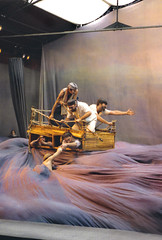
"Actors rehearse for the new theatre production of The Grand Voyage in Taiwan. The show, directed and designed by Robert Wilson, creates a synthesis of theatre, percussion, martial arts and meditation. It was inspired by the story of mariner adventurer Admiral Zheng."


Thursday, February 4, 2010

"Roadkill", a Dance Theatre Performance by Australian Splintergroup at Enwave Theatre in Toronto


Last evening went to see "Roadkill" by Australian Dance Theatre Company Splintergroup at Enwave Theatre, in Toronto. And I'm happy, it was a performance full of suspense, darkness and energy, where fears of the unknown become movement around a car on the road.

Cameras are not allowed inside the theatre, so no photos of the performance itself, but you can see the trailer Splintergroup uploaded in Youtube:


Being on the road, in the middle of nowhere, with a broken car... It seems a perfect extreme situation for a drama, in theatre or in dance, and it was indeed for Roadkill. Splintergroup choreographed (1) simply life and simply bodies going to and coming from the magical universe of fears and unknown realities in Australian outback. I loved those so many ways to narrate with images and sounds; with darkness as a frame. Bodies moved in different realities and everyone of those realities was concrete, touchable for us, spectators. I didn't was scared, I was amazed by entering to them in those worlds of nothing and fading. Two young men (Gavin Weber and Gryson Millwood), one young woman (Gabrielle Nankivell), without names, living interminable terrible moments that maybe never happened.

Of course "Roadkill" is more than a choreography, it is a full representational act of our time.

One thing I love of Australian Performing Arts is that they seem not to have any tradition to follow, as if Australians were born in Performing Arts at the end of 20th century; they don't follow any narrative or style older than those appeared around 70s, when Postmodernism brought a new blow of light to a tired Western theatre.


If you want to listen what they think about their show:


(1) The choreographers are Gavin Webber, Grayson Millwood and Sarah-Jayne Howard.


Saturday, January 30, 2010

Wayang Kulit Balinese Shadows Puppet Theater (2): "The Sacrifice of Bima" (The Performance)


Wayang Kulit Performance: The Sacrifice of Bima.
Wayang Kulit (By Gustavo Thomas © 2012. All Rights Reserved)


Once having explained (with help of a Balinese master, of course) the details of both the Wayang Kulit and the performance I witnessed at the Oka Kartini Gallery on July 19th 2009 (see my Blog post about it: http://gustavothomastheatre.blogspot.ca/2009/12/wayang-kulit-balinese-shadows-puppet.html), we can go on to the filmed material of the performance (which lasted approximately 20 minutes) and my experience there.

Evidently, ancient Balinese and Sanskrit were incomprehensible to me, but not so the sound of the singing (or reciting) and the music, nor the aesthetic visual aspect and the actions (I think in the video you will be able to appreciate it quite well in a manner similar to how I I lived it). Yet, there are some comments that I would like to share with you:


Kayonan


In addition to the characters that were presented in the video in the previous post, you will note the presence of a sort of leaf or butterfly (when it moves); it is a tree, "the tree of life" or Kayonan. It is one of the most important puppets and appears both at the beginning and at the end of each performance: it represents the centre, the life force, balance, which is why negative characters are placed on one side and the positive ones on the other one, with the Kayonan in the middle.


The length and public of the performance


The performance lasted a little over an hour and I noticed something that Covarrubias mentions in his book about public attitudes abroad (1): faced with a lack of understanding of the text and the lack of an ear educated to listen to the sounds of that language and music, they just started to get bored, but not so the Balinese public and some others (including me) that found an interest in them and struggled to keep from falling with the rest, but the common foreign public did fall into boredom. Some children went out to play, but others remained; in the end whole families were leaving the place before the end of the performance.


Covarrubias explains (2) it is not a children's theater, it is a religious drama featuring mythological epics that last 6 to 8 hours, full of beauty and codes that even the more stringent Balinese intellectuals enjoy (3); it is the case that the shadows, fire, song, and puppetry get the Balinese children's attention, but that's just a bonus. Hence its difficulty, hence the apparent lack of interest beyond a few minutes during the performance of almost a fifth of its normal length!

Unlike some Chinese shadow theater companies, the Balinese have not changed their themes and stagings for a child audience, nor do they show just excerpts so small only the fight scenes and acrobatics games are displayed (4). Moreover, Chinese puppets have an unparalleled movement while the Balinese ones may, in some cases, only move their arms (5)


Wayang Kulit (By Gustavo Thomas © 2012. All Rights Reserved)


The Dalang and improvisation


The technique of the Dalang (the master manipulator) is, without any doubt, the same both for this performance as well as for the one he performs inside a temple, and the only fault, if I can call it that, are some comments in English ( "Hello, How are you? Do you speak English?, etc.). that, nevertheless, belongs to improvised moments of comedy that exist in long for-Balinese-only performances too; that comedy is contemporary (with up-to-date jokes), improvised and, as I mentioned, part of the tradition of representing the Wayang Kulit.


The Dalang and battles


As expected, the battle scenes have the most movement and dramatic power of representation, and at some point we lose the awareness that this whole movement is performed by a single person behind the screen, the Dalang.


The puppets and their material behind the screen


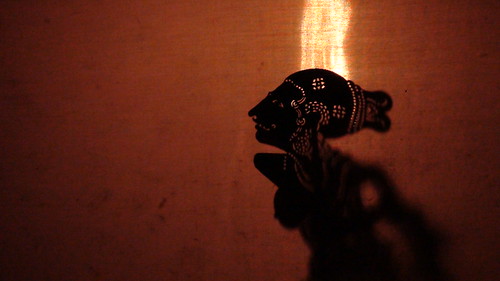
When you see the puppets of the Balinese shadow theatre in the windows of the shops or even in a stack while carried by the company's aides, one cannot perceive the beauty they achieve when they become shadows with help of the lit oil lamp, literally giving them the energy that the Dalang then activates to achieve the movement of life. I had had such an experience in Cambodia, in Siem Reap (6) with this same type of puppets, but that performance was done by children who had developed their technique and who somehow didn't make us see their puppets in the best way possible; but here, with a Dalang (an expert), the images remained in my memory and I remember especially the light passing through the holes carved on the doll as truly spectacular moments.


I personally enjoyed the continuous image of the tree, even more so when it "flies" like a butterfly and goes away and comes back again with the flame of the lamp in the center; in the same manner, the sound of the small Gamelan orchestra (bieng the first time I listened to it beyond restaurants' or shops' background) made me enjoy the show a lot.




About the videos


The performance was about an hour and half long with no intermissions; the numbering of the videos is due to the fact that Youtube does not allow posting more than 10 minutes of material, so I split the performance into three parts (5 if I count the two extras videos, the introduction one and the one of the shots from behind the screen).


Video: Wayang Kulit "The Sacrifice of Bima" (Third part)


(1) Covarrubias "Island of Bali" page 237.
(2) Covarrubias "Island of Bali" pages 234-237
(3) Certain types of stories are performed only for the deity, as is the case with the theater and dance from India.
(4)
My post on a shadow theater performance in Wuzhen, China, is a perfect example of such only-for-kids performances: Wuzhen (II) A Chinese Shadow Theatre Experience.
(5) Some of the puppets from Java's shadow puppet theater can move the jaw.
(6) See my post on three performances of shadow theater in Siem Reap, Cambodia:
Three Shadows Puppet Theatre Plays in Siem Reap, Cambodia.


Texts, photographs and videos in this Blog are all author's property, except when marked. All rights reserved by Gustavo Thomas. If you have any interest in using any text, photograph or video from this Blog, for commercial use or not, please contact Gustavo Thomas at gustavothomastheatre@gmail.com.


Wednesday, January 13, 2010

Hosho Nohgakudo Theatre in Tokyo. A Glance to the interior.


Beginning this 2010 with a nice memory to my visit in January of 2008 to one of the most important Nō Theatre Buildings in Japan, the Hosho Nohgakudo Theatre. I went to see a whole program of Nō and Kyōgen (1), but it was impossible to record any video of it, so I only can show a glance of the building interior; not bad at all I think, specially its traditional stage made entirely by wood.


(1) You can see an example of this kind of program in my post:


Thursday, December 31, 2009

New Year 2010


My best wishes for all of you, followers of this Blog, in this coming year 2010.

Gustavo Thomas

Sunday, December 27, 2009

Photographs of Wei Family Shadows Opera Theatre Troupe Performance in 2007


Two years ago I published a post on a performance I saw at South Gate Space in Dashanzi 798, in Beijing, a performance by Wei Family Shadows Opera Theatre Troupe (1). It was a very interesting example of traditional Chinese Shadows Puppet Theatre; today, after the problem I had with Youtube, re-uploading all my videos, I took advantage of the situation and extracted some still images from those videos and I got a nice group of photographs of the performance. Hope you enjoy.

Slideshow of Photographs


Monday, December 21, 2009

Wayang Kulit Balinese Shadows Puppet Theater (1): "The Sacrifice of Bima" (preliminaries)


The Balinese Shadow Theater or Wayang Kulit is one of the most fascinating spectacles in Balinese culture. As with Chinese drama (Chinese Opera) that originates in the puppet theater of antiquity, Wayang Kulit is probably the origin of several spectacular Balinese dances such as Legong. (1)

Wayang Kulit means shadows and also means leather (2). This shadow play, performed with puppets made of leather (usually ox), is a religious and artistic tradition, like most things in Bali. Based on the Hindu epics The Ramayana and The Mahabharata, it has been, for centuries, a way of telling the people about the origin of the universe and used as a fun way to listen to poetry.

Handled by a single master manipulator, Dalang (at one time considered more than a teacher, a priest), who also provides the voices for all the characters, recites poetry and at times improvises with humor; Wayang Kulit is a real direct line that takes us back to the ancient storyteller, one of the three origins of theater, according to Jerzy Grotowski. (3) The Dalang is accompanied by a small group of musicians, the Gamelan (a traditional Balinese orchestra), all of them behind the traditional screen which, even today, is illuminated by an oil lamp. (4)


As in any religious spectacle each element of the stage has a symbolism: the screen or Kelir symbolizes the properties of life on earth, being stretched between two bamboo poles it in turn symbolizes the universe; the trunk of the banana tree, where the puppets are fixed while on scene but not in use, is Pertiwi or Mother Earth; the lamp itself, Damar, is the sun, with three skeins representing the Hindu gods Brahma, Vishnu and Shiva (5). Positions, entries, and poses of the Dalang himself while handling the puppets, everything has a symbolism and everything must be done with strict control of movement.


Pictures: screen layout and musical instruments


Pictures: Arrangement of the Dalang, musicians and puppets behind the screen.


Bali's artistic life has evolved and changed dramatically with western civilization, but in turn it has been preserved thanks to tourism, which has made its existence a matter of interest to the island. Wayang Kulit has changed the reason for its presentation to an audience: you can have religious performances and business performances, the teachers are the same, the techniques are the same, what changes depending on the type of performance is the length of the representation and the audience; a performance can last all night in a temple and during a festival for mostly Balinese audiences; a one hour long show at any temple or gallery (as in this case), with only tourists and a small group of ever present curious Balinese children.

The performance I attended took place at a gallery-hostel, Okra Kartini, in a stage where there are regular performances of Wayang Kulit before 50 or 60 people. The video bellow shows the preparations for that performance. It shows how the screen was set up and how the music starts, as well as an explanation (in English) that the director of the company gave (in this case not the Dalang, who was behind the screen) about the characters and the story we were going to watch.

There is an additional, very short video that I took at the end of the performance, which shows how the musicians and the Dalang were seated behind the screen.

In the next post I will show the videos of the full performance.


(1) Island of Bali. Author: Miguel Covarrubias. (2) Balinese Dance, Drama and Music. Authors: I Wayan Dibia, Rucina Ballinger. (3) The other two are the man playing ( a game) and the shaman or medicine man. (4) The Chinese, for example, have lost that tradition; in the four years I lived in China I saw no shadow show that was not illuminated with electric lamps. (5) Balinese Dance and Drama ...


Texts, photographs and videos in this Blog are all author's property, except when marked. All rights reserved by Gustavo Thomas. If you have any interest in using any text, photograph or video from this Blog, for commercial use or not, please contact Gustavo Thomas at gustavothomastheatre@gmail.com.


Friday, December 18, 2009

A BBC interview with the quickest Masks Changing performer in China


I've talked before about Masks Changing in Chinese Opera in a post on my travel to Pingyao, Shanxi Province (1). Now I just want to share a nice BBC video about it but in Sichuan Opera: an interview and demonstration with today's quickest masks changing performer in China, He Hongqing.

Click in the link bellow.


Monday, December 14, 2009

Le Dernier Caravansérail. Odysées.


I've just got the DVD of the film "Le Dernier Caravansérail. Odyssées.", based on the staging by the Théâtre du Soleil and directed by Ariane Mnouchkine.

My body shudders every time I remember this production I saw in Paris in December 2004, in that wonderful space Mnouchkine and all members of Théâtre du Soleil have created and established for decades.

The first scene where, in an absolutely cynical game of theatricality, recreates the crossing of a raging river at a border by Afghan illegal immigrants, a crossing that will lead to the uncertain freedom they seek in the West, and it shattered any block I might have had as a theatrical spectator. Magnificent, powerful, loaded with enough real artifice to assume it as real. The actors were in realism (who cares!); their colleagues helped them move, within view of the public, those enormous fabrics and create the raging waves of the river; the sound, loud, clear enough to be recognized as strong winds, as the noise of the running water, and as the force of a great theatre performance that was beginning.

Afterwads, scene after scene and the tragedy of emigration, of cultures in collision, of the humanity of the lost traveler. Humanity, grandeur, cruelty, evil, love, helplessness, sounds of a helicopter, of a train, yelling, crying, letters and nostalgia. I remember so much ...

That Saturday, at the Cartoucherie in the outskirts of Paris, I spent 6 hours with them, with the space itself, with its actors, with their books, with their food, reading from their walls and absorbing their performing art. I had just quit my project for my own theater company a year before, and I had done it for travelling and for the experience of devoting my life to see the world of the stage that I have had the opportunity to find, to see its greatest masters, and I was really thankful for my stay there.

This extraordinary performance lasted nearly 6 hours (including breaks for lunch and dinner), and the final response was not only the heart-felt applause, but the emotion, the crying, the offering of our hearts broken by and open to what they had delivered to us.

That night I rediscovered the loving exchanges of theater, and also the tremendous force of Artaud's words echoed in the presence of the actor in that scene, the blood and dismemberment, but Artaud whimself would have been absolutely amazed at how Le Dernier Caravansérail exposed that through the work, devotion, sincerity and honesty of the effort of all of that (already legendary in my memory) company.

Mnouchkine has remained engraved in my memory as a great director and as an ordinary person: in her theater, before the beginning of her work, she talked to the audience as if to children, hers and of others; she showed us where to sit, how to behave, what to cover with (it was 3 degrees centigrade, with no heating) and at times she scolded us... I saw her gray hair, her face with her big nose and her wrinkles, her hands, her torso thick as a grandmother's, and I was thinking, this is the woman who moved this whole world.

To my mind came the teachers of the independent theater in my country and the world I had known, those messiah (some of them) and parents (most of the others), and recognized her as part of that tradition of the theater company of the world, of travel, of many men, women and cultures and, of course, I loved her with my memories and her present, I loved her as the theatre person I am and as the orphan with no more father-master I was at that time. (1)

The DVD "Le Dernier Caravsérail. Odyssées" is a filmed version, within the theatre scene but released as a film image, which Mnouchkine usually does with each of her productions, perhaps not with the same force that is achieved in real life but as a product that becomes a beautiful example of what one experienced there. I can use my critical sense when watching it (and I'm sure I will), but I prefer to enjoy it first as if someone had edited the memories of one of the most exciting and beautiful moments of my life.


(1) Antonio González Caballero, my teacher and spiritual father, died in May 2003.

Thursday, December 10, 2009

Youtube canceled my account. For some time it will be impossible to see videos published before this date.

I had problems with Youtube because I published some videos which copyright was restricted or because I edited some background music that had rights, I did everything possible to avoid them by changing them, etc, but Youtube did not give me option and canceled my account. I had almost 500 videos, and only 5 had a problem with the video and about 10 with the background music.
It is a pity because all videos (nearly 500) that I posted on blogs (and youtube) are impossible to recover from there (Youtube) they simple erased all, of course most of them are mine recorded during my travels and my visits to the theaters or during my taijiquan lessons in China; so, I have to go to my personal archives and publish them again but it will be a very slow and annoying work.

I'll try to show them as soon as possible.


Sorry for this unfortunate incident.


Gustavo Thomas

If you are interested in using any text, image or video from this Blog, please contact the author writing your e-mail and information in comments. (comments are private)
Gustavo Thomas. Get yours at bighugelabs.com