Monday, September 13, 2010

Trigger Festival 2010: The Honesty Of Cruelty.


On June 9th, 2010, I was invited to a Performance-Party at Raging Spoon, an alternative venue in Toronto. This party was part of the Trigger Festival, an independent art festival focused on alternative ways of living and doing art.

Even though Toronto has a very large alternative community, it is hard for anyone from that community to get a place in this city, a city which dreams of being part of the success of the American way of life (Canadian-style). So, an event like the Trigger Festival was almost unknown to most Torontonians, with almost no publicity anywhere and without any special place in those "what-to-do" magazines. Even then, that night Raging Spoon was almost full of people (around 100, maybe more) looking for some crazy and different performance acts, and they were not disappointed.

Some 10 performance acts were scheduled for that night and two of them deserve my special mention because they were surprising and shocking from my point of view. I wasn't prepared to see anything interesting (I was going to a party), so I didn't bring my cameras and I only could take video and photographs with my iphone, I apologize for the bad quality of the images.


Transvestite, AIDS and a bottle of wine.

First, it was a foreign homosexual man, a transvestite who lives in Toronto, exposing his impotence and his suffering with his AIDS treatment, through a very shocking performance. (See video "first performance")
Here, the act with the actions as I can remember them.

He...

- appears dressed like a woman with a big handbag, with a juice extractor, a bottle of wine , beets and medical pills.
- cuts and prepares some slices of beet for a juice, and puts the pills on the floor.
- extracts the juice while singing,
- opens a bottle of wine.
- takes off his underwear and lies down with his back on the floor.
- introduces the mouth of the bottle into his anus and empties the contents of the bottle while singing.
- shows, in silence, the empty bottle and drinks the last drops.
- puts the glass with beet juice on the floor and, seating close to it, fills the glass with the liquid coming out from his anus.
- shows to the spectators the glasses filled with beet juice and wine from his anus.
- drinks the liquid and swallows the pills.
- cleans perfectly, using his clothes, all the area of the performing space.


A queer girl beaten

Second, a lesbian girl, from Québec, expressing her impotence before the world, the sexism and the incomprehension of society, repeating scenes of her real life when she was humiliated and beaten, inviting the public to shout and to cry if they shared her hate. (See video "second performance")
It is a little more difficult to remember exactly the order of actions but I will try to do it:

She...

- gives spectators a paper (see the photos) with a sentence in English and French inviting to shout or cry if we fell like it.
- listens to (as we do as well) several voice recordings with some men talking about her, about her appearance, her sexuality and in all cases humiliating her, as if everything were fuel for an emotional explosion.
- after several minutes of listening to the recordings she explodes into crying and shouting.
- Another girl enters and holds the first girl's arms while she's shouting loudly, it seems she is  being beaten by some people. Some spectators shout with her.
- falls on the floor, in silence.
- takes two banners with sentences in English and French: "I refuse to be a Victim" and "Thanks to the Queer community"


So, after that evening, I've being thinking a lot about what I saw there.

If we are as honest as those performers were, then those acts would change our perspective of watching spectacles.

Those were no spectacles for themselves, but they were theatrical acts, performing acts, half reality and half staging. Their performers gave a lesson of honesty, yes, but those weren't direct speeches during a real scene of crisis, those acts were also "theatre" and "performance"; we have to remember that they thought what to do on stage and what to show and say to the others; those performing acts walked on the line, on the border, of psychodrama and of personal theatre, they were in part an isolated hysterical impulse of an antisocial human being, and the summon of the creative saint-actor of "le Théâtre de la Cruauté". 

Yes, it was shocking and strange, not professional and not well staged, but unique. You won't see much of this in other parts... It was something terribly "unique".

Then some questions arise: What would happen if they were prepared actors, if they were great acrobats or very well prepared clowns? What would happen if they were educated singers? What kind of spectacle would we see? For sure something unbearable, because art and life together are Zeus' fulminating lightning.

If that combination doesn't happen, there is still the simple performance act they presented, and I think: I would rather see these honest performing acts than dozens of Off Broadways productions or those Toronto American-like plays on King street theatres, but tell me, please, who then will pay for it? who will pay for the honesty of "la cruauté" we saw that evening? Nobody will do it; well, yes, the performer himself, as it was.

It has to be an isolated act, behind the professional life, an alternative act, in a subterranean world, an underground act.

Certainly, it has to be a provocative act but outside the official and codified world of "art".

I love good theatre, good technique, the amazing way technical tradition is shown on Beijing Opera stage or Noh Theatre dramas, the way realist players can manage a character in a Tennessee Williams' play, but I'm also attracted by honesty, by cruelty, by that we can call a "trigger".

There is, undoubtedly, a dichotomy (not a contradiction) in my idea of art appreciation and creativity, but I enjoy that, it is like fuel in my creative life.

There is also a desire... and I won't say what this desire is.


Here, a slideshow of photographs of the whole event; you will recognize the acts I've been talking about.


First Performance


Thursday, September 9, 2010

Antonio González Caballero Photographed in 1999

Antonio González Caballero, 1999
(By Alejandro Yustiaza)


Some days ago Alejandro Yustiaza, a former member of Esférica Ludens, sent to me a whole set of photographs of Antonio González Caballero at his home (and work place) in 1999.

There is something interesting in this set, aside of presenting more images of González Caballero the man, they show to us another González Caballero's home, the last one, in 20 de Noviembre Avenue, very close to the other one, both in México City Historic Downtown. We can see some of his paintings on the background of almost all the photographs of the set, and also we can get a glance of the last place he used to work at, giving lessons and transmitting his Acting Method. 

At that moment González Caballero's body was very weak after suffering several complicated surgeries, and we see him thin and tired; his hands, under the skin, are almost bones and veins, very impressive.

In this post I only share those photographs showing González Caballero alone, next week I will post more, he having a conversation with me and giving lessons.

You will notice that there are some images a little bit dirty or with some scratches, that's because of the time and problems with the digitalization. Be kind.


Tuesday, August 31, 2010

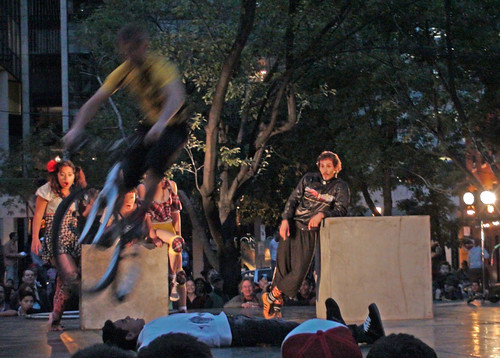
ID, A Cirque Éloize Performance at Toronto Buskerfest 2010

Cirque Éloize performance at Buskerfest 2010 in Toronto

Yes, I finally could see a Cirque Éloize performance, and it was during this Toronto Buskerfest 2010. For many years I was trying it but always something happened stopping me to go. 

ID is the name of Cirque Éloize's last spectacle, and it is all around street acrobatic acts, much of it with street dance (Capoeria and hihop styles), bicycles, street climbing, etc. It seems that it has been a great success in its natal Montréal and they are trying to expand that success to Toronto and all over Canada. 


The Toronto Buskerfest Cirque Éloize's performance I saw was only a 30-minute extract from the original spectacle (originally for an inner stage and not for street festivals), but it shows many of the impressive acts included in it: some street acrobatic dance, a play with a hoop, and acrobatics with a bicycle. Well, I said impressive acts, when actually there were not as impressive as they should be. After have seen the video you will agree with me that this was not the best way to introduce a very interesting modern circus company to any public, many of the movements during this performance had no strength nor projection, and some parts were almost bad performed. I guess it was because this wasn't the original performing plan and they were very aware of the danger of working on a stone stage; even do the bicycle acrobatic act is surprising and well done.

Now I'm looking forward to see this company performing on a theatrical stage (in October this year), and then add my opinion to that of many others who have seen Cirque Éloize before, that they are an amazing modern circus company with the similar level of quality than its big brother, Le Cirque du Soleil.


Friday, August 27, 2010

Sau'rus, A Close-Act Theatre Performance at Buskerfest 2010 in Toronto

Sau'rus, A Close-Act Theatre Performance at Buskerfest 2010 in Toronto

Street Performers from all over Canada, and some others from other parts of the world, gather every year in Toronto at Buskerfest. Close-Act Theatre, a Dutch Street Theatre group performed yesterday (August 26th, 2010) SAU'RUS, a spectacle where 3 actors on stilts and dressed like dinosaurs, walked all around St. Lawrence Market and beyond, playing with the public and posing for some great photographs.


Pretty impressive images, with no story at all, but they gave lots of fun and movement to this usually static festival.

I saw two performances, one during the day (at 4 PM) and other one during the evening (at 8 PM), so you have two videos to watch. Enjoy.


Wednesday, August 18, 2010

Teaching without pupils... A poem from the Brechtian's exile.

Brecht during his exile in Denmark. Seated close to him, Hellen Weigel.


Sometimes life outside your country and your artistic field seems unbearable, sometimes is only a melancholic sentiment of emptiness and impotence.

These poems (quoted by Hans Burger) were written by Brecht during his exile in Denmark:


 "Teaching without pupils/

Writing without fame/

Are difficult."


"There speaks the man to whom no one is listening:/ 

He speaks too loud / 

He repeats himself / 

He says thing that are wrong: 

/ He goes uncorrected."


Thursday, August 5, 2010

The legal prosecution of Art...

The precept of point 25 of the Nazi Programme of 1920, stated: 'we demand the legal prosecution of all tendencies in art and literature of a kind likely to desintegrate our life as a nation' ... but I listened and read that during my 4 years living in China!

What is this?


- Posted using BlogPress from my iPhone

Monday, July 26, 2010

Topeng Tua Dance Performance at Ubud Royal Palace, Bali


Topeng Tua Dance is part of a group of mask dance-dramas in Bali named Topeng, which literally means "to close or press against the face"(in reference to the use of a mask, of course). Covarrubias depicts these dances as "masked actors playing local historical plays (babad); mostly pantomime, but with dialogue by the comic characters"(1) 


According to I Wayan Dibia and Rucina Ballinger "Topeng is done for Odalan (temple festivals) and a myriad of other rituals. In a traditional performance, five men play all the roles (called Topeng Panca, meaning "five dancers") simply by changing masks and headdresses. The drama begins with the panglembar or introductory characters who pave the way for the entrance of the king. The dancer show off his virtuosity through pure dance movements. The three most popular masks are Topeng Keras, a strong primer minister character with red or brown face denoting strength and courage; Topeng Keras Bues, strong yet goofy with bulbous eyes and large, humorous movements; and the beloved Topeng Tua, an old man who remembers his youth. He stumbles, wipes the sweat off his brow, breathes heavily with exertion and blows his nose"(2) It is a long ritual dance-drama festivity where these three characters, the king and clowns interact with the people in a rather comic way.


That evening at Ubud Royal Palace's stage, in July 2009, I only had the opportunity to see the Topeng Tua Dance, the dance of the old men remembering his youth, a short choreography (6 minutes) among the 9 other dance performances, so it was only a small bite of the Topeng dances. From my point of view it wasn't the best choreography of that night, especially after have seen the Legong Kraton and the Baris Tunggal dances, but it kept my attention very well and I enjoyed it.


You will see in the video I recorded how the old character, Topen Tua, as they said (I Wayan Dibia and Rucina Ballinger) "stumbles, wipes the sweat of his brow, breathes heavily with exertion and blows his nose", but also how he picks up a head lice from his white long hair, kills it with his finger nails and then shakes it off his fingers only to come back to his hair and pick another one. I have no information about weather this was a change of the original dance or simply our writers didn't want to embarrass anyone mentioning it as a part of the choreography. I can remember the same kind of actions missing in narrations of Chinese Theatre by Chinese writers in reference to spitting. 

What it is remarkable in the technique of this dance is the continuous use of codified movements and series of physical actions with a minimum of improvisation, what it seems to be one of the secrets of its every night success.


Monday, July 19, 2010

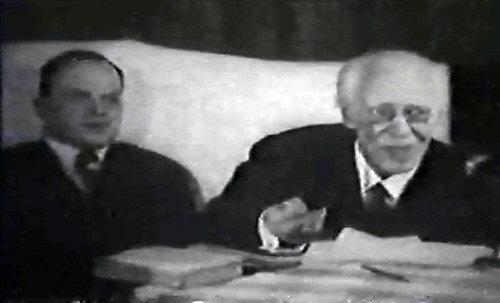
Stanislavski during a Rehearsal of Tartuffe (Original film)

Stanislavski in Rehearsals


Searching about the Moscow Art Theatre golden era I found an original Soviet film, now digitized, showing an old Constantin Stanislavski directing Tartuffe. The film is interesting because it also has the voices recorded. For many of you, I am sure, it will be the first time to listen to the master and his way he  used to answer some questions from his actors.

It is a pity I can not translate this into English. I found a very kind Spanish girl who translated into Spanish (you can found that video in my Blog in Spanish) if that works.


Monday, July 12, 2010

The Hitler's Technique of Saying a Political Speech


Reading "The Coming of The Third Reich" by Richard J. Evans I found a very curious paragraph dedicated to Hitler's technique of saying a speech during his early years as a politician (that means, the technique which brought him to success). Even if this short historical analysis is important to understand how Hitler influenced through his speech some millions of Germans and many other millions around the world in that moment of history, it is also an interesting example of speech technique as simple as that, and more, it is written in a very practical way by Evans, so, very functional for actors and orators as well (if you don't have some moral and political issues from past decades, of course):

"While conventional right-wing politicians delivered lectures, or spoke in a style that was orotund and pompous, flat and dull, or rough and brutish, Hitler followed the model of Social Democratic orators such as Eisner, or the left-wing agitators from whom he later claimed to have learned in Vienna. And he gained much of his oratorical success by telling his audiences what they wanted to hear. He used simple, straightforward language that ordinary people could understand, short sentences, powerful, emotive slogans. Often beginning a speech quietly, to capture his audience's attention, he would gradually build to a climax, his deep, rather hoarse voice would rise in pitch, climbing in a crescendo to a ranting and screaming finale, accompanied by carefully rehearsed dramatic gestures, his face glistening with sweat, his lank, dark hair falling forward over his face as he worked his audience into a frenzy emotion. There were no qualifications in what he said; everything was absolute, uncompromising, irrevocable, undeviating, unalterable, final. He seemed, as many who listened to hi early speeches testified, to speak straight from the heart, and to express their own deepest fears and desires. Increasingly, too, he exuded self-confidence, aggression, belief in the ultimate triumph of his party, even a sense of destiny. (...)" (Page 172.)


Of course today that "school" of speech technique is absolutely recognizable and very bad received if used in similar way, it was the summit and the final of its kind (as powerful as it was), but it is still a theatrical technique, a way to produce some reactions from spectators through voice and gestures. A colorfoul analysis should be done it that sense, but not by me, I only wanted to share this curiosity.

As many have said before me, theatre and their techniques can be used to transform real life over and over again, but remember that they are theatre techniques at the end.


Note: I'm not embedding any video of Hitler speeches because all of them are propaganda edited by the Nazi government or by actual followers, so it wouldn't show the technical line Evans wrote about. 


Wednesday, July 7, 2010

"Atmósfera de lugar." Antonio González Caballero's apartment in 1996.


ATMóSFERA DE LUGAR. El departamento de Antonio González Caballero en 1996 on Vimeo by Gustavo Thomas


On Wednesday February 11th 2009 I received an email from Ángeles León, a student at Antonio González Caballero's workshop during the nineties, in response to my post of February 10th 2009 about the apartment where González Caballero had lived for over 50 years and its mural paintings inside. This is the Ángeles León's mail (with the Spanish  original):


"Hi Gustavo,

Greetings.

I'm Ángeles León. I studied under González Caballero from 1992-1996. I experienced the teacher's moving from Pino Suárez Avenue to 20 de Noviembre Avenue. I have a video with all the murals of the apartment at Pino Suárez.

I do not know if someone's already written to you about this, but the murals were destroyed by the building's owner. He even told that to the teacher personally, his words were "it gave us so much pleasure to destroy them, we threw paint, crap and more on them." Whether this is true or not, we were with our teacher in those days and we took it for true that the murals were destroyed. The teacher was depressed for several days. Then he started painting black and white pictures, where some of the faces were similar to those in the murals and the teacher himself said that they represented the suffering of the murals at the time of being destroyed. They were very expressive faces, grotesque and large. He made several paintings in that style.

The building was being renovated inside to turn it into a place to rent offices. Even the master used to greet the workers, until the turn to remodel his apartment arrived and that was when they took him out. After that, everything stopped, as you can imagine.

That's it. I send you a big hug.

Sincerely

Ángeles León

And it was not until a few weeks ago, nearly a year and a half later, that I received a new email from her announcing the digitization of the video she had mentioned before, and with that news the possibility to edit it and publish it on the Internet.

Why do I think this video is so important?

First of all it is a personal matter: González Caballero was my teacher and friend, and in many ways he also was a father to me. Furthermore, his apartment at 36th Pino Suárez Avenue was where I was educated in theatre for 9 years, it was the place where I learned acting, and the place where I decided to start writing and then to develop my own concepts of stage direction and my interest in researching about performing arts. What is impressive, I am sure, is that I was not the only one that experienced big changes there: generations of actors, playwrights and directors who passed by his acting workshop did, as well as friends and strangers seeking help in their professional work.

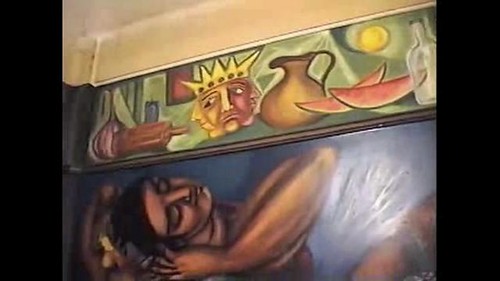
González Caballero's apartment was as peculiar as a place where an artist, a painter, a writer and a teacher has lived can be: a place that becomes home, meeting room, rehearsal room, painting and sculpture studio, art school, etc. Its rooms were galleries of paintings by González Caballero as well of paintings by his mother, who in the last 20 odd  years of her life was entirely devoted to painting; he also had a small collection of original prehispanic pieces and paintings by other artists of his generation. In his dinning room there was a mural painting on two entire walls showing images that would be identified with the best of the so-called Mexican school of painting (Escuela mexicana de pintura), of which he was an heir. Other paintings had been done on the wall of the main hall too.

As it was explained in the mail from Ángeles León, those murals were destroyed; once González Caballero left that place, all that remained of them was scattered memories and some photographs.

For several years I have tried to gather visual information on all of Gonzalez Caballero's paintings, including those lost murals, and I have been able to publish a series of photographs in some sites like Picasa and Flickr, and I wrote a post in this Blog about the murals with photos by Lis Valadés, also a student at the acting workshop during the 90s.

So far there had been no more, till now.

"Atmósfera de lugar. El departamento de Antonio González Caballero en 1996" (Atmosphere of a place. Antonio González Caballero's apartment in 1996) is the name I have given to the edited version I made from the original video (digitized from a VHS) that Ángeles León gave to me. "Atmósfera de lugar" is also the name of one of the  acting technique "Apoyos" that was taught in that apartment, and anyone that knows about it recognizes that there exists a world with the physical space we live or work in, as well as a history with the place that changes depending on the experiences with the place itself. The video, from my point of view, seeks to recreate the feeling the apartment left in all of those who were educated there, that somehow lived there, and that maintain an inner atmosphere of the place that made it so special.

In the eyes of a stranger unrelated to the work or to the person of González Caballero, this is a curious-eye walk through a unique place, and certainly an aid to those who want to venture into the knowledge of the life and work of this Mexican artist .

The music I used for editing the video is the work of "Bosques de mi mente" (www.bosquesdemimente.com), who very kindly accepted the invitation for his music inclusion. His musical pieces really fit into my idea of that atmosphere that is created in our physical and mental recall, and in conjunction with the video the images acquired great strength and depth.


If you are interested in using any text, image or video from this Blog, please contact the author writing your e-mail and information in comments. (comments are private)
Gustavo Thomas. Get yours at bighugelabs.com