Friday, February 18, 2011

The Far Side of the Moon (La face cachée de la lune) by Robert Lepage, at The Grand Theatre of Quebec


Last February 10th, 2011 I saw the mythic Robert Lepage's creation "La face cachée de la lune" (The dark side of the Moon) at the Grand Theatre of Quebec, Canada. I simply could corroborate that Lepage is a great storyteller and a great stage director; he theatrically knows how to deal with our age and how to use its different languages.


Here a video from Youtube showing some extracts of the play (in French as I listened to it in Quebec)


Monday, February 14, 2011

"La danza del padre" Fourth movement: Le père au foie douloureux.


We see you seated with your feet lying up, we expect something from you, but we don't know what.You've been there, maybe for hours, something hurts and you scream at times.
Your hands push your liver and your face is seized with unbearable pain.
You talk with God, you have a conversation with him but we only can listen to you.
You ask God to let you to continue your mission, you shout that you need time to doing it in peace.
What mission, Dad? What mission God entrusted you?
You have your audience, you know, it's your theater, we are your children;
is your death scene again.
In a few days you'll have surgery because you have stones stocked inside you.
A grain of truth in your ever invented dance of death.


Thursday, February 10, 2011

íslenska óperan. The Icelandic Opera Theatre.

íslenska óperan (By Gustavo Thomas 2010)


There is a new one in construction and it will be fantastic, but the old íslenska óperan building got its own charm. It remembers me those 1900's provincial theatre buildings in my native Mexico (the Icelandic Opera building was built in 1928). 

Sorry, only exterior images of it. As I said in my past post about Iceland, I went there in a very good time for tourism but in a very bad time for performing arts, all the theatres were in Summer pause.


The new opera house in construction (July, 2010)


(All photographs by Gustavo Thomas. All Rights Reserved. 2010)


Sunday, February 6, 2011

"La danza del padre" Third movement: Le père emmène le frère au cimetière.


My brother will die and my mind edits the memory of it:
You are taking him to somewhere, 
he is weak and ill.
No matter where you took my brother in real, he never returned to us.
You take him to the cemetery, that's what I see.
You do not cry, but I only can see your back.
Maybe I see this scene as others of your lies,
where you were acting and made us believe that you had died.
The truth is harsh and also creates lies in me.

Wednesday, February 2, 2011

Þjóðleikhúsið (National Theatre of Iceland)

Þjóðleikhúsið (National Theatre of Iceland) 2010.


As part of my continued desire for sharing travels and experience, I publish today one video and some photographs of Þjóðleikhúsið, The National Theatre of Iceland, a beautiful building from the 1950's in Reykjavik. The theatre was designed by Guðjón Samúelsson, and was formally opened on April 20, 1950.

I was in Reykjavik in the Summer of last 2010, an amazing travel, plenty of good memories. It was sad that, during all July, none theatre is open in Iceland; so, I only took images of the exterior, but I am sure they're worth watching them.


Saturday, January 29, 2011

"La danza del padre" Second movement: Le père au coeur.


You have screamed and beaten, one of your children has fled from you.
You have fallen touching your heart with one of your hands, you're hurt and you're suffering; touching the wall with your other hand, you seem to want to stop the world with it.
We, brothers, cried; now, scared, we see our father fall.
We, as spectators, believe in your death.


Wednesday, January 26, 2011

"La danza del padre" First movement: Le père qui danse


I remember you falling because of the wind passing by the window, 
you screamed as if you said a word in other language, French perhaps (you didn't speak French). 
I didn't want to hear you cussing. 
You said your back was broken... 
I saw it all.


"La danza del padre", A Theatre Project Step By Step.

From now on I'm going to post every valuable step of my new theatre project "La danza del padre". The origin of this project is very simple: my memories of my father's actions around his hypochondria. 

I've called it "La danza del padre" because those memories usually come to me as physical and vocal actions and with the time they has been edited one by one in my mind, exactly as they were part of a choreography built inside me.

I love the idea of this stage process, and I'm aware of the possible pain it can provoke to me, but also of the artistic pleasure I can get from it, so it is fair I guess.

My last project (Asylum) failed because it depended of others to its realization, now it only depends of my own work, creativity and desire.

¿Do we start working?

Thursday, January 20, 2011

The Stage Director in Roberta Carreri's defintion.


Roberta Carreri, the Odin Teatret Actress, defines in her book Tracce the work of the stage director, in this case Eugenio Barba, based on her experience with the creation of Judith.

This definition is particularly interesting for us, people of the theatre, and specially for those dedicated to exploring the actor's technique. Roberta Carreri speaks about her own director, with whom she has worked in a unique, respected, successful and absolutely alternative theatrical style (or school) for more than 30 years:

(A stage director) is the person that during weeks, months, years, struggles to infuse life to the spectacle, first defending the actor's creativity, and then following his own creative logic to guide the sensorial voyage of the spectator.


Of course Roberta Carreri didn't write the definition per se, she just wrote about her acting experience and about her director, and this is what I extracted from it.

The original text in Italian says: 

(Talking about the process of Judith...) "Per settimane, messi, anni Eugenio ha lottato per infondergli vita, difendendo in un primo periodo la creatività degli attori, e poi seguendo la sua logica creativa per guidare il viaggio sensoriale dello spettatore.(1)


I like to get some definitions this way, because it always refers me back to my own creative interests, it works for my own growth; these are points of reference coming from others' experiences, from others who are the masters of my theatrical world.


(1) "Tracce. Training e storia di un'attrice dell'Odin Teatret." Roberta Carreri. Il Principe Costante Edizioni. Milano, 2007.


Thursday, December 9, 2010

An Obituary from the Empire... The Death of Riszard Cieslak according to The New York Times.


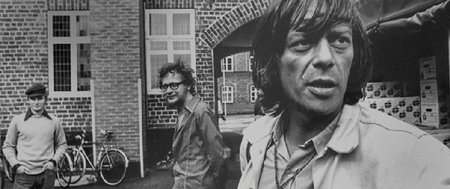
left to right: Stanisław Ścierski, Jerzy Grotowski, Ryszard Cieślak; Holstebro, Denmark, 1970
photo: Andrzej Paluchiewicz


While trying to write a poem to Ryszard Cieslak, and doing some research about him, I found the The New York Time's obituary dedicated to Cieslak's death in June 16th,1990. You have to read the paragraph about the theater critics' opinion of him...


"Ryszard Cieslak, Actor, 53

Published: June 16, 1990

Ryszard Cieslak, an actor and a central figure in the Polish Laboratory Theater, died Thursday at the Burzynski Research Institute in Houston. He was 53 years old and lived in Manhattan.Dr. Stan Burzynski said that Mr. Cieslak had been admitted to the institute June 5, and that he died of lung cancer.Mr. Cieslak joined the Laboratory Theater, which Jerzy Grotowski founded in 1959 in Poland as a vehicle for experimental drama, in 1962. After its dissolution in 1977, Mr. Cieslak and Mr. Grotowski worked together in numerous dramatic projects.Theater critics cited Mr. Cieslak in 1969 as Off Broadway's most outstanding creator and the actor with the greatest promise.For the last four years, Mr. Cieslak taught acting to advanced students at the Tisch School of the Arts at New York University."


"in 1969 as off Broadway's most oustanding creator and the actor with the greatest promise" ... Those God-like critics were very grateful with Cieslak in 1969, but there is nothing concrete about a final valorization of his work in 1990.

Even when The New York Times is one of my favorite newspapers it doesn't mean I see this journal as outside the American empire's media world, and it is a big part of it, of course. This newspaper has been one of the main promoters of American realism and a Broadway style of doing theatre since its beginning, almost erasing (in its own version of performing arts history) any other kind of style or exploration coming from other parts of the world.


If you are interested in using any text, image or video from this Blog, please contact the author writing your e-mail and information in comments. (comments are private)
Gustavo Thomas. Get yours at bighugelabs.com