Friday, March 23, 2012

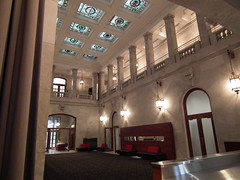
Puppet Museum (Museu da Marioneta) in Lisbon.


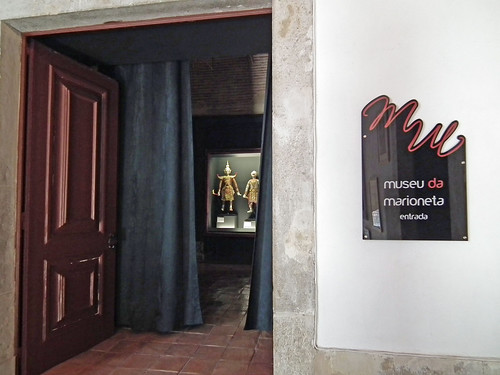
Museu da Marioneta (Puppet Museum), Lisboa. (Lisbon. 2011)
Puppet Museum (Museu da marioneta) entrance in Lisbon. (By Gustavo Thomas. 2011)


I know, I did travel to Lisbon at the end of September 2011, but as with many other experiences in my travels I could not share it when this happened. To every thing its time comes.

That visit to Portugal was a total delight, and although I did not see a single play or dance performance (I remind you that I actually went to a party to Andalusia, where I would give my first presentation of Butoh to a live audience), there were some "performance" experience worth sharing. One of these experiences has already appeared in this Blog: Hieronymus Bosch painting "The Temptation of St. Anthony", a masterpiece at the National Art Museum in Lisbon. Today I offer you a second one I consider interesting to share: the pictures I took inside the Puppet Museum in Lisbon (Museu da Marioneta).

Lisbon is a city of lovely and very old neighborhoods, we can walk among streets with Roman ruins, Islamic period buildings, medieval churches or, especially, Portuguese imperial era squares and palaces, take a charming tram or even a street elevator to a "miradour". Yes, walking is the best way to know and enjoy the city. So in one moment you get to discover the beautiful facade of the former Convent das Bernardas, a seventeenth century building (today completely remodeled) that now houses the Museo da Marioneta (The Puppet Museum).

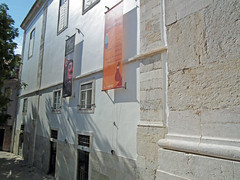
Museu da Marioneta (Puppet Museum), Lisboa. (Lisbon. 2011)
Puppet Museum in Lisbon, former Convento das Bernardas. (By Gustavo Thomas. 2011)

Of course, inside the tourist guide a museum dedicated to puppets does not have a big role but even though I wanted to visit it; I had the wrong idea (read somewhere before my arrival) that Asian puppet tradition entered though Portugal and its influence caused the development of puppet theater in Europe, so I wanted to see those objects-documents (the puppets) who testified that idea. As I said before it was not an entirely correct information: yes, there is a whole ancient tradition of puppet theater in Portugal but there is no great evidence of ancient Asian influence in it; the Portuguese Puppet tradition comes originally from the southern province of Alentejo, with the puppets of Santo Aleixo, which were very famous in the late eighteenth century, currently enjoying a renaissance in the same  Portuguese province with performances, festivals and exhibitions of ancient collections.

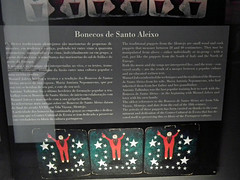
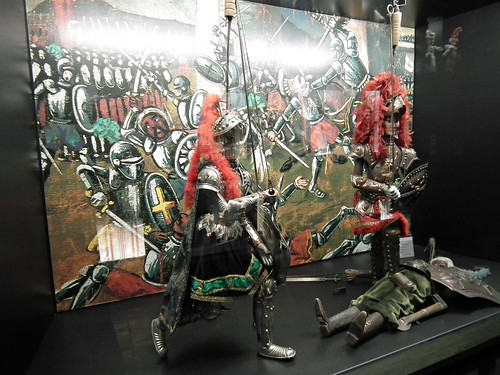
Museu da Marioneta (Puppet Museum), Lisboa. (Lisbon. 2011)
Boneços de Santo Aleixo, Puppet Museum in Lisbon (By Gustavo Thomas. 2011)

My visit to this museum in Lisbon could not be what I was expecting at first but it paid off, I enjoyed  the big collection of puppets from around the world on display, as well as the curious creations of several Portuguese Puppet theatre companies of the twentieth century, especially by the promoter for the realization of this museum, the puppet company of S. Lourenço.

As I'm used to do, I'll show you the more interesting pictures (in my point of view, of course) but you have in the end a slideshow with all of them; in the same way you can visit flickr.com and open the album (following the link from each photo) and see them with more calm on that site.

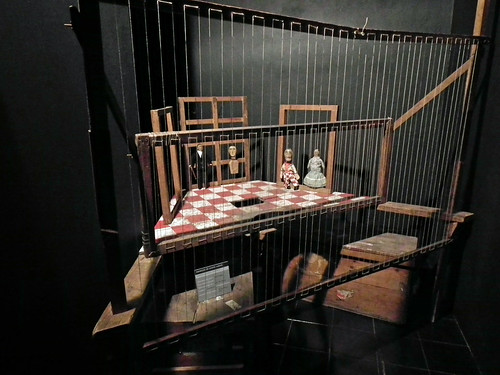
Portuguese Puppet Theatre Stage at Museu da Marioneta (Puppet Museum), Lisboa. (Lisbon. 2011)
Stage of traditional Portuguese puppet theatre. Puppet Museum in Lisbon (By Gustavo Thomas. 2011)

Portuguese Puppet at Museu da Marioneta (Puppet Museum), Lisboa. (Lisbon. 2011)
Portuguese puppets from beginning of twenty century. Puppet Museum in Lisbon (By Gustavo Thomas. 2011)

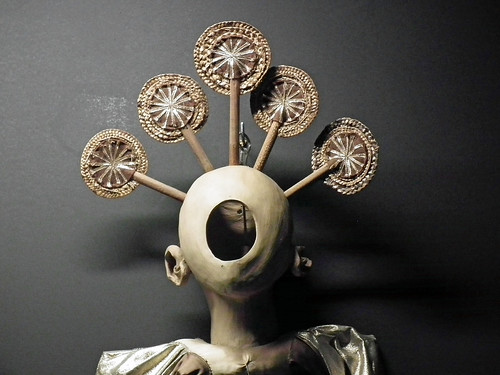
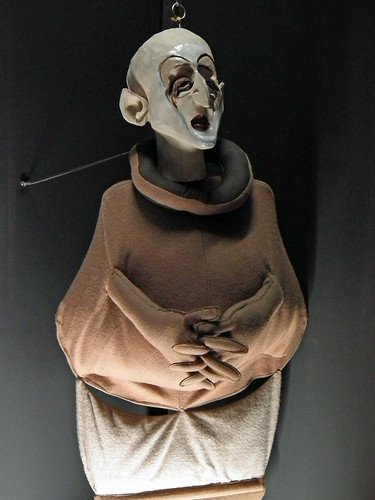
Portuguese Puppet at Museu da Marioneta (Puppet Museum), Lisboa. (Lisbon. 2011)
Modern Portuguese Puppet. Puppet Museum in Lisbon (By Gustavo Thomas. 2011)

Portuguese Puppet at Museu da Marioneta (Puppet Museum), Lisboa. (Lisbon. 2011)
Modern Portuguese Puppet. Puppet Museum in Lisbon (By Gustavo Thomas. 2011)

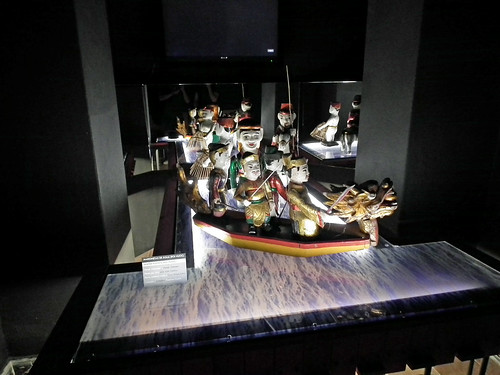
Vietnamese Puppets at Museu da Marioneta (Puppet Museum), Lisboa. (Lisbon. 2011)
Vietnamese aquatic puppets. Puppet Museum in Lisbon (By Gustavo Thomas. 2011)

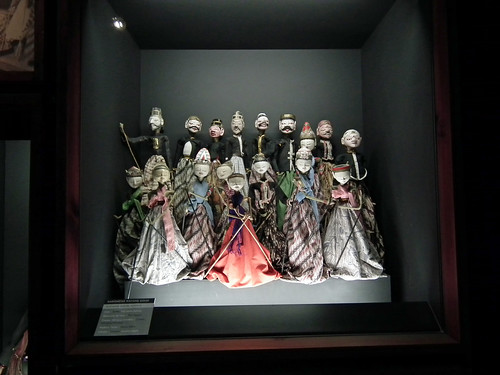
Indonesian Puppets at Museu da Marioneta (Puppet Museum), Lisboa. (Lisbon. 2011)
Indonesian puppets. Puppet Museum in Lisbon (By Gustavo Thomas. 2011)
 
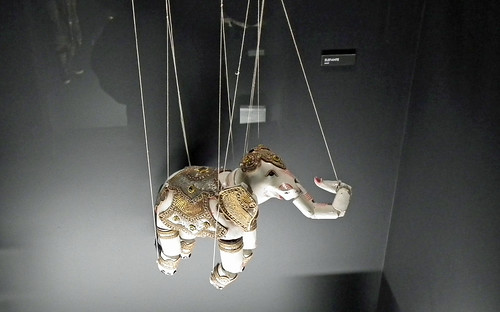
Indian Elephant Puppet at Museu da Marioneta (Puppet Museum), Lisboa. (Lisbon. 2011)
Indian elephant Puppet. Puppet Museum in Lisbon (By Gustavo Thomas. 2011)


Texts, photographs and videos in this Blog are all author's property, except when marked. All rights reserved by Gustavo Thomas. If you have any interest in using any text, photograph or video from this Blog, for commercial use or not, please contact Gustavo Thomas at gustavothomastheatre@gmail.com.

Friday, March 16, 2012

Henrik Ibsen advices to a young writer.


Laura Petersen (Later Laura Kieler)

 
In 1870 he was not at the peak of his career but he was already famous and a controversial writer, a good poet and was on his way to becoming an European personality; around his 40s Henrik Ibsen could receive letters with texts of new born writers, especially women writers.
Laura Petersen, a Norwegian young writer, published a kind of sequel to Ibsen’s poetic play Brand entitled Brand’s Daughters. Michael Meyer, Ibsen’s biographer, depicts this text as “an imaginary sequel (...) an emotional contribution to the debate on women’s rights”. Today we recognize Ibsen as a 19th century champion for women rights (thanks to some of his plays of maturity), but in that time, around 1870, that wasn't a very easy subject for him.  In fact, he wasn't a very open minded man about that: when he was younger and living in Italy he asked for the expulsion of some members of the Scandinavian Club in Rome who let their wives enter to the club (reserved only for men) without being noticed; and years later he used to have some lively debates with Camilla Collet, a Norwegian novelist recognized by her fighting for women rights; Collet, following Meyer’s text “... was scandalized by what she regarded as an old fashioned man about ideas on women’s place in society”.

So, when Laura Petersen sent to him her Brand’s Daughters asking for advice, one could only expect the letter would be ignored or at least rejected in a polite way.  But no, something happened to Ibsen when young women writers approached to him asking for advice.  Suddenly, the gentleman surged from him,  and a patient and kind wise man always replied. Thanks to that attitude towards young women artists we can now read a document with some advices, coming from his own hand, directed to a young writer.
Letter to Laura Petersen (June 11, 1870):
"Are you thinking of continuing to write? (…) Much more is needed than mere talent. One must have something to create from, some genuine experience. If one lacks that, one doesn't write in the true sense, one just makes books (…) Intellectually, man is a long-sighted animal; we see most clearly from a distance; details distract; one must remove oneself from what one wishes to judge; one describes the summer best on a winter's day (…) The main thing is to be true and faithful to oneself. It is not question of willing to go in this direction or that, but of willing what one absolutely must, because one is oneself and cannot be otherwise. The rest is only lies." (*) 

Laura Petersen never went out from Ibsen's life, both were linked for ever; she married later and her name changed to Laura Kieler, and a terrible real anecdote with her husband was Ibsen's inspiration for A Doll's House; Nora Hellmer was modeled on this young lady who was thinking on women rights since her adolescence.

Ibsen, with the honesty and wisdom his letter shows, was not only a good mentor to Laura Petersen but a prophet of his own future way to work.


(*) Henrik Ibsen Biography. By Michael Meyer. Page 320.


Texts, photographs and videos in this Blog are all author's property, except when marked. All rights reserved by Gustavo Thomas. If you have any interest in using any text, photograph or video from this Blog, for commercial use or not, please contact Gustavo Thomas at gustavothomastheatre@gmail.com.


Sunday, March 11, 2012

"At the other half upon the journey of my life...

This was during my last rehearsal in November 2011 (Gustavo Thomas. 2011)


Blogs, I know, no longer are, in the hyper fast and ephemeral world of internet, the only way of personal contact between the author and his readers, but in my case they may be the only way to stay a little longer in the reader's memory (digital memory) than is achieved with an update on my professional facebook page or the seconds following the publication of 140 words in my twitter.  My theatre blog here on Blogger remains a recurring place for those who want information about me, my work and my dreams themselves as creator and as a person. In that sense I now use it after so long an absence.

For several months I've been away from my professional life as a theater watcher and narrator, as a writer and practitioner on the scene, and that's been due to the "overwhelming" need to stay almost motionless and due to being engulfed an altered state of my mind with powerful pain medication that would not let my head function normally and coherently.

In early January 2012, after two months of clinical tests and an annoying illness, I had to undergo neck surgery to get rid of two huge blood clots that had become completely infected all around. The cause? A Butoh exercise performed with extreme depth and concentration (in excess), coupled with a lack of medical care; the specialist's confusion led him to delay longer than he should have in trying to discover the cause (and possible consequences) of the lumps in my neck, without realizing the dangerous infection that developed unhindered by medication for almost a full month. The surgery, an emergency one, fast and simple, was quite successful, but recovery has been long and painful. The healing of the wound, which in English is called "packing", consists of keeping the wound open until it heals "itself" helped only by daily changes of dressings that fill the gaps to try to maintain the skin moistured and prevent the closing of the wound too soon leaving gaps that may cause other abscesses in the future.

Two months have passed so far and I can barely see the beginning of the end of the healing process; although it hasn't closed completely, the wound is already healed by some 90% and I hope that in about two weeks it will have healed fully.

This unfortunate event interrupted a very interesting part of my creative life because I was immersing myself in the creation of my first professional Butoh performance; after nearly two years of study and practice I was at the right time to start.  Also, the very long process of publishing the book of the Acting Method by Gonzalez Caballero had to come to a stop (I'm at the end of 25 years of work with this book), as well as my current analyses on my theatre and acting techniques blog that follow from the work of the four authors proponents of this method of acting: Ibsen, Strindberg, Chekhov and Pirandello. That which I was able to continue was my practice of painting and drawing in digital format, and thanks to the altered states of my mind caused by medicine and pain, the writing of poetry.

I restart my professional work slowly and with new energy, without fear of cliché, I promote in me the idea of a renaissance: and I am clearly walking in the other "half of the road of life", outside of that dark and ominous forest in which I fell for many moments of uncertainty and pain.


Thanks for following and staying close.


Gustavo Thomas
Toronto, Canada
March, 2012.


Texts, photographs and videos in this Blog are all author's property, except when marked. All rights reserved by Gustavo Thomas. If you have any interest in using any text, photograph or video from this Blog, for commercial use or not, please contact Gustavo Thomas at gustavothomastheatre@gmail.com.

Sunday, January 8, 2012

Ibsen, the anarchist, speaks about Freedom


Here a very short quotation from an Ibsen’s letter to Georg Brandes (1872) where the Norwegian poet complain about the misconception around his texts over his idea of freedom. The text shows an Ibsen much more closer to Anarchism than to any liberal believes:

"I shall never agree to identify Freedom with political freedom. What you call Freedom I call freedoms, and what I call the battle for Freedom is nothing but the continuous pursuit of the idea of Freedom. He who possesses Freedom otherwise than as something to be striven for possesses something dead and meaningless, for by its very definition Freedom perpetually expands as one seeks to embrace it, that if, during the quest, anyone stops and says: "Now I have it!" he shows thereby that he has lost it." (...) "The state must be abolished!" (...) "There's a revolution to which I gladly lend my shoulder. Abolish the conception of the state, establish the principle of free will and all that is spiritually akin to it as the one prerequisite for a universal brotherhood-there is the beginning of a Freedom that is worth something!" (*)

Of course, a text that didn’t help to change the general idea that Ibsen was an ultra radical in the political ambience in the end of European 19th century.


*Ibsen Biography. By Michael Meyer. page 338.


Texts, photographs and videos in this Blog are all author's property, except when marked. All rights reserved by Gustavo Thomas. If you have any interest in using any text, photograph or video from this Blog, for commercial use or not, please contact Gustavo Thomas at gustavothomastheatre@gmail.com.

Tuesday, January 3, 2012

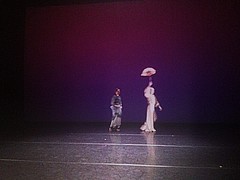
In Between, Butoh and Dance Performance by Yoshito Ohno and Lucie Grégoire at L'Agora de la Danse, Montréal. (2011)

In Between, A Performance By Yoshito Ohno (大野庆人) and Lucie Grégoire at L'Agora de la Danse (Montreal. 2011)
In Between, by Yoshito Ohno and Lucie Grégoire (Montreal. 2011)

I was very excited about watching Yoshito Ohno for first time live on stage (at L‘Agora de la danse); my only experience had been through videos and inside his father’s studio (the Kazuo Ohno Dance Studio), but he was only teaching and sometimes performing minimal chains of movements. Wednesday November 16th 2011 was the day to see him performing in a real production.

In Between is a project, a part of a trilogy (the second part) that Yoshito Ohno has been working with Lucie Grégoire since 2008. Lucie works mainly with modern dance techniques, but she’s been very close to Butoh and also works with it. Master Ohno follows his father's (Kazuo Ohno) teachings as well as his rich experience working (at various times) with Tatsumi Hijikata from the 1950’s till 1970’s; he is a real heir of those Butoh creators.

Lucie Grégoire and Yoshito Ohno performed In Between with several solos and duos, little by little mixing their personalities and techniques. My interest was, obviously, in observing all of Ohno’s movements, but Grégoire was so powerful and the whole piece of such great unity that it was impossible not see both works.

In Between is the encounter of two cultures of body movement, Butoh and Modern Dance, but also the encounter of two artistic personalities. None of them left aside their personal background, style of movement or ways of seeing their own performing art, but their encounter is successful, it reaches a union of a very high quality.

Yoshito Ohno's style of Butoh is simple, clear, we could see and differentiate each action in his work; his movement was so concrete that we could keep our attention on his eyes, his hands or his legs without missing other parts; he knows very well how to direct our attention. His hands were specially strange and beautiful, with almost no movement in them but always charged with energy. We feel him trembling and we never stop watching him.

There were two types of music, two epochs (actually several), and their images gently exploded in front of us. I cannot forget the movements of Grégoire’s back and arms, as well that infant dressed like a rabbit (or a rabbit itself) Yoshito offered to us.

One to one the solos became duos and their physical speech resulted comprehensive and simple: it doesn’t matter what exactly they were talking about, we observed their music, their past, their dreams, we could see their own relatives on stage.

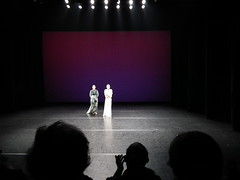
In Between, A Performance By Yoshito Ohno (大野庆人) and Lucie Grégoire at L'Agora de la Danse (Montreal. 2011)
Yoshito Ohno and Lucie Grégoire. In Between. (Montreal. 2011)

Like a ritual, they looked for their ancestors, for their own ghosts. And what we see at the final scene, two charming ghosts coming from the past in a lovely union, is one of the most beautiful and simple images anyone could ever see on stage.

We were pleased and we were happy at the end of In Between.


Texts, photographs and videos in this Blog are all author's property, except when marked. All rights reserved by Gustavo Thomas. If you have any interest in using any text, photograph or video from this Blog, for commercial use or not, please contact Gustavo Thomas at gustavothomastheatre@gmail.com.

Friday, December 23, 2011

The meeting between Henrik Ibsen and Hans Christian Andersen, a curious note.

Hans Christian Andersen

Henrik Ibsen


In Ibsen’s Biography by Michael Meyer, Meyer reconstructs a curious meeting in London between two giants of Literature, Henrik Ibsen and Hans Christian Andersen. The whole text is a curiosity, it depicts very well, in a real situation, those two extreme personalities, that child-like and frivolous Andersen and the reasonable and self-assured Ibsen, but also is full of simple funny anecdotic details which make reading literature (or theatre) history a big pleasure:


"Hans Andersen was eager to meet the new dramatist, having apparently forgotten their brief encounter in 1852. On 11 August (1870) he noted in his diary: "Fru Melchior told me that the poet Ibsen was dinning today with Carl Bloch, and expressed surprise that I had not been invited. I was put in a bad humor by the thought of how little attention B.  had paid to me." "I wasn't there," he wrote the next day to Henriette Collin, "but would have liked to have been invited, to see at last this Norwegian poet who doesn't like the Norwegian." A week later he got his wish, when Moritz Gerson Melchior, a politician in whose eighteenth-century house overlooking the Sound Andersen had, by generous arrangement, a permanent suite of three or four rooms, gave a party for the two writers. Andersen tried to prepare himself for the meeting with a little homework, and the result depressed him. "Read Peer Gynt," he noted in his diary fro 18 August, "which is written by a mad poet. One goes crazy oneself reading this book. The poetry isn't good either, there is something sick and distraught about the whole thing. Am sorry I read it, as Ibsen is coming here this evening fro the first time. I've never seen him; he's said to be taciturn and gloomy." But the occasion passed off unexpectedly well, for the diary continues: "After dinner he arrived with Bloch, and made a good impression … He talked well and amiably. We all liked him."

Andersen's diary conceals how close the evening came to being a disaster. According to John Paulsen, who had the story from Ibsen himself:

"Many of the city's most notable personages were among the guests. Everyone had arrived and was ready to sit down, but no Andersen descended from his room upstairs. A quarter of an hour passed, half an hour; a nervous restlessness settled on the company, and the hostess looked unhappy. Message after message was sent up, but he still did not appear. The hostess quietly went upstairs, but returned with a more worried expression than before. he would not come down. No one said anything to the guest of honor, but Ibsen sensed what was afoot. Andersen did not like to be with people of whose sympathy he was not sure. When people mentioned strange authors he would naïvely ask: "Does he admire me?" The atmosphere grew more embarrassed. It was now three-quarters of an hour past the appointed time for supper. The host and hostess were at loss what to do. Were they to sit down without Andersen?
Then Ibsen saved the situation. He took his host aside and asked to be allowed to go up to Andersen's room and speak with him. The host nodded and showed him the way. A minute after, to the joyful surprise of the company, the two great writers entered the room arm in arm, Andersen evidently deeply moved, smiling through his tears. He was like a small child who has got his way.
"But what happened between you and Andersen in his room?" I asked Ibsen. Ibsen smiled at the memory. "I embraced him and paid him a casual compliment. He was moved and, as he returned my embraced asked, 'Then, you really like me?'" Ibsen added: "It was one of the pleasantest evenings I have ever known. Andersen could be lovable and entertaining as few other men when he wanted to be."

Andersen was delighted with his new acquaintance. He wrote to a friend that he had found Ibsen "very amiable, unassuming and pleasant. I like him a lot, but Peer Gynt not at all."


*Ibsen Biography. Michael Meyer. Page 323.


Texts, photographs and videos in this Blog are all author's property, except when marked. All rights reserved by Gustavo Thomas. If you have any interest in using any text, photograph or video from this Blog, for commercial use or not, please contact Gustavo Thomas at gustavothomastheatre@gmail.com.


Tuesday, December 20, 2011

Exploring Internal Body Zones (Zonas del Cuerpo). Video 3. Neck and Seventh Zone.


Gustavo Thomas Butoh Vlog (Oct 26, 2011): Internal Body Zones Training Part 4. Neck and Seventh Zone. (NO SOUND) on Vimeo by Gustavo Thomas
Working with body zones: Neck and Seventh zone (By Gustavo Thomas. 2011)


This is the fourth of a series of posts where I expose videos (recorded by me) showing the acting exploration of different Body Zones (Zonas del Cuerpo) and combinations of them.

Those who already know about González Caballero's acting method will understand what I meant with Zonas del Cuerpo, but those who don't know anything about this acting method maybe it is better first to go to this link and take a little look (it is in Spanish): http://agcmetodo.blogspot.com/2007/04/el-apoyo-zonas-del-cuerpo-el-cuerpo.html.

If you want to see the last post of this series, follow the links bellow:

- Sexual and Seventh zones: http://gustavothomastheatre.blogspot.com/2011/11/exploring-internal-body-zones-zonas-del.html

- Chest and Seventh zones: http://gustavothomastheatre.blogspot.com/2011/11/exploring-internal-body-zones-zonas-del_24.html

- Head and Seventh zones: http://gustavothomastheatre.blogspot.com/2011/12/exploring-internal-body-zones-zonas-del.html


The process of this exploration is very simple: in front of the camera, and only my face, I must work in the inner concentration of one Body Zone (Zona del Cuerpo), with different levels and positions within the same zone, then I combine it with another zone (in this case the seventh zone, known as the crown, the only one with which all zones in this exploration will be combined).
As the only thing exposed on screen will be my face, no other part of the body will react to the impulse coming from the concentration on the body zone, only the face.

These videos are also part of my Butoh Vlog (http://gustavothomastheatre.blogspot.com/p/gustavo-thomas-butoh-vlog.html ) therefore it is important to clarify that I'm not listening to any piece of music during the explorations or recordings, nor any movement within the space will be the goal (as it is in Butoh). Even when that could mean for someone that it would not be Butoh, I still considered this exploration as part of my training in this discipline because I'm working with inner images and impulses with muscle movement as reaction of it, and that's one of its principles.

I believe the results (and the process itself) of these explorations will be very interesting for those who want to follow them, watching, studying or carrying out the exploration as well. For myself I'm opening another door in my own acting work, and I'm sure it will be the same for others who want to venture into this acting method and its infinite possibilities for exploration.


Gustavo Thomas Butoh Vlog (Oct 26, 2011): Internal Body Zones Training Part 4. Neck and Seventh Zone. (NO SOUND) from Gustavo Thomas on Vimeo.
Gustavo Thomas Butoh Vlog (Oct 26, 2011):

Internal Body Zones Training Part 4: Neck and Seventh Zone.

Working with Internal Body Zones (Zonas del cuerpo). This time working with Neck and Seventh zone, the crown (Zona de la cabeza y séptima zona).
Diferent positions concentrating attention inside the zone. From intensity in low level till climax and back to low level.

This is part of a daily training, I don't have any aesthetic goal in doing it (even when using a video effect or choosing a particular part of that training).
This is a document of my daily artistic life.


Texts, photographs and videos in this Blog are all author's property, except when marked. All rights reserved by Gustavo Thomas. If you have any interest in using any text, photograph or video from this Blog, for commercial use or not, please contact Gustavo Thomas at gustavothomastheatre@gmail.com.


Thursday, December 15, 2011

Butoh Workshop With Jocelyne Montpetit in Montreal, Québec.

After my last Butoh workshop session with Jocelyne Montpetit (Gustavo Thomas. 2011)
Gustavo Thomas and Jocelyne Montpetit. Montreal, Québec. 2011.


The decision to travel to Montreal was clear: Yoshito Ohno would perform at L’Agora de la Danse and I wanted to see him on stage; as I knew Jocelyne Montpetit lived there, I hoped that she could give one of her workshops during the period that master Ohno would be performing.  And so it was, as part of a 4 weekend workshop, I took 4 very productive sessions (two weekends).

It is known that if one does not work with a teacher (whether it be Jocelyne Montpetit or Yoshito Ohno) a longer time, like at his/her studio every day, for example, there is a danger that each of those "short" workshops that one is taking in this or that place could be the same as others you have already taken before. I did not consider it such a big problem in my case. I'm still in the very base of the pedagogical work of Butoh and a renewal of what I had taken with Montpetit would be a reinforcement, or at least one good review.

I'll do a simple (but not hollow) description of the 4 sessions, because I wanted to include them all in this post:

The sessions were conducted in an imposing building, the old library of Montreal city, today the offices of the National Arts Council, in one of several studios or rehearsal rooms that are very well adapted for performing arts works.
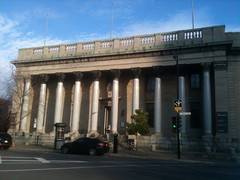
Butoh Workshop With Jocelyne Montpetit (Montreal. 2011)
Ancient Montreal Library. 2011.

Butoh Workshop With Jocelyne Montpetit (Montreal. 2011)
Ancient Montreal Library. 2011.


Jocelyne Montpetit was usually there before our sessions, rehearsing or working with others students. Close before 3 pm she would come to greet us and invite us to enter to the classroom.

Each session lasted 2 hours, from 3PM to 5 PM and there was always music to work.  Jocelyne usually gave an indication with a very small theoretical framework or story according to the objective of the exercise to come. Her comments after each exercise were always general (perhaps another story concerning the purpose of the exercise), and only in very special cases were there comments directed at a specific person.


Session 1: Golden threads, wind blows and eyes on the forearms.


- Walking with the image of golden threads which pull from the center of the body and arms (a thread in each finger) to the sky and, once we are at the highest point, on the verge of crashing down, the same golden threads pull us down, taking all our body (and fingers) to the ground.

- Walking while the wind hits parts of our body. We would have to open the body itself to the wind, as if there was a hole in our torso where the wind could pass. This was an idea of Kazuo Ohno: "open the body."

- Walking as if blind: our eyes in the head do not work anymore, our eyes are now in the forearms, and they lead our walking. We move towards where our eyes in the forearms look. Jocelyne asks us to walk in different levels, to the sky and to the ground. Our movement is slow, careful, gentle. For the first time I have a much more sensitive perspective of Maeterlinck's play "Les aveugles".

The exercises are long, a long time is dedicated to each one of them. Jocelyne, during the exercise, approaches and sometimes gives directions, sometimes touching parts of our body and provoking a different movement, more directed at what she believes is the purpose of the exercise. Sometimes, very rarely, someone in the group speaks or even complains about an indication, but that is exceptional, generally all our work is silent.

The music is varied and uniquely beautiful, profound and inspiring: Arvo Pärt, Maria Callas, Jessy Norman, some pieces of Latin Blues, Fado, and so on.

Jocelyne likes to work in groups.  The same exercise is repeated in small groups, dividing the whole group in two, or all together with a final indication of movement, as if she were directing a choreography.
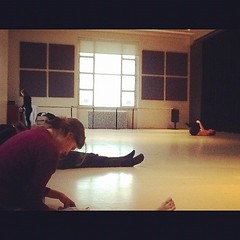

Butoh Workshop with Jocelyne Montpetit
Butoh workshop with Jocelyne Montpetit. Montreal. 2011.

Session 2: A sheet of silk in the hands, a soap bubble that should not be broken, the blind and the wind blows again.
 

- Moving with a sheet of silk in our hands, an imaginary sheet of silk with a small bubble in the middle. Our feet are as soft as the silk in our hands. Jocelyne talks about Noh theater and tells us about that child that had to learn to walk smoothly for years to make his debut, coming and going unnoticed for an entire 5-hour performance.

- Walking with a large soap bubble in the hands, a continuous movement with that bubble in different levels of high. Attention to the other soap bubbles, some are already on the ground and we should avoid breaking them. There should be an exaggerated attention to the whole space, the space itself is a soap bubble, we must avoid breaking the space.

Jocelyne recalls how in Japan, waiting for an appointment with an blind acupuncturist, there was a child playing quietly in the middle of the waiting room; when the blind acupuncturist opened the door and came forward, he gently stopped when he felt the child playing on the floor, then continued walking around the boy... With that attention we should move throughout the space.

- Walking as if blind with our eyes on the forearms again: we did it alone, in small groups, with the entire group split in two.

- Walking with the wind hitting us. Again we work in small groups, different levels of wind force hitting us; at times the wind pushes a particular part (the shoulder, for example), then the whole torso, sometimes we fall to the ground because of the power of the wind blowing; when we come back to walk, we do it facing it, its force against us.
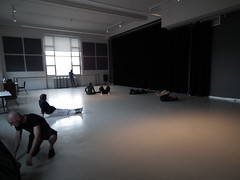
Butoh Workshop With Jocelyne Montpetit (Montreal. 2011)
Butoh workshop with Jocelyne Montpetit. Montreal. 2011.

Session 3: Bones movement, a carp moving inside our body, a million small flowers on the ground, and Ophelia with long hair, moved by the river flow.
 

- All movement start where our joints begin. Hijikata called it "movement of the bones". One special way to move, a way of being fully present during the movement. The idea of moving from the joints is not a technical idea, it is not a doll or robot that moves, we would have to find the soul of the movement of the bones.

As to being present while moving, Jocelyne recalls that Kazuo repeated the same question to his students during the improvisations: "Where are you? Where are you?”.

- Being moved by a carp swimming in our body. This is another story of Kazuo’s: when Kazuo’s mother was dying, she told him she felt something like a carp moving inside throughout her body; without thinking about it, she had taught Kazuo a new way of moving on stage. A carp should lead our movement.

- As we move we have to avoid crushing a million tiny flowers in the ground, we should be delicate and light. It is an image by Hijikata, to silence the movement of the body.

- Walking mixing the inner movement of the carp, and avoiding crashing that million tiny flowers.

The music, as usual, is deep, sensitive, charming. The energy is perceived in all of us; my walking is very delicate and sensitive, emotions run freely.

The difficulty of working with these two images is part of the challenge of the Butoh conceived by Hijikata: Multiple images provoking different movements simultaneously. Jocelyne remembers that one of Hijikata’s collaborators was able to manage up to 60 images in one sequence.

Jocelyne speaks about images and mixes that word with "visions"; sometimes images are visions, sometimes visions are images.

- We are Ophelia, Shakespeare’s Ophelia (even though our images inevitably are mixed with those by the painters who have also recreated the character). In the river, inside the water our immensely long hair is pulled by the river flow. There is no acting, but living the image. The music by Arvo Pärt, so beautiful, creates a blast of emotion, mixed with the strength of Shakespeare’s scene.

Jocelyne splits the group in two, women and men; one group watches the other. She loves how our movements look.
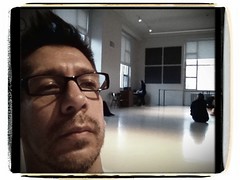

Butoh Workshop With Jocelyne Montpetit (Montreal. 2011)
Gustavo Thomas. Butoh workshop with Jocelyne Montpetit. Montreal. 2011.
.


Session 4: A "Dandelion", moving bones, the carp, a million flowers, and Ophelia who dies again.
 

- We have to become a dandelion and use the onomatopoeia "Puff!" as an idea of expanding the body, exactly as dandelion expands when the natural time comes. A long exercise, with enough time to feel the flower, its characteristics, giving time for dilatation, for “expansion”, for that "Puff!".

- Moving the bones, leaving the bones move the body; lightening the body while walking.

Hijikata said that a butohka’s body should be like a corpse, a dead body that gets its life on the move.

- The carp moves us, swimming within our body; and walking on those millions of tiny flowers that we do not want to crush.

Repeating the same exercise, but never repeating it, each time we have to search for the life of the movement, feeling the carp once and a thousand times.

I remembered watching and enjoying some carps swimming at a little pond inside  a restaurant in Kyoto, and also, during my movement I recalled another carp, at the beautiful pond of the Imperial Palace in Tokyo, drawing a curved line in the water before coming to me and opening its mouth asking me for food.

Jocelyne talks about images, visions, about different ways of seeing life. She recalled another myth about Hijikata: he used to chose his collaborators depending on their poetic vision of the world; he showed them a bowl of miso soup and asked what they saw there, and depending of their response he worked with them or not; if they saw a bowl of soup, they were rejected, if they saw images or symbols, they were accepted. A myth, explains Montpetit, but a myth that exemplifies the need for a poetic vision in the Butoh artist.

- Ophelia turned out to be an exercise of almost a whole hour. Her long hair was hit by the current and carried as far as possible. As this was the second time doing it, we could spend more energy in the movement of the river flow over our long hair. A very sensitive exercise, but long, tedious at times, perhaps an endless movement. Tabula Rasa by Arvo Pärt made it feel epic, tragic.

Jocelyne again insisted on splitting the group in men and women, watching each other; then all together but in a certain position. Was she already staging something or only doing something for her personal enjoyment? I don’t know and I didn’t ask her.

That was the final exercise, and it a very good end.
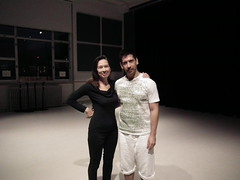

Butoh Workshop With Jocelyne Montpetit (Montreal. 2011)
Jocelyne Montpetit and Gustavo Thomas at the end of the
Butoh workshop. Montreal. 2011.

I returned to Toronto with the idea of retaking my daily training with all that I could assimilate during those 10 days in Montreal, but it wasn’t possible: the Ophelia exercise left a physical sequel in me, an neck injury that has lasted more than a month (with several visits to the doctor). No problem, I’ve been waiting for many years to be free and create through Butoh, now I can spend some holidays resting and thinking about everything. In Spanish we say:  “Esos son los gajes del oficio”. (*)


(*) Which translates literally as “Those are the perks of the trade”, although it’s meaning is closer to “It comes with the job”.


Texts, photographs and videos in this Blog are all author's property, except when marked. All rights reserved by Gustavo Thomas. If you have any interest in using any text, photograph or video from this Blog, for commercial use or not, please contact Gustavo Thomas at gustavothomastheatre@gmail.com.
Saturday, December 10, 2011

Ibsen at War: "My book is poetry; and if isn't, it will become such."


Ibsen's original draft of Peer Gynt. Act V. (Photo from H. Ibsen Biography by Michael Meyer.)


After the publication of Peer Gynt in 1867, in his motherland, Ibsen was attacked as no other author before, attacked because of his style of poetry, his subjects and his strange idea of theatricality (even when Peer Gynt wasn’t conceived for the stage). But that wasn’t the Ibsen of some years before, immature and choleric, who didn’t know how to reply any attack; Italy, the exile and the success of his “Brand” had given to him a self-assurance that nobody in Norway could brake in the future.

After Peer Gynt was published Henrik Ibsen has become a monster.

The next is an extract of a letter to Bjørnstjerne Bjørnson (December 9, 1867) as a reply of all those critics:

"Dear Bjørnson, (…) My book is poetry; and if isn't, it will become such. The conception of poetry in our country, in Norway, shall shape itself according to this book. (…) However, I am glad that this injustice has been flung at me; it is sign of divine aid and dispensation; anger increases my strength. If there is to be war, then let there be war! If I am not a poet, what I have to lose? I shall try my hand as a photographer, I shall deal with my contemporaries up there, each and all of them, one by one, as I have dealt with these language reformers; I shall no spare the child in its mother's womb, nor any thought nor feeling that may have motivated the actions of any man who shall merit the honor go being my victim. (…) Do you know that all my life I have turned my back on my parents, on my whole family, because I could not bear to continue a relationship based on imperfect understanding?"(1)

Ibsen is capable to assure that his own text would become in Norway the concept of poetry itself (and it was almost true), and it wasn’t what his critics called errors and mistakes. Who can assure that?

He knew he was at war if he wanted to be the most recognized author in Norway, and that famous sentence about photography that many of us are used to identify as Ibsen’s start in Realism became his chant of battle: “I shall deal with my contemporaries up there, each and all of them, one by one, as I have dealt with these language reformers; I shall no spare the child in its mother's womb, nor any thought nor feeling that may have motivated the actions of any man who shall merit the honor go being my victim.”

We only have to recall his most important plays to see that those words were accomplished.

Ibsen also made a very hard confession about turning his back to his parents and family; coming from a very provincial background, with no intellectual or artistic links, all his relatives were mere obstacles in his way to fame as a writer (since his adolescence he never saw any of them again). Only a man with all his goals in mind, ready to fight any battle to be the number one in his world could write in that manner.

He wanted it, he fought for it and he got it. He was monster.


(1) Ibsen Biography. By Michael Meyer. Double Day, 1967.

Texts, photographs and videos in this Blog are all author's property, except when marked. All rights reserved by Gustavo Thomas. If you have any interest in using any text, photograph or video from this Blog, for commercial use or not, please contact Gustavo Thomas at gustavothomastheatre@gmail.com.

Wednesday, December 7, 2011

Min Tanaka's The Rite of Spring at L'Ópera Comique(1987)


Min Tanaka


Some discoveries are worth sharing immediately, and it is what I'm doing now with this video of a 1987 Min Tanaka's production at L'Ópera Comique, The Rite of Spring.

I knew a little about Tanaka's work thanks to Jocelyne Montpetit, the Butoh dancer; she met him during the 80's in Japan and even worked in his company. Last November during the workshop I took with her in Montreal she told me about someone who has posted The Rite of Spring in Youtube, and that could be a very good example of Tanaka's work if I wanted to understand the words she transmitted about him.

For some stupid reasons I forgot the tip and it was till today that I accidentally came to that Youtube link. Of course I cannot talk more about Min Tanaka's work, but you must know that he's considered one of the most important heirs of Tatsumi Hijikata, the founder of Butoh, but also a very important dancer and choreographer independently of his relation with Butoh.

The Rite of Spring was staged one year after Hijikata's death, and was considered totally a Butoh production (at least by Westerner's eyes), that style of Butoh coming from Hijikata's branch, the dance of darkness o Ankoku Butoh. Other thing was coming at the same time with Kazuo Ohno and his Butoh of light, as some have called Ohno's Butoh.

Please enjoy this whole recording of The Rite of Spring directed by Min Tanaka in 1987:

 The Rite of Spring part 1/7

 The Rite of Spring part 2/7

 The Rite of Spring part 3/7
The Rite of Spring part 4/7

 The Rite of Spring part 5/7
 The Rite of Spring part 6/7

 The Rite of Spring part 7/7


Texts, photographs and videos in this Blog are all author's property, except when marked. All rights reserved by Gustavo Thomas. If you have any interest in using any text, photograph or video from this Blog, for commercial use or not, please contact Gustavo Thomas at gustavothomastheatre@gmail.com.

If you are interested in using any text, image or video from this Blog, please contact the author writing your e-mail and information in comments. (comments are private)
Gustavo Thomas. Get yours at bighugelabs.com