Friday, June 24, 2011

A Secret (Learning Butoh with Yoshito Ohno)

Yoshito Ohno drinking tea at his studio. Yokohama. (By Gustavo Thomas. 2011)


-As you pray (while we pray in motion) gather your hands .-

And the hands lead us, thinking about what we are praying, seeing it, dancing.

Yoshito stops and, approaching us, says: - A secret! -

He takes the page of a large photo book and shows it to us:

-Nara, a beautiful city, a very old and important Japanese city. There are many Buddhas there but one of them is special; this Buddha is special, look...-

Then he brings the photo of the Buddha closer to us... What's special about it?

Cover of Buddha of Nara Photo Book. Yoshito Ohno studio. (By Gustavo Thomas, 2011)

- Look at his hands ... They don't come together; there is a minimal separation in between, barely a rice-paper fits in between them.  There is not another one like it in all Nara. That makes it very special. Everything is compressed between his hands; it is powerful. Kazuo Ohno knew that; it is a secret ... 

He looks at us, smiling and thoughtful, at each and every one of us around ...

-Pray with your hands together and feel a separation the width of rice-paper.-

And our hands worked with that separation, and we moved with Maria Callas and Anthony singing in the background. In later sessions we used a handkerchief. That separation could be not only in our hands, but between our knees, as a young and caring woman, and you could also feel that paper between the arms and trunk, between the feet and the ground as the walk of a Japanese Noh master.

Yoshito Ohno shows all while speaking: he is the Buddha of Nara, he is the beautiful and shy teen who walks with a minimal separation between her knees, he is Kazuo Ohno when he performed a woman and his arms barely touched the flanks of his trunk and he is also a walker on rice paper.  He continually separates from us and takes a few steps with his hands almost joined together and raising them to heaven. He doesn't pretend to be a role model, it is just that he must inevitably move as he speaks.

Yoshito Ohno and the rice-paper between his hands. Yokohama. (By Gustavo Thomas, 2011)


Yes, his sessions are full of little and big secrets about Butoh, on how to achieve the inner strength of our movement:

- pay attention to your back, as if it spoke;
- a direct encounter with the whole of the space, with its corners, the front, the back, the up and down; thanking the space...
- know where to land your gaze while walking; if you look down you always seems sad, it is better to look neutrally forward, openly.

We "move" every secret, we explore every secret, we practice, without further instructions, without judgement.

The examples to reveal the secrets each are given, as always happens in his workshop, with the remembrance of passages from the two great masters of Butoh, Kazuo Ohno and Tatsumi Hijikata, but also with simple drawings: geometric patterns to discover the different displacements of our body in space, or Chinese characters (Japanese writing originated in, and retains the use of, Chinese characters) on the body, on man, on day. He talks while drawing, he shows us each drawing he makes, he lets us touch it and review it.

The showing of a palpable example when mentioning every secret functions as an inspiration pivot, as a guide beyond than words or formal instructing; at the end every secret comes to us through an internal image that is created from listening to him, seeing him move, looking at a picture or touching an object. We did it, as I'll talk about in the next post, touching flowers, silk, bamboo, balls...

Zen circle image at Yoshito Ohno studio. Yokohama. (By Gustavo Thomas, 2011)

That painting, so simple, known as the "Zen circle" is one of the biggest inspirations for the discovery of the body in motion as a circle, as a whole, as philosophy on scene. Yoshito tells us that his father was also a philosopher and that he philosophized on stage through Butoh, and that one of the inspirations for philosophizing while moving was that image of the circle drawn by a Zen monk, a circle that clearly doesn't close but which we know includes everything. Kazuo Ohno was not Buddhist but he was a sensitive, religious man, wherever he found inspiration he stopped and moved.

That circle is explored everywhere, be it in the space, be it inside and outside the body, be it with our hands. The hands that emanate from the circle itself, those hands that he tells as waterfalls of force surging from Hijikata. Hands are the holders of the circle that is a sphere, the moon. Yoshito asks us to look at the moon, to feel the moon and see it as a manifestation of that zen circle, and the sphere. Our hands can touch the moon, take it, split it into two, move with it, with its strength, with its attraction, with its poetry.

Moving with the spheres on each hand. Yokohama. (By Gustavo Thomas, 2011)


Several sessions with a number of spheres; inner images that move us, and that make us philosophize without thinking, while moving ... How can one philosophize without thinking? I never asked myself that question while working ... Perhaps there was also another secret.

Those secrets and that philosophizing cause a change in others, teacher Yoshito Ohno tells us. For years people around the world came to the workshop of his father, they listened to him speak, watched him move, moved with him and then something happened, they changed, their life changed. Kazuo Ohno had the force to change others through their own secrets unveiled at each session (secrets that no one could decipher or explain), explored through the philosophical or poetic or surreal movement of Butoh. 
After a few sessions, those visitors changed the paths of their creativity and, in many cases, their very lives.


Texts, photographs and videos in this Blog are all author's property, except when marked. All rights reserved by Gustavo Thomas. If you have any interest in using any text, photograph or video from this Blog, for commercial use or not, please contact Gustavo Thomas at gustavothomastheatre@gmail.com.

Saturday, June 18, 2011

Eleonora Duse watching Ibsen's window...

"La Duse watching Ibsen's window" (By Gustavo Thomas. 2011)


She was there when he was dying
but couldn't see him,
couldn't kiss him,
nor thanking him.

She was there, just waiting for him to appear
but he never did

She was there, just looking and waiting,
they say...


"Duse was visiting Norway for the first time, largely in the hope of meeting the dramatist who had provided her with her greatest triumphs. On her arrival she sent a letter and flowers to Ibsen asking if she might call merely to say "¨Thank you". Suzannah, however, telephoned that Ibsen was too ill to receive anyone. Lugné-Poe, who was with Duse at the time, tell what followed

I remember very well that morning when she had just received this sad message. I went in to her and found her swathed in the long white paladrane which she loved to wear. She sat fearful, annihilated, hollow-cheeked, her face tired and lined as though life was abandoning her. She asked me: "What shall I do? Please, what shall I do?"... What could I do for her? I had hoped so much, for her sake... Next morning, around noon Duse and i found ourselves outside Henrik Ibsen's house. She had bought Norwegian boots, for she wished to go there on foot. We walked round the left of the palace, and at the stroke of twelve we stood beneath the corner window, where, every day at this time, people could see Dr. Ibsen in person, sometimes with a secretary or someone at his side. Duse stood there waiting, in the cold and snow. Who, even thirty years later, would not be shaken by the memory of having been present at that sad and silent meeting? Eleonora Duse on the pavement, looking for the old poet's silhouette behind the big window."

Ibsen's Biography. By Michael Meyer.

My painting is based in a original photograph of Eleonora Duse taken for the production of Ibsen's play The Lady from the Sea.


Texts, photographs and videos in this Blog are all author's property, except when marked. All rights reserved by Gustavo Thomas. If you have any interest in using any text, photograph or video from this Blog, for commercial use or not, please contact Gustavo Thomas at gustavothomastheatre@gmail.com.

Tuesday, June 14, 2011

Two Street Butoh Performances at Noge Street Performance Festival in Yokohama (2011)


I’ve already shared my experience as spectator of a traditional Japanese puppet theater performance (1) during this Noge Street Performance Festival in Yokohama. Now is the turn to show you some pictures and videos of the performances of two street Butoh dance groups: 
- 吉本大輔 Yoshimoto Daisuke (They call themselves in English: Ultra Ego.)
Watching Butoh in this kind of festival and space (an open space) transforms it in a more strange way than usual (we all agree that Butoh itself is not a very common performing art): it works very well in a visual point of view but it seems that all its characteristic inner strength disappears; it becomes a colorful spectacle and somewhat comical, but almost nothing in it recalled me traditional Butoh performances. Anyhow, that did not seem to bother the artists who were well adapted to those conditions, public and space, and even, I would say, they were acting in a kind of festive mood, very ad hoc with a street event like this.


The two groups performed on the same street space within the festival (24th, April, 2011), one after the other, and lasted about an hour each.
Enjoy.


(1) See my post of April 4, 2011: Traditional Japanese Street Puppet Theatre Performance: A Drunk Scene and The Lion and the Butterflies. 

Texts, photographs and videos in this Blog are all author's property, except when marked. All rights reserved by Gustavo Thomas. If you have any interest in using any text, photograph or video from this Blog, for commercial use or not, please contact Gustavo Thomas at gustavothomastheatre@gmail.com.

Monday, June 6, 2011

"La danza del Padre" Comic Strip and Video for the Second Movement: Le père au coeur

Second Movement: Le père au coeur

Basic or original drawing


Comic Strip


by Subliminal
2009 - Licensed under
Creative Commons
Attribution Noncommercial Share-Alike (3.0)


Texts, photographs and videos in this Blog are all author's property, except when marked. All rights reserved by Gustavo Thomas. If you have any interest in using any text, photograph or video from this Blog, for commercial use or not, please contact Gustavo Thomas at gustavothomastheatre@gmail.com.

Wednesday, May 25, 2011

"La danza del Padre" Comic Strip and Video fo the First Movement: Le père qui danse

In La Danza del padre (Father's dance) creation-process the original drawings have got movement, first through the shape of a comic strip and now as a video. Its singular drama is getting more power and clarifying its theatrical story.

These are only tests, experiments around, but I'm almost sure  that's the way to do this. I'm very excited because everything is new for me and feel passionate exploring it.  

First movement: Le père qui danse

Basic or original drawing 


Comic strip based in the original drawing and text of the First Movement


(*) "Trapped By Time" by Subliminal
http://ccmixter.org/files/subliminal/28890
is licensed under a Creative Commons license:
http://creativecommons.org/licenses/by-nc/3.0/

Texts, photographs and videos in this Blog are all author's property, except when marked. All rights reserved by Gustavo Thomas. If you have any interest in using any text, photograph or video from this Blog, for commercial use or not, please contact Gustavo Thomas at gustavothomastheatre@gmail.com.

Friday, May 20, 2011

At the beginning are the founders, prayer and the offering. (Learning Butoh with Yoshito Ohno)


The three Butoh masters in an improvised niche. Kazuo Ohno Dance Studio. (2011)
Butoh is young, very young; it was born in the fifties of the 20th century and it specifically recognizes a single founder, Tatsumi Hijikata. Hijikata discovered in Kazuo Ohno his partner for revolution. Kazuo then becomes the co-founder of the new style and, according to others, its counterpart as well: while Hijikata worked what was grotesque, dark, tense and destructive, Kazuo worked what was bright, soft, loving. Through them both Butoh takes on an unusual expansion and its influence will cover hundreds of artists of all fields around the world.


The first thing master Yoshito Ohno did, after we introduced each other, was to show me a book with photographs by William Klein, 'Tokyo', with images of Kazuo Ohno, Tatsumi Hijikata and Yoshito Ohno doing a "happening" in Shimbashi area in 1960. It was like telling me that he was part of the big moment in Butoh (and indeed he was part of it; a kind of presentation of himself as someone to be trusted.

William Klein Photograph of Kazuo Ohno, Tatsumi Hijikata and Yoshito Ohno. (1960)
William Klein photograph of Kazuo Ohno, Tatsumi Hijikata and Yoshito Ohno. (1960)

Yoshito Ohno has always been there; from the beginning he has been an observer and a total practitioner of the Butoh revolution in Japanese art, of its development and its changes: as a teenager he took part in several performances by and with Hijikata, he learned from his father how to dance, he saw Hijikata die and accompanied his father in every performance during his last 30 years. Being part of its own mythology, Yoshito Ohno transmits Butoh through the example of the creators in the same place in which Kazuo Ohno and Tatsumi Hijikata worked for years, where Kazuo Ohno left his own legacy.
Yoshito Ohno dancing at his father studio. (2011)
Therefore, any instruction to follow in the workshop of master Yoshito Ohno has as a benchmark either of the two founders of Butoh, some of their movements, some of their anecdotes, some of their speeches, some of the comments by others on their work: if you're going to move your hands, master Ohno talks about Hijikata's hands when he was on stage, about how they seemed to emanate energy from the fingers and palms; if it had to do with the feet, he speaks of how Hijikata had such strength in his feet that, the day he died, at midnight, a sparrow came and stood on them for a moment; if you're going to work with the gaze, he talks about how Kazuo avoided the gaze directed toward the ground while he moved along the floor or how he seduced theater technicians with movement and gaze exercises that earned him the respect of those who did not know who he was. If someone had talked about the creation of a surreal body in Kazuo (and that's what a Japanese critic called it), that served us to search for our our own surreality and create it in our body. In the beginning there are always the founders of Butoh.
They then, the creating teachers, are our starting point and inspiration. To them we also offer our work.
And before every offering, we learn to pray.
Never before, until the first day of work with master Yoshito Ohno, had I heard of the idea of praying on stage, in a way so simple, and without implying any religion. Several Western teachers had told me about a sacred workspace, but they seemed clumsy attempts to sanctify something that was totally alien to us.

When my first exercise with master Ohno was just to pray, something new appeared: in his way of saying it (I was lucky to have someone translate for me in real time during that session), in his intonation, in his eyes, the instruction was different; we should take the first step by praying, the first exercise, that is, the first movement, the first movement improvisation.
The first step is, always, to pray.
Yoshito Ohno explained to us that Butoh dance was born out of the memories in Hijikata and Kazuo Ohno of the terrible tragedies of the Second World War, their hatred and their pain; he talked about how Kazuo had suffered in his journey back to Japan from the Philippines, of how he had seen people die on the boat, and that he prayed with them, with those images, and that he also offered them his movement. Then he would ask: what's in your prayer? about what do you pray? for whom do you pray? And that way we began to move.
Yoshito Ohno playing the same music as his father did. (2011)

Every day the starting working sentence was "pray"(inoru "
祈る")
, then he would go where there the sound system was and began playing records, two, three, four pieces: Schubert's Ave Maria (which Kazuo so appreciated), Il mio babbino caro (by Maria Callas), Amazing Grace, or pieces of Buddhist music. And then we prayed, day by day, and each session, and in its repetition new possibilities for prayer were in us: I prayed for those dead who Kazuo saw, for my own dead ones, I prayed for the image of a dying Kazuo, for the feet of Hijikata's corpse, I prayed for my own past ... and I moved, like the others who were there and  who also prayed and moved.
Learning how to pray through movement. Yoshito Ohno's Butoh Workshop. (2011)

From that praying came the offering, our movement as an offering: the story of that offering by Kazuo for all those dead people was profoundly powerful, just as the one in which he dedicated his dances to his mother, to the great love he felt for her, where his prayer turned into the sensation of an umbilical cord on stage which was in reality a huge womb.
That offering was a petition, a petition to our strength, to the workspace, contact with it, all our senses on it, with all four corners, four sides, the ground, the sky.
Our movement shouldn't be external, prayer and the offering should be internal: "Nobody knows how you must pray and offer yourself, only you, find your prayer, find your way of offering by moving." It is an ongoing exploration.
That was more than a month ago and today, back home, I still do that, exploring;  every day I wake up to move and pray with the momentum of those searching sessions in Yokohama ... Why? I can not say for sure why, I just think I simply need it now.


Texts, photographs and videos in this Blog are all author's property, except when marked. All rights reserved by Gustavo Thomas. If you have any interest in using any text, photograph or video from this Blog, for commercial use or not, please contact Gustavo Thomas at gustavothomastheatre@gmail.com.


Saturday, May 14, 2011

Kazuo Ohno Dance Studio in Yokohama: The Place and its Objects.

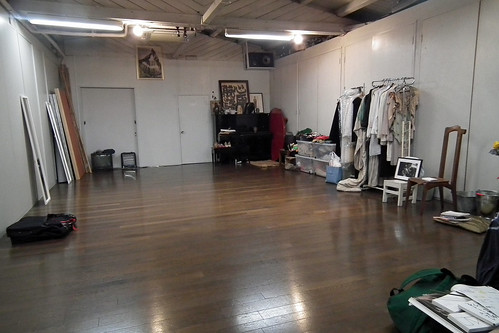
Kazuo Ohno Dance Studio (Yokohama, 2011)


The first step is the place, the space: no one can imagine dance without a space.
My dream to visit, step into and and learn at the study of Kazuo Ohno in Yokohama must then begin by a small account of the space.
Kazuo Ohno built his studio, back in the 60's, next to his home on the hills of Kamihoshikawa, part of Yokohama's metropolitan region, less than an hour by train from central Tokyo. It was, and still is, a humble studio, simple but very functional: it has a wooden floor, a piano, several closets, a bathroom, a kitchenette, lounge chairs, a television, a glass cupboard, a sound system, a small illumination system; it's built from wood and metal sheets, with a group of supports that, when it rains, keep the studio from flooding by water running down the hill; outside, there is a shelf for shoes and a basket for umbrellas . From the entrance one can see the dining room and part of the kitchen of Ohno's house, and one feels ashamed to enter into the privacy of the home and prefers to look away.
Getting to the studio is a journey, is not easy, and everyone gets lost their first time, be they foreigners or Japanese - it's not a matter of language. And that's because, being in a hilly area where alleys and labyrinthine stairs are the only ways, one can not find the one alley and stair leading to the studio. For about 35 minutes I went up and down the hill several times, took several stairs, asked passers-by, checked the map a dozen times; exhausted and with so tired my legs were shaking, in the end I decided to take the first alleyway off the road and follow its roundabout path and there, after a turn which was not visible from the main road, the sight of the stairs that would finally lead to the study.
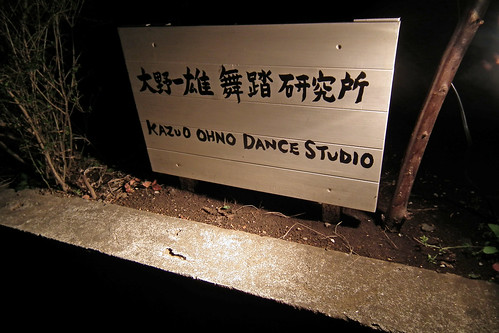
Mid-way up the hill you discover a wooden sign that reads, in Japanese and English, "Kazuo Ohno Dance Studio."
Sign entrance at Kazuo Ohno Dance Studio (Yokohama, 2011)


I was finally in front of that sign, a highpoint in my life as a student: I was there after that weary journey to find the place, after a month of uncertainty due to the earthquake in the north of the country and problems at the Fukushima nuclear power plant, after a year of studying and discovering Butoh dance with several teachers in Canada, and after a little more than 20 years after first seeing the figures of Kazuo and Yoshito Ohno on stage, setting their work as an example before all my students, my colleagues and myself. There was I, in front of that sign, and I stood there for several minutes.
It was night already, some wind was blowing lightly, you could hear the trains passing in the distance,  you could also hear some crickets, and nothing else.
Before meeting master Yoshito Ohno I got to know the studio, I could see his objects exactly as Kazuo Ohno used them (Yoshito Ohno has respected in full the arrangement of things and nothing has changed place): his chair, his music, his dolls, puppets and masks, his books, his costumes, the shoes of his female characters, his hats, the floor.
As is the usual Japanese (and Eastern) custom, you leave your shoes at the entrance and enter barefoot, that way you can go around the premises with the confidence that you won't damage anything nor will bother anyone the noise of your walking. And so I did, I entered like that, barefoot, and so I stepped where Kazuo and Yoshito stepped and danced together, where sometime they stepped and danced along with Hijikata, where now, by himself, Yoshito Ohno steps and dances, as the heir that is .
I remembered some pantomime class that I had taken in my university years, where for the first time in my life I heard the idea that the workspace was a sacred place, that you should greet it and ask it for permission to enter. I thought of the feet of the teachers, of their bodies falling and rolling, and to those images, as my mother used to say, I "entrusted myself"
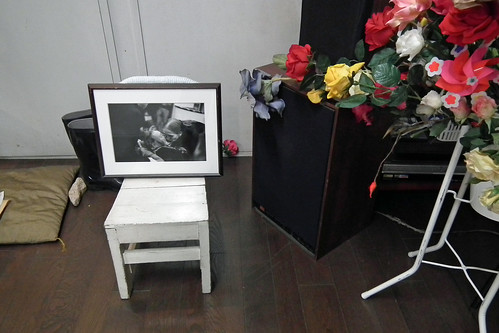
In my stepping I checked all of the space and my eyes fell on a picture on a tiny wooden chair: was the moment when Pina Bausch visited an ailing Kazuo and gave him a kiss; a really beautiful photograph, a very hard one, which made me tremble. Strange paradoxes of life, Pina visited the ailing, and perhaps dying Kazuo, but she would die a year before him.


Kazuo Ohno Dance Studio (Yokohama, 2011)

I know some of you, artists or not, understand my dwelling on this first step into the workspace of the studio of master Ohno, my devoting a blog entry to this account of the place where one has dreamed of being and of learning in.  I know some of you have dreamed of stepping into a place you really felt was sacred; it is you I'm addressing and for whom I write these texts, I took these photos and this video that illustrates that first step in my visit to the dance studio of master Kazuo Ohno in Yokohama, last April 20th 2011.


Texts, photographs and videos in this Blog are all author's property, except when marked. All rights reserved by Gustavo Thomas.
If you have any interest in using any text, photograph or video from this Blog, for commercial use or not, please contact Gustavo Thomas at gustavothomastheatre@gmail.com.


If you are interested in using any text, image or video from this Blog, please contact the author writing your e-mail and information in comments. (comments are private)
Gustavo Thomas. Get yours at bighugelabs.com