Wednesday, January 7, 2009

Grotowski Year 2009. A programme of events.


I've just received from Alejandra Nettel, a Mexican actress linked to Grotowki Institute, the programme of The Grotowski Year 2009:


Dear All

I warmly invite you to the Inauguration of the Grotowski Year 2009. The programme of the Inauguration includes among others the opening of the exhibition Dust. Apocalypsis cum Figuris in the photographs of Maurizio Buscarino, international conference Grotowski: what was, what is. And what is to be done, the concert by Bauls from West Bengal (India) and the meeting with Peter Brook devoted to his book With Grotowski. Theatre is Just a Form, led by Professor Georges Banu.

Bellow and in the attachment you can find the complete programme.

More information about the programme of the Grotowski Year 2009 you can find on the website www.grotowskiyear.pl.

Best regards,

Izabela Mlynarz


Wrocław, 12th–15th January 2009

INAUGURATION OF

THE GROTOWSKI YEAR 2009

Co-hosts: Ludwik Flaszen, Rena Mirecka, Zygmunt Molik

PROGRAMME OF THE INAUGURATION

12th January (Monday)

4 pm

The Great Hall of the Wroclaw Town Hall, Old Market Square

• Words of welcome by Jaroslaw Fret, Director of the Grotowski Institute

• Speech by Bogdan Zdrojewski, Minister of Culture and National Heritage and presentation of the medals Order of Merit and Culture Gloria Artis (the Gold Order for Ludwik Flaszen, the Silver Orders for Rena Mirecka and Zygmunt Molik)

• Speech by Rafal Dutkiewicz, President of Wroclaw

• Speech by Kazimierz Grotowski

6:30 pm

The Apocalypsis Space of the Grotowski Institute, RynekRatusz 27

Opening of the exhibition Dust. ‘Apocalypsis cum Figuris’ in the photographs of Maurizio Buscarino, organised by the Grotowski Institute in collaboration with the Lower Silesian Photography Centre “Domek Romanski” – Gallery of the Centre for Culture and Art in Wroclaw; spatial arrangement Stanislaw Lose, curator Grzegorz Ziolkowski

13th–15th January (Tuesday–Thursday), 10 am – 7 pm

International conference Grotowski: what was, what is. And what is to be done

The Assembly Hall of the Ossoliński National Institute, Szewska St. 37

Speeches by: Paul Allain, Georges Banu, Mario Biagini, Abani Biswas, Tinkori Chakraborty, Janusz Degler, Marco De Marinis, Ludwik Flaszen, Marc Fumaroli, Leszek Kolankiewicz, Dariusz Kosinski, Jenna Kumiega, Jack Lang, Else Marie Laukvik, Ferruccio Marotti, Zbigniew Osinski, Carla Pollastrelli, Richard Schechner, Luisa Tinti

Guest: Jana Pilátová

13th January (Tuesday), 9 pm

Film presentation Sacrilegious Rite, Abounding in Sorcery’. On Jerzy Grotowski’s Laboratory Theatre, directed by Krzysztof Domagalik, produced by Polish Television, Warsaw 1980; meeting with the director

The Conference Hall of the Ossolinski National Institute, Szewska St. 37

14th January (Wednesday), 9 pm, T

Songs for Grot. Concert by Bauls from West Bengal (India) on the 10th anniversary of Jerzy Grotowski’s death

Museum of Architecture, Bernardynska St. 5

15th January (Thursday), 7 pm

Meeting with Peter Brook devoted to his book With Grotowski. Theatre is Just a Form, edited by Paul Allain, Georges Banu and Grzegorz Ziółkowski (Wrocław: Grotowski Institute, 2009; in collaboration with the British Grotowski Project); led by Georges Banu

The Assembly Hall of the Ossolinski National Institute, Szewska St. 37

12th–31st January 2009

The Old Market Square in Wroclaw

Exhibition 50 Years of the Laboratory Theatre, created by Barbara Kaczmarek (graphic design), Duncan Jamieson (revision of the English text), Toyotaka Ota (montage of the video presentation) and Grzegorz Ziolkowski (concept and text)


12th January (Monday), 6:30 pm

The Apocalypsis Space of the Grotowski Institute, Rynek Ratusz 27

Opening of the exhibition Dust. ‘Apocalypsis cum Figuris’ in the photographs of Maurizio Buscarino, organised by the Grotowski Institute in collaboration with the Lower Silesian Photography Centre “Domek Romanski" – Gallery of the Centre for Culture and Art in Wroclaw; spatial arrangement Stanislaw Lose, curator Grzegorz Ziolkowski

Admission free


In 1979 in Milan Maurizio Buscarino, a remarkable Italian artist, photographed the rehearsals and performance of Apocalypsis cum Figuris by the Laboratory Theatre, as well as recordings of the film documenting this performance. Until now only some of his pictures were published. After years – at the Grotowski Institute’s request – the author edited the rest of the photographs and chose some of them especially for the exhibition in the historical space of the Laboratory Theatre where Apocalypsis was created in 1968. This selection, which includes forty seven pictures, makes the time travel possible. Thanks to it we have a possibility to encounter the historical work of Jerzy Grotowski and his group in unique way.

The exhibition will be open until 31st January 2009 at the Grotowski Institute and after that it will be transferred to the Lower Silesian Photography Centre – “Domek Romanski”, Gallery of the Centre for Culture and Art in Wroclaw (pl. bpa Nankiera 8, Wroclaw). Opening of an exhibition in “Domek Romanski” is planned for the end of March 2009.

We wish to thank Roberta Secchi for her invaluable help.

Maurizio Buscarino Grotowski in black and white

A journey into Grotowski’s ‘aura’ through the lens of the great theatre photographer, Maurizio Buscarino, who recently recovered from his archives shots of the last performances of Apocalypsis cum figuris as well as other photos. This is for the current exhibition arranged in Wrocław for the tenth anniversary of Grotowski’s death.

Buscarino has photographed the theatre and theatres, theatre in prison, puppet theatre, theatre pilgrimages, performances by theatre groups and Kantor’s creations. For more than thirty years he has been the eye and the memory of the new theatre. His photographs are not just documentary evidence: they narrate, evoke, suggest, and interpret. Amongst other things, he also took photographs of Grotowski, especially his Apocalypsis cum figuris in 1979, at the Palazzo Reale in Milan, shortly before the announcement of the Teatr Laboratorium’s dissolution.

(The fragment of the interview by Massimo Marino, published in Hystrio, a quarterly magazine on the theatre and performance, Year XXII, no. 1, Milan 2009. Translated by Roberta Secchi with Paul Allain. The whole interview is available on the website www.grotowskiyear.pl)


13th–15th January

International conference Grotowski: what was, what is. And what is to be done

The Assembly Hall of the Ossolinski National Institute, Szewska St. 37

Admission free

13th January (Tuesday)

Chair: Ludwik Flaszen

10–11:15 am speech by Jack Lang

11:15 am –12:15 pm Georges Banu Stanislavski/Meyerhold et Brook/Grotowski: le sens de ces amitiés dans le XX-ème siècle

12:30–1:30 pm Else Marie Laukvik ‘Shining up the Grotowski Room’. Memories of an Actress

Chair: Leszek Kolankiewicz

4–5 pm Ferruccio Marotti ‘The Constant Prince’ – a reconstruction, a strange adventure

5:30–7:30 pm Zbigniew Osinski and Richard Schechner In a Dialogue about Grotowski

14th January (Wednesday)

Chair: Zbigniew Osinski

10–11:15 am Jenna Kumiega Reflections

11:15 am – 12:15 pm Leszek Kolankiewicz Druga ojczyzna Grotowskiego: Haiti (Grotowski’s second homeland: Haiti)

12:30–1:30 pm Marco De Marinis La ricerca sul rituale nel lavoro di Grotowski

Chair: Georges Banu

4–5:30 pm Abani Biswas and baul Tin Kori Chakraborty The Inner Man

6–7:30 pm Ludwik Flaszen Grotowski i jego cień (Grotowski and his shadow)

15th January (Thurday)

Chair: Marco De Marinis

11–12 am Marc Fumaroli Grotowski ou le passeur de frontières

12–1 pm Meeting with Mario Biagini

3–5 pm Panel discussion Grotowski – and what is to be done: 10 years later

With: Paul Allain, Dariusz Kosiński, Carla Pollastrelli and Luisy Tinti, led by: Janusz Degler

Guest: Jana Pilátová

Partner: Narodowe Centrum Kultury

Languages: English, French, Italian, and Polish

The conference was programmed by Grzegorz Ziolkowski

Collaboration: Magdalena Madra

We asked Ludwik Flaszen’s advice


13th January (Tuesday), 9 pm

Film presentation Sacrilegious Rite, Abounding in Sorcery’. On Jerzy Grotowski’s Laboratory Theatre, directed by Krzysztof Domagalik, produced by Polish Television, Warsaw 1980; meeting with the director

The Conference Hall of the Ossoliński National Institute, Szewska St. 37

Admission free

Krzysztof Domagalik’s film, consulted by Zbigniew Osinski, is one of the most important documentaries devoted to the work of the Laboratory Theatre. It presents the history of the company since the beginning of the group existence until 1980 through the commentary, illustrations such as photographs and fragments of other films, but above all through the speeches of the creators: Jerzy Grotowski, Ludwik Flaszen, Ryszard Cieslak, Zbigniew Cynkutis, Rena Mirecka, and Zygmunt Molik.

Until now this film was barely known beyond Poland. However, in 2009 it will be released in DVD format with English subtitles by Polskie Wydawnictwo Audiowizualne in collaboration with the Grotowski Institute. It will be presented with English subtitles on 13th January 2009 in the Ossolineum as well.


14th January (Wednesday), 9 pm, T

Songs for Grot. Concert by Bauls from West Bengal (India) on the 10th anniversary of Jerzy Grotowski’s death

Museum of Architecture, Bernardynska St. 5

Tickets – Tomasz Jurek: bilety@grotowski-institute.art.pl


Bauls from Bengal

Bauls originate from a community of wandering mystical singers that goes back to the Middle Ages. Even if they are Hindus, they do not recognize caste divisions, they profess equality of faiths and religions and retain that Divinity has its place in the Heart of every Man. Bauls were re-discovered by Rabindranath Tagore, a renowned Indian poet. Tagore regarded Bauls’ poems as masterpieces of Indian literature. Performing arts and creative techniques have become for Bauls a way of living that was originally combined with the search for inner knowledge. Nowadays it is the artistic aspect that prevails, to the detriment of personal search. Bauls make their own characteristic musical instruments and are true masters of improvisation. They live through their music. The joy of being alive and present that comes from, it is what makes them become true Bauls, i.e. “God’s fools”.

MONER MANUSH / THE MAN OF THE HEART

Translation from Bengali by Eleonora Caturegli Biswas

That is why, brother, I have become a crazy Baul.

I do not obey any master or order.

Man-made distinctions don’t affect me.

I dwell in the joy of love that springs forth from my being.

Love knows no separation, but only the meeting of hearts forever.

And so I am joyful, I am singing and dancing with one and all.

That is why, brother, I have become a crazy Bail.

Ki bole Manush moreWho says man dies?

Who says man dies?

I cannot understand this

After his death by whom will be the man judged?

The five essences of the matter are present in the human body,

We can easily understand it

From one soul, two others are born.

The universal spirit is immortal

The universal spirit lives in the mortal beings

We call it, the cycle of life and death

Who is the operator of this system?

He has no images,

He is invisible,

No one is able to describe him

He is playing his game silently

The soul of all living beings lives in the Universal soul,

By whom is fulfilled the source of the pure Force?

Our precious body will be destroyed

The water of the ocean is formed from the waters of all the flowing rivers

Which again go back to their source

The ocean never dries

The high and low tides go away and again come back

In this way the man is leaving and returning

Monshur* says, “The soul of human beings comes back again and again,

Endlessly”.

* Monshur Fakir a known Muslim master of the last century.

More songs of the Bauls on the website www.grotowskiyear.pl


15th January (Thursday), 7 pm

Meeting with Peter Brook devoted to his book With Grotowski. Theatre is Just a Form, edited by Paul Allain, Georges Banu and Grzegorz Ziolkowski (Wroclaw: Grotowski Institute, 2009; in collaboration with the British Grotowski Project); led by Georges Banu

The Assembly Hall of the Ossolinski National Institute, Szewska St. 37

Admission free


“From early on, Grotowski recognized the double nature of forms. They conceal, but they also protect the life that is within. For this reason, he set up his own barriers, so as to conceal and protect the work he was doing with his dedicated companions in their well-guarded private space. When he eliminated spectators from his theatre, and when he refused to allow writers to describe and evaluate his explorations, this was to prevent mere descriptions from replacing the vivid life of actions. And yet Grotowski, a great reader, an encyclopedic man of learning, knew well how essential in human life it is for understanding to be passed on, for there to be a chain of transmission. His quest was not only in a personal need to force the crust of the earth to open so as to reveal the blazing core hidden in its depths. It was also, in his own chosen field of theatre, to guide others, to help them discover in exact, detailed and repeatable ways what laws, what practices make this deep inner penetration possible. In this way, he could develop a craft that could be transmitted directly, from person to person, a craft that examined the relationship between impulse and action, and made their coming together possible. He carefully separated himself from his explorations, so that they could continue one day without him”. (an extract from the book)


Peter Brook was born in London in 1925. He directed his first play there in 1942 and then went on to direct over eighty productions in London, Paris and New York. His work with the Royal Shakespeare Company includes Love’s Labour’s Lost, Measure for Measure, Titus Andronicus, King Lear, Marat/Sade, US, A Midsummer Night’s Dream, and Antony and Cleopatra. In 1971, he founded the International Centre for Theatre Research in Paris and in 1974, opened its permanent base in the Bouffes du Nord Theatre. There, he directed Timon of Athens, The Ik, Ubu aux Bouffes, Conference of the Birds, L’Os, The Cherry Orchard, The Mahabharata, Woza Albert!, The Tempest, The Man Who, Qui est là?, O! les Beaux Jours, Je suis un Phénomène, Le Costume, The Tragedy of Hamlet, Far Away, La Mort de Krishna, Ta Main dans la Mienne, Le Grand Inquisiteur, Tierno Bokar, and Sizwe Banzi is dead – many of these performed both in French and English. In opera, he directed La Bohème, Boris Godounov, The Olympians, Salomé and Le Nozze de Figaro at Covent Garden; Faust and Eugene Onegin at the Metropolitan Opera House, New York, La Tragédie de Carmen and Impressions of Pelleas, at the Bouffes du Nord, Paris and Don Giovanni for the Aix en Provence Festival. Peter Brook’s autobiography, Threads of Time, was published in 1998 and joins other titles including The Empty Space (1968) – translated into over 15 languages, The Shifting Point (1987), There are No Secrets (1993), Evoking (and Forgetting) Shakespeare (2002). His films include Lord of the Flies, Marat/Sade, King Lear, Moderato Cantabile, The Mahabharata and Meetings with Remarkable Men.

In December 2007, upon the initiative of Georges Banu and Grzegorz Ziolkowski, Peter Brook’s book about Jerzy Grotowski Teatr jest tylko formą was published in Polish by the Grotowski Institute. For the inauguration of the Grotowski Year 2009 the author prepared the English edition of this book, which is published by the Grotowski Institute. At the same time, Actes Sud publishes the French version Avec Grotowski. Le théâtre n’est qu’une forme – with Georges Banu’s introduction.

The author, the editors and the publisher would like to thank Nina Soufy for her invaluable help.

Contact regarding any publishing matters:

Monika Blige: monika@grotowski-institute.art.pl


Information

In January the book in Polish Grotowski powtorzony (Grotowski Repeated), edited by Stanisław Rosiek (Gdansk: słowo/obraz terytoria, 2008, in collaboration with the Grotowski Institute in Wroclaw) will be available. See: www.terytoria.com.pl

The special issue of the journal Performance Research entitled On Performatics edited by Richard Gough and Grzegorz Ziolkowski (vol. 13, nr 2, June 2008), which is the response to the conference Performance Studies and Beyond, organised at the Grotowski Centre in December 2006 – is also coming out in January 2009.


Patronage:

Media partners:


T – tickets

Reservation and ticket sale for the Baul concert – Tomasz Jurek: bilety@grotowski-institute.art.pl

www.grotowskiyear.pl

The Grotowski Year 2009 Office:

office@grotowski-institute.art.pl

Producing Director of the Grotowski Year 2009

Joanna Klass jklass@grotowski-institute.art.pl

Producer of the International Theatre Festival The World as a Place of Truth

Anna Lewanowicz anna@grotowski-institute.art.pl

Assistant Coordinators

Karolina Bykowska, Rachel Jendrzejewski, Marie Magneron

office@grotowski-institute.art.pl

Press Contacts

Tatiana Drzycimska, Anna Pupin

media@grotowski-institute.art.pl

The Grotowski Institute

Rynek-Ratusz 27, 50–101 Wroclaw, Poland

tel. + 48 71 3445320, tel./fax + 48 71 3434267

www.grotowski-institute.art.pl

Contact

• Archive – Adela Karsznia: adela@grotowski-institute.art.pl

• Administration – Magdalena Madra: magda@grotowski-institute.art.pl

• Programme section – Izabela Mlynarz: iza@grotowski-institute.art.pl

• Publishing section – Monika Blige: monika@grotowski-institute.art.pl

Director: Jaroslaw Fret /Programme Director: Grzegorz Ziolkowski

Friday, January 2, 2009

Joe Louis Thai Puppet Theatre. A second visit.


The new visa regulations set in China in the run up to the Olympic Games forced me this July 2008 to travel suddenly to Thailand; I was a few days in Bangkok trying to get my papers in order as soon as possible and continue my stay in China . Of course, I also took the opportunity of the trip to make a second visit to Joe Louis Puppet Theater, see again its staging of the plays and calmly take a few pictures of his collection of puppets on permanent on display.


The company


Two years after my first visit I could verify my observations (expressed in my posting of June 17, 2008: Nattayasal Hun Lakhon lek: Joe Louis Puppet theatre of Thailand) on the importance of the puppet theater of Joe Louis and his role as classical theater in Thailand, Asia and the world. I verified the permanence of its codification, of its dramatic structure and of its staging, as well as the quality of the interpretation.


The first time I was there, in December 2006, we were informed that Joe Louis was ill and that he would not be able to attend the theater to see the work of his company or to greet people as customary. Joe Louis died in May 2007.

In mid-2006 the company took the global prize for puppet theater in Prague, Czech Republic. Although it was an important prize that placed them on an international level, the demise of Joe Louis a year later brought to the company problems and challenges to its survival.

Apparently the living figure of Joe Louis in Thailand lent a big weight to his work and continued support to his work; once he passed away such support has been increasingly difficult to achieve and I understand that the theater today is in danger of disappearing due to the construction of a shopping mall in the land they occupy; construction plans are imminent and so far the construction company and the theater have not been able to reach an understanding to designate a space for the theater inside the mall.


The performances


Joe Louis conceived his puppet theater by following a classical structure with elements of the most respected traditional theater in Thailand, Khon, but including modern stage elements; and so we can see in their performances both video and background sound, photographs and the use of modern materials (such as plastic and foam) in the construction of some puppets; smoke machines, for example, are used for the mystical atmosphere of certain scenes.

His position was open to the idea of spectacle and public attention, leading him to create a performance structure with a certain uniqueness, which I define in a few points:

- The performances are of a strong educative style and are directed mainly to tourism.

- Before each performance a video documentary presents the history of both the theater of Joe Louis as well as of Thai puppets;

- An explanation-demonstration (in Thai and English) of the origin of the dance of the puppeteers and the puppets themselves, and of the origin of the stories that will be told in the piece to come, is staged

- The representation itself, with all the elements of the Thai stage culture, takes about an hour.

- Once the performance is over, some playful interaction (which has nothing to do with the piece represented) with the spectator takes place: they play with the spectators, give them kisses, hide objects, and so on.

All these elements, unrelated to the piece of art itself but necessary for the functioning of the physical theater, provoked in me (having seen him for the second time) a certain weariness and disappointment that vanished only during the course of the representation of the piece.


The play represented is the same that I saw two years ago, "The Myth of Rahoo and the lunar eclipse." Although the Joe Louis theater has other plays ( "Mayarap" and "The Birth of Sudsakorn," among others), they show none of them but only "The Myth of Rahoo ...", dedicated to tourists.

The company does not appear to have a project to create a group of connoisseurs or followers of their work, I noticed that, on the contrary, they are not open to research, analysis and criticism. Apparently they do not have a plan to deepen their creative work, or at least there are no conditions to implement it. With the exception of a few books and printed newsletters, actual information is scarce, with most of these booklets devoted to recounting the legendary story of Joe Louis’s puppets.

I see in all this a threat of extinction, because the creative movement of their teacher has been stalled and its evolution halted. With Joe Louis dead, his heirs are apparently trying to survive in the chaos of loss with just what they inherited.


Puppet Gallery


Before the performance one can take a stroll through the corridors of the theater and find a gallery-museum where they have on permanent display about twenty puppets (medium sized) and masks built by Joe Louis. The exhibit is interesting, the work is truly beautiful. We have the opportunity to meet Joe Louis, as he’s been immortalized as a wax figure (of sorts) in which we see him handling one of his dolls.


*


It's a real shame to see the fragility with which the company maintains itself at both the physical and aesthetic levels, and I do not know how far it'll be able to stay and, furthermore, evolve.

There will be time to return in a few years and discover the path that helped them to continue their "revolution" or the path that led them to disappear.


Joe Louis Pupet Theatre Web site: http://www.thaipuppet.com/en/

Monday, December 29, 2008

Happy New Year 2009!

After two years of writing this Blog I only can say:


Thank you to all of you!


I wish you a very happy new year 2009!


Gustavo Thomas
Beijing, China
December 30th, 2008.

Tuesday, December 23, 2008

Pingyao Tea House Theater (3): Three scenes of Shanxi Opera

Shanxi Opera (晋剧) Scenes performance: Changing Masks


Following my series of "Pingyao Tea House Theater" (1), this last part presents three scenes performed during the same spectacle for tourists I have been talking in part 1: one acrobatic scene, one comic scene and one quick-changing masks scene.

Even the spectacle that night were not only of Shanxi Opera it was an unique opportunity to see a company specialized on it playing some characteristic scenes of that kind of Chinese theatre. Shanxi Opera performances are not as easy to find than Peking Opera performances; there are no much companies and their seasons are rare, usually they give some isolated performances in very special occasions.

The acrobatic scene did not show to me anything special, being very similar to other kind of Chinese operas I have seen before, I only corroborated my appreciation of those amazing actors-acrobats always working to perfection (even in spectacles like this).

The Comic scene was an interesting surprise; it was the first time I heard singing like that, not only comically but with a very special use of the rhythm. This Shanxi Opera song showed to me a very fresh way to sing in traditional Chinese theatre, codification was still there but the difference with Peking Opera (the opera I have seen the most) seemed huge.


I couldn't miss a quick-changing Mask scene; people from all over the world come to the South of China to see these actors doing that amazing switch of masks. It was a pity they did not do that inside a real opera scene, instead of it they performed those changes like an act of Magic. Not bad but it seemed to me more Las Vegas-kind spectacle than a Shanxi Opera one.


(1) "Pingyao Tea House Theater (1): Shanxi Opera Scenes Murals.", and
"Pingyao Tea House Theater (2): Seeing today Chinese spectators as an anthropological experience?"


Texts, photographs and videos in this Blog are all author's property, except when marked. All rights reserved by Gustavo Thomas. If you have any interest in using any text, photograph or video from this Blog, for commercial use or not, please contact Gustavo Thomas at gustavothomastheatre@gmail.com.


Wednesday, December 17, 2008

北京龙在天皮影 Longzaitian, Chinese Shadow Puppet Theatre Company: "Tale of the goat and the wolf"


About a year ago the renovation of Qianmen street begun. In downtown Beijing, Qianmen was the main avenue that for centuries led the whole of the known world to the main gate (Qianmen means “front gate”) of the walls of the forbidden city.

After the fall of the millenary Chinese empire (at the beginning of the 20th century), the pre-communist years and the communist era itself, Qianmen street became just some old houses and buildings on the verge of collapse. Surrounded by one of the neighbourhoods (hutongs) of greatest commercial and cultural tradition, Qianmen remained important only due to its location, south of Tian’anmen Square.


After a year of works, Qianmen has been mostly renovated and, though there are tinges of aesthetic falsity (its central part was conceived as a thematic luxury mall, for example), the street looks like during the best years of the Qing dynasty. What’s most interesting in this important renovation is the rescue (at least façade-wise) of the most important buildings, of traditional shops and of a series of places where Beijing’s cultural life developed for hundreds of years. And so, walking on the street and its environs we can visit famous shops, traditional pharmacies, restaurants, cinemas (the first one of China, for example) and some theatres.

One of the theatres that has had more movement thanks to the street renovation (yet not its building, which still is to be renovated) is the one that belongs to the Longzaitian (or “Dragon in the Sky” in Chinese, 北京龙在天皮影) shadow puppet theatre company.

In one building the company houses three small theatre halls, some puppet-creation workshops, and a gallery-museum.

What I found most enjoyable during this visit was the possibility to (finally) watch and watch again shadow puppet performances in Beijing; it had always been hard for me to find an established place where shadow puppet performances took place regularly and by a stable company. Until then, I had only been able to see isolated performances by provincial groups or, in very special events, by pekinese groups.

Last October 12th (Sunday) 2008 I saw two performances with two of the company’s groups: “The story of the goat and the wolf”, addressed to children, and “The three defeats of the skeleton-demon”, a traditional performance based on a story taken from “Journey to the West”, one of the greatest pieces of Chinese fantasy literature.

At that point in my stay in China, and having seen dozens of performances by different groups and companies, I think I was able to better appreciate the work needed for a performance; I recognised the use of a more “flexible” kind of puppet, and a clearer way of telling stories for the modern spectator. I still can’t recognise the differences in their techniques for handling the puppets, but it is true that, unlike the groups from the Chinese provinces, the shadow puppet groups from Beijing are (as is the case with traditional opera) oriented more to real entertainment and they manage to keep the attention of the modern spectator; they have no qualms in transforming traditional plays.

The company is made up of two groups, one for children and one for traditional performances.

I’d like to mention two curious facts. The puppets for “The tale of the goat and the wolf” are handled by puppeteers with dwarfism (the company advertises them as such; a possible translation of the Chinese words used could be “pocket puppeteers”), and they don’t sing nor play instruments (as is usual in Chinese shadow puppet groups), but instead make use of “playback”.

I managed to record the whole of “The tale of the goat and the wolf”, which lasts about 13 minutes, but the traditional piece “The three defeats of the skeleton-demon”, which lasts longer (some 23 minutes) didn’t fit in the memory of my camera and therefore I couldn’t record all of it.

For now, I share “ The tale of the goat and the wolf” and I promise to share a traditional play in a next posting.


Due to the length of the video (13 minutes) I couldn’t upload it to Youtube as one video, and split it into two; here are the links:


Complete video in Ipernity:


Wednesday, December 10, 2008

三枝橘制作 Théâtre des trois oranges: A rehearsal of Luxun's "Ye Cao" 野草


Here some images of one rehearsal of Ye Cao 野草 (Wild Grass), last Théâtre des Trois Oranges's production in Beijing, China. October, 2008. I was invited by Xavier Froment and it was interesting to see this production since rehearsals and then having a point of reference to watch the performance.

I had also the opportunity to see (for first time) Kang Luqi working. He is one of Froment's titular actors. During this rehearsal I saw him as any other actor repeating movements, recalling texts, etc. But days later watching him on stage, in performance, things were different, in front of my eyes he became a very strong image of a good actor, surprisingly finding a place in my spectator's memory.

There will be a special post for the performance.


Wednesday, December 3, 2008

Pingyao Tea House Theater (2): Seeing today Chinese spectators as an anthropological experience?


The Pingyao Tea House Theater is, as its name says, a Tea House; ancient tea houses in China were much more than their name implies to us in these days: they were hostels (special ones, not just anyone could stay there, only people from a specific region or group), party saloons, theaters, a kind of cabaret, restaurants and, of course, places where you could drink some tea. Historians say that performances in there were done in the middle of a unimaginable chaos ( it seems a common characteristic of theaters around the world in the past): people were eating, drinking, having fun, playing all kinds of table games, shouting, laughing, walking, and not always with an interest in the spectacle being performed at the moment. You can observe in detail the picture above, a Tea House performance during the last years of Qing Dinasty, as a very good example of what I am talking about.

It seems that temples and palaces were similar, a theater performance was part of a huge movement around festivities or court parties. None of these conducts seem to have bothered the artists, they were used to it.

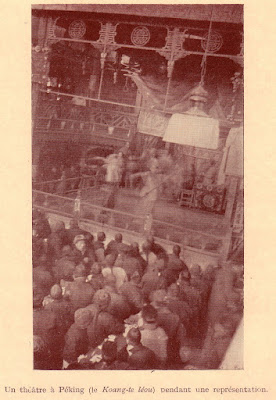
The next photographs show not a tea house but a theatre (Kuang-te lou) in central Beijing at the beginning of 20th Century (1), you can even see tables and how, during the performance, people are served food and drinks.

Chinese spectators has changed a little bit ( in comparison to Western ones); the arriving of Western codes of conduct at theatres at the end of the 19th Century created an intellectual elite who knew very well how to act as a spectator of any Western style performance (music concerts, theatre, ballet, opera, etc), but Chinese traditional performing arts maintained the same conduct depicted above: chaos and more chaos. It is until the end of the Mao era that Chinese spectators start to see both kinds of spectacles, Western and Chinese, with only one code of conduct, the culture of silence, at least in theory. Playwright Arthur Miller had a fantastic experience in 1980's Beijing and depicts very well, in his book "Salesman in Beijing", how Chinese spectators behaved during performance. (2)

Today, a common Western spectator still perceives as different how a Chinese spectator reacts to any spectacle and how they behave during a performance, but the change with how it used to be in the past is remarkable. Even today in the VIP section you can be served tea and cookies, with waiters walking from one seat to another during the performance, people receiving phone-calls and people talking in a normal level of voice, yet the theatre staff always ask for silence and for people to turn off their mobiles.

So, that code of conduct during a spectacle is threatened with its end, except for one special place, tea houses for tourists.

Now we can come back to our post subject. The Pingyao Tea House Theater is a theater which opens for tourists, for groups and more groups of hungry and energetic Chinese tourists. They come to this place after a long day of walking and visiting temples, museums, shops around the ancient city of Pingyao, and they want to finish the day with a meal (the most important experience for any Chinese), a laugh and enjoying a very traditional show. That is what I called an anthropological experience: a bit of that ambiance and public conduct under which performances were done in the past. A game, of course, but a very interesting one.

It is kind of difficult, due to the noise during Chinese opera performances, to differentiate the spectators’ noise, but you can taste a little bit of it in the next videos:


Video: spectators getting into Prince Gong Residence Tea House Theatre


And the last one, in the turist village of Wuzhen, a Shadow Puppet Theatre spectacle; spectators were children but that afternoon none of their teachers asked for silence... (if you listen carefully you will noticed voices of adults as well)

I remember some of the words my teachers tried to define (in their ignorance of it) the Oriental theatre: a theatre where dance, acting, singing, acrobacy, secular parties and religion were mixed... and its spectator behaved in accord to it.


(1) "Théâtre et Music Modernes en Chine" by George Souliè de Morant. Librairie orientaliste Paul Geuthner. Paris, 1926.
(2) "Salesman in Beijing" by Arthur Miller. London, 1984.


If you are interested in using any text, image or video from this Blog, please contact the author writing your e-mail and information in comments. (comments are private)
Gustavo Thomas. Get yours at bighugelabs.com