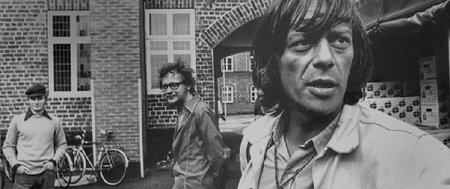
Showing posts with label Grotowski. Show all posts

Monday, February 17, 2014

"I am America" performance by the Open Program of the Workcenter of Jerzy Grotowski and Thomas Richards in Toronto.

The Open Program after I am America performance in Toronto (Photo by Gustavo Thomas © 2014)


Last night the Studio Theatre of the U of T was again packed, this time to see "I am America" by the guys from the Open Program of the Workcenter of Jerzy Grotowski and Thomas Richards.

It was a great night, full of energy and, as some of the people said during the short Q&A session, with many reminiscences of the Grotowskian tradition of doing things.

Once more singing was a very important part of the work but not the less the poetry of Allen Ginsberg, the vocal game and in some moments a very impressive fluidity of the movement of many of the actors.

If in "Electric Party Songs" we saw a young group singing, this time we saw and noticed a theatrical group of young artist doing very well what they wanted to do and that is remarkable, as spectator very appreciable and enjoyable.

Public was less shy in the applause and more enthusiastic in their comments after the performance.

Some of the guys of the Open Program are very young but it was impressive the way they grew on stage during their actions.

Being a critical work on America, the country, through the voice and questions of immigrants (if I understood correctly) I felt opened to the critic of the Americanism, and some of the ironies there were very enjoyable; America is a country and a being who they (or we?) dream with, fall in love, hate and think eternally about.

I kept some images in my memory, especially around the American flag used as a dress and wings, and some remarkable vocal and physical moments.

I couldn't avoid to recall the taste of "Akropolis" (one of the great works directed by Grotowski) during some editions of actions and in the tempo of the actors' work.

At the end, again during the short Q&A session, and old man mentioned about the difference between the joy he felt in this work and the suffering (probably he used other word) people felt in the first Grotowskian works, and Mario Biagini made him notice that the inner work of the main actor in The Constant Prince, Cieslak, was a line of associations related with a very pleasurable moment during the adolescent years of the actor (his first sexual encounter) but the public, worked by the edition of the actions by the director, saw other thing, a man being tortured. Joy then has been always present in this group, even without the physical presence of Grotowski, and this time openly exposed.

Finally I can say that Mario, actor himself, is a master of directing audiences when talks about his work with Grotowski and the group, using his own skills to reach the people who is listening to him, we all were almost static with his words about Grotowski giving to the people through his work, founding the truth (Mario’s truth) in his voice and body in every sentence, giving us what is in his experience as an artist and as human being.

Lovely moments, and now looking forward to see what will happen next in this residence of the Open program in Toronto, with their masterclasses, screening and performances to come.

(I didn't take any photographs of the performance, sorry. I wanted to concentrate myself in the work I was going to see. So, you have here only two of the group during the applause, just as a visual document of the event).


Mario Biagini speaking after the performance of I am America in Toronto (Photo by Gustavo Thomas © 2014)


Texts, photographs and videos in this Blog are all author's property, except when marked. All rights reserved by Gustavo Thomas. If you have any interest in using any text, photograph or video from this Blog, for commercial use or not, please contact Gustavo Thomas at gustavothomastheatre@gmail.com.


Wednesday, March 2, 2011

Tell me about your two friends, Jerzy... "Avec Grotowsky" Texts by Peter Brook about Jerzy Grotowski.


I've just started reading "Avec Grotowski", a book by Romanian-French theatre researcher George Banu, where collects Peter Brook's words about Jerzy Grotowski.  In the introduction of the book Banu quotes a short conversation with Grotowski, a really charming and clarifying sentences about one part of Grotowski's personal world:

" (...) je l'interrogeais sur son amitié bifrons avec Barba et Brook :
'Tu as deux amis. De quoi parles-tu avec Eugenio? Et avec Brook?
- Avec Eugenio je ne parle que du théâtre, avec Peter je ne parle que de la vie !' "


...and we can translate those words in this way:


" (...) I asked him about his bifrons friendship with Barba and with Brook :
'You have two friends. What do you talk about with Eugenio? and what about with Brook?
- With Eugenio I only speak about theatre, with Peter I only speak about life!' "

That demon of two heads (bifrons) puts every of its heads on each side of Grotowski, but the Polish director was never in the centre of anything, ¡he always was on the extreme!

Fascinating research for unveiling the secrets hiding behind the encounter of great men!

"Avec Grotowski" is without any doubt a book full of wisdom of life, wisdom of human relationships, and wisdom of theatre itself. I'm reading it with passion and curiosity. We'll see...


- Posted by Gustavo Thomas. Registered by Creative Commons.

Thursday, December 9, 2010

An Obituary from the Empire... The Death of Riszard Cieslak according to The New York Times.


left to right: Stanisław Ścierski, Jerzy Grotowski, Ryszard Cieślak; Holstebro, Denmark, 1970
photo: Andrzej Paluchiewicz


While trying to write a poem to Ryszard Cieslak, and doing some research about him, I found the The New York Time's obituary dedicated to Cieslak's death in June 16th,1990. You have to read the paragraph about the theater critics' opinion of him...


"Ryszard Cieslak, Actor, 53

Published: June 16, 1990

Ryszard Cieslak, an actor and a central figure in the Polish Laboratory Theater, died Thursday at the Burzynski Research Institute in Houston. He was 53 years old and lived in Manhattan.Dr. Stan Burzynski said that Mr. Cieslak had been admitted to the institute June 5, and that he died of lung cancer.Mr. Cieslak joined the Laboratory Theater, which Jerzy Grotowski founded in 1959 in Poland as a vehicle for experimental drama, in 1962. After its dissolution in 1977, Mr. Cieslak and Mr. Grotowski worked together in numerous dramatic projects.Theater critics cited Mr. Cieslak in 1969 as Off Broadway's most outstanding creator and the actor with the greatest promise.For the last four years, Mr. Cieslak taught acting to advanced students at the Tisch School of the Arts at New York University."


"in 1969 as off Broadway's most oustanding creator and the actor with the greatest promise" ... Those God-like critics were very grateful with Cieslak in 1969, but there is nothing concrete about a final valorization of his work in 1990.

Even when The New York Times is one of my favorite newspapers it doesn't mean I see this journal as outside the American empire's media world, and it is a big part of it, of course. This newspaper has been one of the main promoters of American realism and a Broadway style of doing theatre since its beginning, almost erasing (in its own version of performing arts history) any other kind of style or exploration coming from other parts of the world.


Thursday, November 25, 2010

Video with Grotowski explaining his Poor Theatre

If you've ever wondered about Grotowsky explaining his Poor Theatre, here you have a video of Polish television with an interview where the Polish director talks precisely about that  (use de cc button to see English subtitles):


Sunday, June 7, 2009

"Grotowskian" Theatre in Iran. Tantalos and Afshin Ghaffarian's Blog.

All photos and videos in this post are published as a reference and are taken from Afshin Ghaffarian’s Blog and his Youtube channel at http://holy-actor.blogspot.com.


"Medea", performed in Iran’s desert. Tantalos Group, 2008.


A few months ago I discovered the blog of Iranian actor Afshin Ghaffarian, http://holy-actor.blogspot.com, who published some posts showing videos and photographs of a performance called “Medea” by the group "Tantalos". This performance had taken place in the desert of Iran, and it was considered part of a “Grotowskian” theatrical tradition; the videos and photographs documenting it made me find recognizable images more of the style of some followers of the Polish teacher in his vision of the 60s and 70s, I believe, than the style that was developed in the last years of Grotowski’s life. Apparently "Tantalos" also had an exchange with a Mexican director, Raul Valles, who went to Iran with his group and ran a joint show, "Lemnos", with the same style (some videos in the
Blog document the fact).

I visited Iran in 2005 and traveled throughout the country for over two weeks but I could not find any expression of experimental or avant-garde theater; before arriving it was almost impossible to obtain any information about it, even through Internet. So, when I found Ghaffarian’s Blog and discovered a follower of Jerzy Grotowski in the land of the ayatollahs, it was a very strange surprise and it seemed reason enough (at least for me) to speak of it and, of course, to share it with all of you. I sent him an e-mail looking to establish contact and contemplated even the idea of returning to Iran and learning more about this unique (because of the context in which it is done) creative exploration. I hadn’t published any posts on the topic because I never had a reply to my e-mail and Afshin’s Blog had had no entries since October 2008. I decided to wait until he gave signs of life.

During that wait I spent some time reviewing his work, his photos, videos and texts ... I saw in him the dream of any artist discovering a new area of creativity, the singular excitement that the exploratory work of Jerzy Grotowski gives to every young player who enters it and identifies with him. I saw myself with that same excitement when I was discovering and working with the ‘Grotowskian training” in the early 90's in Escenología. I remember Jaime Soriano, my teacher, who had been Grotowski’s asistant in the early 80s, and how he transmitted to us the entire training explored by Grotowski and his actors, the way to create stories through a chain of physical actions; I also remembered the fascinating courses with the Potlach and with the Odin Teatret. I was living again the wonder of being inside a research association as Escenología was (and still is), and working for and with researcher Edgar Ceballos, who had direct and personal contact with Pino di Buduo, Eugenio Barba and of course Jerzy Grotowski. Jaime Soriano was a fervent believer in an actor’s technical work, he introduced us to this whole new wonderful mechanic of creative work, sharing secrets, experiences and his contacts with fellow performers and students who had been with him in Poland, in the United States or India. The discipline, creativeness and desire for knowledge I saw in this young Iranian actor simply became enviable.

Today I’m writing this post because I received a Youtube notification that Ghaffarian had a new video: Tantalos’s last production, "Strange but true", denominated as "Physical Dance Theater".

I have no idea why I didn’t received any reply to my previous e-mail but now he has given signs of creative life and now I have a pretext to share what I have read, seen and experienced with his blog, and of course to send a new e-mail to him.


It is clear from his comments and his training videos that Afshin Ghaffarian is an actor fully convinced of its technical work and his personal searching inside theater, a theater that offers him a philosophy of life, an evolutionary philosophy, and it forms its own creative universe, beyond the vision of theater as a commercial product or a product in the sense of artistic ability to achieve effects.


Although his 2008-Blog documents and information were an interesting reading and showed his first technical training, it was difficult to guess with so short videos and just some photographs the idea of the complete performance of “Medea”, and it is now with "Strange but true" that 9 minutes of continuous video give a clearer view of a Grotowskian style production in the Iran of 2009. An interesting vocal and body technical skill is confirmed by the two actors (Ghaffarian and Yaser Khaseb); you can notice a very intricate partnership on stage, with the use of rhythm and a complete physical intercommunication; there is of course a training behind it, and a strong reason for being on stage, creating. The music is very interesting and it seems it worked as conductor for the show. I do not seek either for a story or to understand the meaning, nor explanations or clarifications, it would be absurd.

I only talk about technical aspects. How would the appreciation of this performance be like inside a theatre? Well, there is no much to say about it, as a video viewer it is virtually impossible to compare my experience with seeing a live performance. I liked some images, I can differentiate some abilities and skills but not more.

But it does confirm my first observation, months ago looking at their documents, that the group would be more related to the exploration of the "theater laboratory" from the 60s and its productions of "El Principe Constante" and "Apocalypsis cum figuris" in searching for "the Holy Actor" and later for "the Theater of the Sources", than the “Objective Drama” or the “Art as Vehicle” explored during Grotowski’s last years in Pontedera, Italy.

For now, I enjoy encountering the work of Tantalos and Afshin Ghaffarian, and being moved by the images and sounds of this performance; we will have time to talk and comment about it later.


I promise more posts about Ghaffarian and Tantalos; I’m more than anxious to keep myself working on it, but I also want to complete the fascinating image of the opposition between a world enveloped in politics and religion as Iran is and a world of a group of young artists looking for a free and metaphysical theater.


Saturday, March 28, 2009

"Manteca" and some memories about the Cuban Theatre I met 15 years ago.


In January 2009 Cubans celebrated the 50th anniversary of the Cuban Revolution, without Fidel, and, it seems, they celebrated with little joy as well as with little support from the Cuban Revolution’s followers in Latin America. Watching journalistic notes about the government celebration, I remembered my last visit to the island, more than 15 years ago.

I do not want to talk (although it is unavoidable) about the condition of Cuban politics and their troubles nor about their achievements and successes (as Raúl Castro has called them). No, I do not want to analyze their situation during those years, I prefer to talk about what I experienced in that visit: its theater.


I travelled to Havana in 1994 as part of a Mexican committee for a theatrical publications encounter, "Encuentro Internacional de Pubicaciones Teatrales Conjunto 94", organized by Casa de las Americas, a very well known Cuban organization. I represented Escenología, the renowned Mexican publishing house as well as the Performing Arts Research Centre, with a donation of some copies of its stage collection books (very famous in the Hispanic world), which comprised about 50 volumes in those days. My job there was simple: to take a course (attending lectures), make a nice speech about Escenología and donate the books in a small ceremony, nothing else. The rest was about enjoying Cuba, its theater and its artists.

The first and biggest impression I had was that theater was immensely popular in the island; apparently, the lack of electronic ways of mass communication dominated the Cuban cultural spectrum, and so theater as a live media was one solution for the entertainment of the common Cuban, exactly as bicycles were for transportation.

I met a few theatre groups, directors, writers, actors, set designers and producers, all of them eager to contact artists and researchers from abroad (I was there as part of Escenologia and not as an actor, so I was kind of a researcher or journalist for them), as I was also eager to learn about their world. These are three of the contacts I still remember clearly.


“Teatro El Público” and Carlos Díaz.


The first encounter was during the inaugural meeting of the congress, with some actors from “Teatro El Público”, a company considered "gay" in Cuba, considered “gay” because of its drama as well as the director, actors, playwrights and of course its subjects. This company had become famous thanks to the stage production of "Las Criadas" (The Maids) by Jean Genet and “Hacia Moscú”, an adaptation of “Three sisters” by Anton Chekhov. Those three sisters in “Hacia Moscú” were played by men. They were preparing a new production of "El Público", the controversial play by Federico García Lorca, whose text is very well known because of its homosexual subject. The group of actors led me that night to the complete company with which I had an informal reunion. It seems that they were on the verge of collapse, but surviving; many of its members had left the country and many others wanted to follow suit; that was a common feeling in the Cuban artistic environment.

They wanted to share their theatrical experience in those productions and repeated some texts and movements for me; it was the first time I listened to Chekhov’s texts with a Cuban accent and the first time I saw them played in that way. I was amazed by this “alternative” way of staging in a communist regime and they absolutely gained my support. They told me about the public reaction to their performances: some spectators reacted by leaving during the play and some by staying and welcoming every movement and text. They also told me that they weren’t chosen to perform during the congress, maybe because of their different productions which could mislead the idea of the Cuban Theatre in the minds of foreigners (I have learnt about that very well now that I am living in China). My meeting with Carlos Díaz, the director, was very short and we could only talk about simple things, and, of course, about the difficulty they had in producing any play of their style, but almost nothing about the acting technique they used or their future plans. Now I have read that Díaz and his company are still working in their own theatre and they are an important institution in the Cuban cultural world (2).

Video: Carlos Díaz (2008)
(http://www.havana-cultura.com/EN/performing-art/carlos-diaz/teatro-el-publico.html#1519)

CARLOS DIAZ / Carlos Diaz' interview


Grotowski followers: "Segismundo, exmarqués"


Note: The next photographs about "Segismundo, exmarqués" appeared in several Internet sites; it seems that the source of them is the next link:


My second contact with Cuban theatre artists was an invitation to a special performance, "Segismundo, exmarqués" by "Teatro Obstáculo", a company which promoted their work as “artaudian and grotowoskian”; my memories are weak about this company but I can remember very well my experience during that performance.

It was a kind of in-home theater (a house where it seems they also lived in) in a central part of Havana. The group caught my attention at that time because of their acting technique; it resembled what we were working in Escenología with Jaime Soriano’s teachings. Jaime, years earlier, had assisted Grotowski in the US, so our links through Grotowski’s way of seeing theatre were evident.


During this performance I saw everything that I had learnt with Soriano, but what I didn’t see was a line, or a sense of one. I remember getting sleepy during the whole performance, though I never found it totally boring. I was enjoying their movements with a very well trained, disciplined body, different movements, and also enjoyed their especial voice, different sounds also, kind of religious songs, some sound explorations using their bodies in combination with their voices, all in an apparent (I can not assure it) disjointed assembly; everything was slow and strange. I discovered those were the same exercises we usually did in our place, but there didn’t seem to be a chain of actions telling a story, it was like a ritual game without sense. Nothing was helping to appreciate that performance: the time of day (noon) and the heat (there was no air conditioning), and lunch hour. The only thing we all were thinking about was getting out at soon as possible to refresh our selves and have a good lunch.

At the end of it I spoke with some other guests, but not with anyone from the company (they left at the end and did not appear again). I have read that the whole company left Cuba and work in Miami.


Fidel and “Manteca”


My third experience with Cuban theatre was the performance of “Manteca”, a play by the Cuban playwright Alberto Pedro Torriente (born 1954). The organizers of the encounter wanted us to appreciate Cuban theatre, but for some reason didn't want we see this performance. They had prepared three others including "Segismundo, exmarqués", "La boda" by Virgilio Piñeira and "Las penas saben nadar" by A. Estorino but not "Manteca".

"Manteca" was a successful Cuban theater production, a production that had attracted crowds during the months before. It was 1994 and Cuba was in the middle of a very strange political moment: some months before Castro had opened the doors for anyone who wanted to leave the island, and thousands did leave, and then he ordered them closed again, followed by some prosecutions and many new restrictions; people were not happy, people were maybe even angry.

I remember this production as a great farce with some points of social criticism. The success of the play had a very simple reason, the reading subtext about a pig secretly raised in an Havana appartment. In the play the animal is loved but hated, it is motif of desire but also of resentment; the pig was identified with Fidel Castro himself. As we were warned of this general reading of the play before seeing the performance, we could then understand the loud laughs among the Cuban spectators that night, it was a public practically in euphoria. The symbolism with the animal clearly took me back to "The Wild Duck" by Ibsen (the pig, as the duck, never appear on stage), but the audacity of Cuban slang and game was what made it truly memorable. The work that we were experiencing as spectator was the theatrical phenomena itself, an event whose worth lies within its context: Cuba with her doors closed once again after the last exodus of the early 90's.

I have rarely enjoyed a live audience as much as I did that night, I can not remember how actors played, and it must have been more common, even more superficial than the other two companies I had seen in Cuba, but certainly they worked well for Cuban standards; those were very functional actors with a very functional technique.

I also discovered that Cubans went to the theater as ancient Greeks did it, to experiment a social catharsis; they could not unleash their anger and their pain in real life but they could do it in a comic piece, in a crazy farce, laughing, clapping, screaming. Everyone wanted the pig, and everyone wanted to steal the pig, and everyone wanted to kill it, to eat it but the animal was untouchable, it was desirable; that was Fidel.


My farewell.

I have not returned to Cuba since that visit and my memories have become a kind of myth edited by my imagination. It is important to write this exercise to locate and deal with them. The 50th anniversary of the revolution and the happiness of the leaders who speak about it made me think about what I lived and what I watched in just the few days I was there. I personally do not remember happiness among Cubans. I remember sadness and worrying faces, especially one, that of a poet I exchanged several books with (a good part of my library exists thanks to an absurd exchange with Cuban artists and students). He chatted with interest about an exchange of ideas with foreign artists, but he was sad and angry; he didn’t want to sell his books but there was no choice, he wanted to eat different, something he could buy in a shop of imported products. I paid for them and I don’t feel bad for it.

At the end of my stay I organized a party with those who I had known. I didn’t spend much money and I could buy what they had a hard time to find and enjoy: cans of tuna, chicken, ham, biscuits, cheese, soft drinks, alcohol ... nothing special. It was a fantastic experience: I learned how to drink “café expresso”, in one stroke; I was taught how to drink rum, smoothly to endure the aroma; and certainly I was taught how to dance alone, with a partner, and in a group. Sweating copiously, the heat of Havana had become bearable, even enjoyable. We all were speaking loudly, in a chaotic way, with alcohol inside and with our heads dancing as well. At some instant they read some texts, some others spoke of their dreams. In the end, the satiety of the meal and the alteration of the vessels stopped, and we began to talk about “the pig"; everything changed, their mood, their faces. They said they were powerless trying to remove that "revolutionary" image of Fidel, they were artists, their work was the theater, not to carry on the Cuban revolutionary image of Fidel all over the world. After hours (literally) of bitterness, they began to get up and leave with some phrases common to them: -"Once again, ending with Fidel!"-, -"All of our parties end up with Fidel" -, -"Now I leave, you continue talking." And that happened, many of them also left Cuba years later.

Our party was almost over, so I left with the last ones for a walk through the “malecón”. At one point a police patrol stopped near us and asked questions; they said we wanted to exploit some tourists or even steal something (they thought I was Cuban, like them), but we were free to go after they checking my papers. My new friends were nervous, some angry, as I was.

Once among friends and in that long and great way along the seaside, with some bitter smiles, I looked at the sea and the huge row of lamps burning through the morning in Havana.

We were free in the solitude of the malecón, we were refreshed by the air, the sea's movement was strong, it was almost dawn, the sea that night was the Cuban theater and it was somewhat rough.


(1) This is a link to a Cuban official cultural site where Díaz is very well treated: HYPERLINK "http://www.havana-cultura.com/EN/performing-art/carlos-diaz/teatro-el-publico.html#1519"http://www.havana-cultura.com/EN/performing-art/carlos-diaz/teatro-el-publico.html#1519
(2) The company's director is Victor Varela, a very well known Cuban director. You can see some examples of his work following this link: www.youtube.com/user/lujuriaenvidiosa

Víctor Varela


Wednesday, January 7, 2009

Grotowski Year 2009 (raw text)

It seems that the last post about the program of the Grotowski Year 2009 couldn't download properly, so I left on the side the photographs to make the text clearer.


Dear All

I warmly invite you to the Inauguration of the Grotowski Year 2009. The programme of the Inauguration includes among others the opening of the exhibition Dust. ‘Apocalypsis cum Figuris’ in the photographs of Maurizio Buscarino, international conference Grotowski: what was, what is. And what is to be done, the concert by Bauls from West Bengal (India) and the meeting with Peter Brook devoted to his book With Grotowski. Theatre is Just a Form, led by Professor Georges Banu.

Bellow and in the attachment you can find the complete programme.

More information about the programme of the Grotowski Year 2009 you can find on the website www.grotowskiyear.pl.

Best regards,

Izabela Mlynarz


Wrocław, 12th–15th January 2009

INAUGURATION OF

THE GROTOWSKI YEAR 2009

Co-hosts: Ludwik Flaszen, Rena Mirecka, Zygmunt Molik

PROGRAMME OF THE INAUGURATION

12th January (Monday)

4 pm

The Great Hall of the Wroclaw Town Hall, Old Market Square

• Words of welcome by Jaroslaw Fret, Director of the Grotowski Institute

• Speech by Bogdan Zdrojewski, Minister of Culture and National Heritage and presentation of the medals Order of Merit and Culture Gloria Artis (the Gold Order for Ludwik Flaszen, the Silver Orders for Rena Mirecka and Zygmunt Molik)

• Speech by Rafal Dutkiewicz, President of Wroclaw

• Speech by Kazimierz Grotowski

6:30 pm

The Apocalypsis Space of the Grotowski Institute, Rynek–Ratusz 27

Opening of the exhibition Dust. ‘Apocalypsis cum Figuris’ in the photographs of Maurizio Buscarino, organised by the Grotowski Institute in collaboration with the Lower Silesian Photography Centre “Domek Romanski” – Gallery of the Centre for Culture and Art in Wroclaw; spatial arrangement Stanislaw Lose, curator Grzegorz Ziolkowski

13th–15th January (Tuesday–Thursday), 10 am – 7 pm

International conference Grotowski: what was, what is. And what is to be done

The Assembly Hall of the Ossoliński National Institute, Szewska St. 37

Speeches by: Paul Allain, Georges Banu, Mario Biagini, Abani Biswas, Tinkori Chakraborty, Janusz Degler, Marco De Marinis, Ludwik Flaszen, Marc Fumaroli, Leszek Kolankiewicz, Dariusz Kosinski, Jenna Kumiega, Jack Lang, Else Marie Laukvik, Ferruccio Marotti, Zbigniew Osinski, Carla Pollastrelli, Richard Schechner, Luisa Tinti

Guest: Jana Pilátová

13th January (Tuesday), 9 pm

Film presentation ‘Sacrilegious Rite, Abounding in Sorcery’. On Jerzy Grotowski’s Laboratory Theatre, directed by Krzysztof Domagalik, produced by Polish Television, Warsaw 1980; meeting with the director

The Conference Hall of the Ossolinski National Institute, Szewska St. 37

14th January (Wednesday), 9 pm,

Songs for Grot. Concert by Bauls from West Bengal (India) on the 10th anniversary of Jerzy Grotowski’s death

Museum of Architecture, Bernardynska St. 5

15th January (Thursday), 7 pm

Meeting with Peter Brook devoted to his book With Grotowski. Theatre is Just a Form, edited by Paul Allain, Georges Banu and Grzegorz Ziółkowski (Wrocław: Grotowski Institute, 2009; in collaboration with the British Grotowski Project); led by Georges Banu

The Assembly Hall of the Ossolinski National Institute, Szewska St. 37

12th–31st January 2009

The Old Market Square in Wroclaw

Exhibition 50 Years of the Laboratory Theatre, created by Barbara Kaczmarek (graphic design), Duncan Jamieson (revision of the English text), Toyotaka Ota (montage of the video presentation) and Grzegorz Ziolkowski (concept and text)

12th January (Monday), 6:30 pm

The Apocalypsis Space of the Grotowski Institute, Rynek Ratusz 27

Opening of the exhibition Dust. ‘Apocalypsis cum Figuris’ in the photographs of Maurizio Buscarino, organised by the Grotowski Institute in collaboration with the Lower Silesian Photography Centre “Domek Romanski" – Gallery of the Centre for Culture and Art in Wroclaw; spatial arrangement Stanislaw Lose, curator Grzegorz Ziolkowski

Admission free


In 1979 in Milan Maurizio Buscarino, a remarkable Italian artist, photographed the rehearsals and performance of Apocalypsis cum Figuris by the Laboratory Theatre, as well as recordings of the film documenting this performance. Until now only some of his pictures were published. After years – at the Grotowski Institute’s request – the author edited the rest of the photographs and chose some of them especially for the exhibition in the historical space of the Laboratory Theatre where Apocalypsis was created in 1968. This selection, which includes forty seven pictures, makes the time travel possible. Thanks to it we have a possibility to encounter the historical work of Jerzy Grotowski and his group in unique way.

The exhibition will be open until 31st January 2009 at the Grotowski Institute and after that it will be transferred to the Lower Silesian Photography Centre – “Domek Romanski”, Gallery of the Centre for Culture and Art in Wroclaw (pl. bpa Nankiera 8, Wroclaw). Opening of an exhibition in “Domek Romanski” is planned for the end of March 2009.

We wish to thank Roberta Secchi for her invaluable help.

Maurizio Buscarino Grotowski in black and white

A journey into Grotowski’s ‘aura’ through the lens of the great theatre photographer, Maurizio Buscarino, who recently recovered from his archives shots of the last performances of Apocalypsis cum figuris as well as other photos. This is for the current exhibition arranged in Wrocław for the tenth anniversary of Grotowski’s death.

Buscarino has photographed the theatre and theatres, theatre in prison, puppet theatre, theatre pilgrimages, performances by theatre groups and Kantor’s creations. For more than thirty years he has been the eye and the memory of the new theatre. His photographs are not just documentary evidence: they narrate, evoke, suggest, and interpret. Amongst other things, he also took photographs of Grotowski, especially his Apocalypsis cum figuris in 1979, at the Palazzo Reale in Milan, shortly before the announcement of the Teatr Laboratorium’s dissolution.

(The fragment of the interview by Massimo Marino, published in Hystrio, a quarterly magazine on the theatre and performance, Year XXII, no. 1, Milan 2009. Translated by Roberta Secchi with Paul Allain. The whole interview is available on the website www.grotowskiyear.pl)

13th–15th January

International conference Grotowski: what was, what is. And what is to be done

The Assembly Hall of the Ossolinski National Institute, Szewska St. 37

Admission free

13th January (Tuesday)

Chair: Ludwik Flaszen

10–11:15 am speech by Jack Lang

11:15 am –12:15 pm Georges Banu Stanislavski/Meyerhold et Brook/Grotowski: le sens de ces amitiés dans le XX-ème siècle

12:30–1:30 pm Else Marie Laukvik ‘Shining up the Grotowski Room’. Memories of an Actress

Chair: Leszek Kolankiewicz

4–5 pm Ferruccio Marotti ‘The Constant Prince’ – a reconstruction, a strange adventure

5:30–7:30 pm Zbigniew Osinski and Richard Schechner In a Dialogue about Grotowski

14th January (Wednesday)

Chair: Zbigniew Osinski

10–11:15 am Jenna Kumiega Reflections

11:15 am – 12:15 pm Leszek Kolankiewicz Druga ojczyzna Grotowskiego: Haiti (Grotowski’s second homeland: Haiti)

12:30–1:30 pm Marco De Marinis La ricerca sul rituale nel lavoro di Grotowski

Chair: Georges Banu

4–5:30 pm Abani Biswas and baul Tin Kori Chakraborty The Inner Man

6–7:30 pm Ludwik Flaszen Grotowski i jego cień (Grotowski and his shadow)

15th January (Thurday)

Chair: Marco De Marinis

11–12 am Marc Fumaroli Grotowski ou le passeur de frontières

12–1 pm Meeting with Mario Biagini

3–5 pm Panel discussion Grotowski – and what is to be done: 10 years later

With: Paul Allain, Dariusz Kosiński, Carla Pollastrelli and Luisy Tinti, led by: Janusz Degler

Guest: Jana Pilátová

Partner: Narodowe Centrum Kultury

Languages: English, French, Italian, and Polish

The conference was programmed by Grzegorz Ziolkowski

Collaboration: Magdalena Madra

We asked Ludwik Flaszen’s advice

13th January (Tuesday), 9 pm

Film presentation ‘Sacrilegious Rite, Abounding in Sorcery’. On Jerzy Grotowski’s Laboratory Theatre, directed by Krzysztof Domagalik, produced by Polish Television, Warsaw 1980; meeting with the director

The Conference Hall of the Ossoliński National Institute, Szewska St. 37

Admission free

Krzysztof Domagalik’s film, consulted by Zbigniew Osinski, is one of the most important documentaries devoted to the work of the Laboratory Theatre. It presents the history of the company since the beginning of the group existence until 1980 through the commentary, illustrations such as photographs and fragments of other films, but above all through the speeches of the creators: Jerzy Grotowski, Ludwik Flaszen, Ryszard Cieslak, Zbigniew Cynkutis, Rena Mirecka, and Zygmunt Molik.

Until now this film was barely known beyond Poland. However, in 2009 it will be released in DVD format with English subtitles by Polskie Wydawnictwo Audiowizualne in collaboration with the Grotowski Institute. It will be presented with English subtitles on 13th January 2009 in the Ossolineum as well.

14th January (Wednesday), 9 pm, T

Songs for Grot. Concert by Bauls from West Bengal (India) on the 10th anniversary of Jerzy Grotowski’s death

Museum of Architecture, Bernardynska St. 5

Tickets – Tomasz Jurek: bilety@grotowski-institute.art.pl

Bauls from Bengal

Bauls originate from a community of wandering mystical singers that goes back to the Middle Ages. Even if they are Hindus, they do not recognize caste divisions, they profess equality of faiths and religions and retain that Divinity has its place in the Heart of every Man. Bauls were re-discovered by Rabindranath Tagore, a renowned Indian poet. Tagore regarded Bauls’ poems as masterpieces of Indian literature. Performing arts and creative techniques have become for Bauls a way of living that was originally combined with the search for inner knowledge. Nowadays it is the artistic aspect that prevails, to the detriment of personal search. Bauls make their own characteristic musical instruments and are true masters of improvisation. They live through their music. The joy of being alive and present that comes from, it is what makes them become true Bauls, i.e. “God’s fools”.


MONER MANUSH / THE MAN OF THE HEART

Translation from Bengali by Eleonora Caturegli Biswas

That is why, brother, I have become a crazy Baul.

I do not obey any master or order.

Man-made distinctions don’t affect me.

I dwell in the joy of love that springs forth from my being.

Love knows no separation, but only the meeting of hearts forever.

And so I am joyful, I am singing and dancing with one and all.

That is why, brother, I have become a crazy Bail.

Ki bole Manush more – Who says man dies?

Who says man dies?

I cannot understand this

After his death by whom will be the man judged?

The five essences of the matter are present in the human body,

We can easily understand it

From one soul, two others are born.

The universal spirit is immortal

The universal spirit lives in the mortal beings

We call it, the cycle of life and death

Who is the operator of this system?

He has no images,

He is invisible,

No one is able to describe him

He is playing his game silently


The soul of all living beings lives in the Universal soul,

By whom is fulfilled the source of the pure Force?

Our precious body will be destroyed

The water of the ocean is formed from the waters of all the flowing rivers

Which again go back to their source

The ocean never dries

The high and low tides go away and again come back

In this way the man is leaving and returning

Monshur* says, “The soul of human beings comes back again and again,

Endlessly”.

* Monshur Fakir a known Muslim master of the last century.

More songs of the Bauls on the website www.grotowskiyear.pl

15th January (Thursday), 7 pm

Meeting with Peter Brook devoted to his book With Grotowski. Theatre is Just a Form, edited by Paul Allain, Georges Banu and Grzegorz Ziolkowski (Wroclaw: Grotowski Institute, 2009; in collaboration with the British Grotowski Project); led by Georges Banu

The Assembly Hall of the Ossolinski National Institute, Szewska St. 37

Admission free


“From early on, Grotowski recognized the double nature of forms. They conceal, but they also protect the life that is within. For this reason, he set up his own barriers, so as to conceal and protect the work he was doing with his dedicated companions in their well-guarded private space. When he eliminated spectators from his theatre, and when he refused to allow writers to describe and evaluate his explorations, this was to prevent mere descriptions from replacing the vivid life of actions. And yet Grotowski, a great reader, an encyclopedic man of learning, knew well how essential in human life it is for understanding to be passed on, for there to be a chain of transmission. His quest was not only in a personal need to force the crust of the earth to open so as to reveal the blazing core hidden in its depths. It was also, in his own chosen field of theatre, to guide others, to help them discover in exact, detailed and repeatable ways what laws, what practices make this deep inner penetration possible. In this way, he could develop a craft that could be transmitted directly, from person to person, a craft that examined the relationship between impulse and action, and made their coming together possible. He carefully separated himself from his explorations, so that they could continue one day without him”. (an extract from the book)

Peter Brook was born in London in 1925. He directed his first play there in 1942 and then went on to direct over eighty productions in London, Paris and New York. His work with the Royal Shakespeare Company includes Love’s Labour’s Lost, Measure for Measure, Titus Andronicus, King Lear, Marat/Sade, US, A Midsummer Night’s Dream, and Antony and Cleopatra. In 1971, he founded the International Centre for Theatre Research in Paris and in 1974, opened its permanent base in the Bouffes du Nord Theatre. There, he directed Timon of Athens, The Ik, Ubu aux Bouffes, Conference of the Birds, L’Os, The Cherry Orchard, The Mahabharata, Woza Albert!, The Tempest, The Man Who, Qui est là?, O! les Beaux Jours, Je suis un Phénomène, Le Costume, The Tragedy of Hamlet, Far Away, La Mort de Krishna, Ta Main dans la Mienne, Le Grand Inquisiteur, Tierno Bokar, and Sizwe Banzi is dead – many of these performed both in French and English. In opera, he directed La Bohème, Boris Godounov, The Olympians, Salomé and Le Nozze de Figaro at Covent Garden; Faust and Eugene Onegin at the Metropolitan Opera House, New York, La Tragédie de Carmen and Impressions of Pelleas, at the Bouffes du Nord, Paris and Don Giovanni for the Aix en Provence Festival. Peter Brook’s autobiography, Threads of Time, was published in 1998 and joins other titles including The Empty Space (1968) – translated into over 15 languages, The Shifting Point (1987), There are No Secrets (1993), Evoking (and Forgetting) Shakespeare (2002). His films include Lord of the Flies, Marat/Sade, King Lear, Moderato Cantabile, The Mahabharata and Meetings with Remarkable Men.

In December 2007, upon the initiative of Georges Banu and Grzegorz Ziolkowski, Peter Brook’s book about Jerzy Grotowski Teatr jest tylko formą was published in Polish by the Grotowski Institute. For the inauguration of the Grotowski Year 2009 the author prepared the English edition of this book, which is published by the Grotowski Institute. At the same time, Actes Sud publishes the French version – Avec Grotowski. Le théâtre n’est qu’une forme – with Georges Banu’s introduction.

The author, the editors and the publisher would like to thank Nina Soufy for her invaluable help.

Contact regarding any publishing matters:

Monika Blige: monika@grotowski-institute.art.pl

Information

In January the book in Polish Grotowski powtorzony (Grotowski Repeated), edited by Stanisław Rosiek (Gdansk: słowo/obraz terytoria, 2008, in collaboration with the Grotowski Institute in Wroclaw) will be available. See: www.terytoria.com.pl

The special issue of the journal Performance Research entitled On Performatics – edited by Richard Gough and Grzegorz Ziolkowski (vol. 13, nr 2, June 2008), which is the response to the conference Performance Studies and Beyond, organised at the Grotowski Centre in December 2006 – is also coming out in January 2009.

Patronage:

Media partners:

T – tickets

Reservation and ticket sale for the Baul concert – Tomasz Jurek: bilety@grotowski-institute.art.pl

www.grotowskiyear.pl

The Grotowski Year 2009 Office:

office@grotowski-institute.art.pl

Producing Director of the Grotowski Year 2009

Joanna Klass jklass@grotowski-institute.art.pl

Producer of the International Theatre Festival The World as a Place of Truth

Anna Lewanowicz anna@grotowski-institute.art.pl

Assistant Coordinators

Karolina Bykowska, Rachel Jendrzejewski, Marie Magneron

office@grotowski-institute.art.pl

Press Contacts

Tatiana Drzycimska, Anna Pupin

media@grotowski-institute.art.pl

The Grotowski Institute
Rynek-Ratusz 27, 50–101 Wroclaw, Poland
tel. + 48 71 3445320, tel./fax + 48 71 3434267

www.grotowski-institute.art.pl


Contact

• Archive – Adela Karsznia: adela@grotowski-institute.art.pl

• Administration – Magdalena Madra: magda@grotowski-institute.art.pl

• Programme section – Izabela Mlynarz: iza@grotowski-institute.art.pl

• Publishing section – Monika Blige: monika@grotowski-institute.art.pl

Director: Jaroslaw Fret /Programme Director: Grzegorz Ziolkowski

Grotowski Year 2009. A programme of events.


I've just received from Alejandra Nettel, a Mexican actress linked to Grotowki Institute, the programme of The Grotowski Year 2009:


Dear All

I warmly invite you to the Inauguration of the Grotowski Year 2009. The programme of the Inauguration includes among others the opening of the exhibition Dust. ‘Apocalypsis cum Figuris’ in the photographs of Maurizio Buscarino, international conference Grotowski: what was, what is. And what is to be done, the concert by Bauls from West Bengal (India) and the meeting with Peter Brook devoted to his book With Grotowski. Theatre is Just a Form, led by Professor Georges Banu.

Bellow and in the attachment you can find the complete programme.

More information about the programme of the Grotowski Year 2009 you can find on the website www.grotowskiyear.pl.

Best regards,

Izabela Mlynarz


Wrocław, 12th–15th January 2009

INAUGURATION OF

THE GROTOWSKI YEAR 2009

Co-hosts: Ludwik Flaszen, Rena Mirecka, Zygmunt Molik

PROGRAMME OF THE INAUGURATION

12th January (Monday)

4 pm

The Great Hall of the Wroclaw Town Hall, Old Market Square

• Words of welcome by Jaroslaw Fret, Director of the Grotowski Institute

• Speech by Bogdan Zdrojewski, Minister of Culture and National Heritage and presentation of the medals Order of Merit and Culture Gloria Artis (the Gold Order for Ludwik Flaszen, the Silver Orders for Rena Mirecka and Zygmunt Molik)

• Speech by Rafal Dutkiewicz, President of Wroclaw

• Speech by Kazimierz Grotowski

6:30 pm

The Apocalypsis Space of the Grotowski Institute, Rynek–Ratusz 27

Opening of the exhibition Dust. ‘Apocalypsis cum Figuris’ in the photographs of Maurizio Buscarino, organised by the Grotowski Institute in collaboration with the Lower Silesian Photography Centre “Domek Romanski” – Gallery of the Centre for Culture and Art in Wroclaw; spatial arrangement Stanislaw Lose, curator Grzegorz Ziolkowski

13th–15th January (Tuesday–Thursday), 10 am – 7 pm

International conference Grotowski: what was, what is. And what is to be done

The Assembly Hall of the Ossoliński National Institute, Szewska St. 37

Speeches by: Paul Allain, Georges Banu, Mario Biagini, Abani Biswas, Tinkori Chakraborty, Janusz Degler, Marco De Marinis, Ludwik Flaszen, Marc Fumaroli, Leszek Kolankiewicz, Dariusz Kosinski, Jenna Kumiega, Jack Lang, Else Marie Laukvik, Ferruccio Marotti, Zbigniew Osinski, Carla Pollastrelli, Richard Schechner, Luisa Tinti

Guest: Jana Pilátová

13th January (Tuesday), 9 pm

Film presentation ‘Sacrilegious Rite, Abounding in Sorcery’. On Jerzy Grotowski’s Laboratory Theatre, directed by Krzysztof Domagalik, produced by Polish Television, Warsaw 1980; meeting with the director

The Conference Hall of the Ossolinski National Institute, Szewska St. 37

14th January (Wednesday), 9 pm, T

Songs for Grot. Concert by Bauls from West Bengal (India) on the 10th anniversary of Jerzy Grotowski’s death

Museum of Architecture, Bernardynska St. 5

15th January (Thursday), 7 pm

Meeting with Peter Brook devoted to his book With Grotowski. Theatre is Just a Form, edited by Paul Allain, Georges Banu and Grzegorz Ziółkowski (Wrocław: Grotowski Institute, 2009; in collaboration with the British Grotowski Project); led by Georges Banu

The Assembly Hall of the Ossolinski National Institute, Szewska St. 37

12th–31st January 2009

The Old Market Square in Wroclaw

Exhibition 50 Years of the Laboratory Theatre, created by Barbara Kaczmarek (graphic design), Duncan Jamieson (revision of the English text), Toyotaka Ota (montage of the video presentation) and Grzegorz Ziolkowski (concept and text)


12th January (Monday), 6:30 pm

The Apocalypsis Space of the Grotowski Institute, Rynek Ratusz 27

Opening of the exhibition Dust. ‘Apocalypsis cum Figuris’ in the photographs of Maurizio Buscarino, organised by the Grotowski Institute in collaboration with the Lower Silesian Photography Centre “Domek Romanski" – Gallery of the Centre for Culture and Art in Wroclaw; spatial arrangement Stanislaw Lose, curator Grzegorz Ziolkowski

Admission free


In 1979 in Milan Maurizio Buscarino, a remarkable Italian artist, photographed the rehearsals and performance of Apocalypsis cum Figuris by the Laboratory Theatre, as well as recordings of the film documenting this performance. Until now only some of his pictures were published. After years – at the Grotowski Institute’s request – the author edited the rest of the photographs and chose some of them especially for the exhibition in the historical space of the Laboratory Theatre where Apocalypsis was created in 1968. This selection, which includes forty seven pictures, makes the time travel possible. Thanks to it we have a possibility to encounter the historical work of Jerzy Grotowski and his group in unique way.

The exhibition will be open until 31st January 2009 at the Grotowski Institute and after that it will be transferred to the Lower Silesian Photography Centre – “Domek Romanski”, Gallery of the Centre for Culture and Art in Wroclaw (pl. bpa Nankiera 8, Wroclaw). Opening of an exhibition in “Domek Romanski” is planned for the end of March 2009.

We wish to thank Roberta Secchi for her invaluable help.

Maurizio Buscarino Grotowski in black and white

A journey into Grotowski’s ‘aura’ through the lens of the great theatre photographer, Maurizio Buscarino, who recently recovered from his archives shots of the last performances of Apocalypsis cum figuris as well as other photos. This is for the current exhibition arranged in Wrocław for the tenth anniversary of Grotowski’s death.

Buscarino has photographed the theatre and theatres, theatre in prison, puppet theatre, theatre pilgrimages, performances by theatre groups and Kantor’s creations. For more than thirty years he has been the eye and the memory of the new theatre. His photographs are not just documentary evidence: they narrate, evoke, suggest, and interpret. Amongst other things, he also took photographs of Grotowski, especially his Apocalypsis cum figuris in 1979, at the Palazzo Reale in Milan, shortly before the announcement of the Teatr Laboratorium’s dissolution.

(The fragment of the interview by Massimo Marino, published in Hystrio, a quarterly magazine on the theatre and performance, Year XXII, no. 1, Milan 2009. Translated by Roberta Secchi with Paul Allain. The whole interview is available on the website www.grotowskiyear.pl)


13th–15th January

International conference Grotowski: what was, what is. And what is to be done

The Assembly Hall of the Ossolinski National Institute, Szewska St. 37

Admission free

13th January (Tuesday)

Chair: Ludwik Flaszen

10–11:15 am speech by Jack Lang

11:15 am –12:15 pm Georges Banu Stanislavski/Meyerhold et Brook/Grotowski: le sens de ces amitiés dans le XX-ème siècle

12:30–1:30 pm Else Marie Laukvik ‘Shining up the Grotowski Room’. Memories of an Actress

Chair: Leszek Kolankiewicz

4–5 pm Ferruccio Marotti ‘The Constant Prince’ – a reconstruction, a strange adventure

5:30–7:30 pm Zbigniew Osinski and Richard Schechner In a Dialogue about Grotowski

14th January (Wednesday)

Chair: Zbigniew Osinski

10–11:15 am Jenna Kumiega Reflections

11:15 am – 12:15 pm Leszek Kolankiewicz Druga ojczyzna Grotowskiego: Haiti (Grotowski’s second homeland: Haiti)

12:30–1:30 pm Marco De Marinis La ricerca sul rituale nel lavoro di Grotowski

Chair: Georges Banu

4–5:30 pm Abani Biswas and baul Tin Kori Chakraborty The Inner Man

6–7:30 pm Ludwik Flaszen Grotowski i jego cień (Grotowski and his shadow)

15th January (Thurday)

Chair: Marco De Marinis

11–12 am Marc Fumaroli Grotowski ou le passeur de frontières

12–1 pm Meeting with Mario Biagini

3–5 pm Panel discussion Grotowski – and what is to be done: 10 years later

With: Paul Allain, Dariusz Kosiński, Carla Pollastrelli and Luisy Tinti, led by: Janusz Degler

Guest: Jana Pilátová

Partner: Narodowe Centrum Kultury

Languages: English, French, Italian, and Polish

The conference was programmed by Grzegorz Ziolkowski

Collaboration: Magdalena Madra

We asked Ludwik Flaszen’s advice


13th January (Tuesday), 9 pm

Film presentation ‘Sacrilegious Rite, Abounding in Sorcery’. On Jerzy Grotowski’s Laboratory Theatre, directed by Krzysztof Domagalik, produced by Polish Television, Warsaw 1980; meeting with the director

The Conference Hall of the Ossoliński National Institute, Szewska St. 37

Admission free

Krzysztof Domagalik’s film, consulted by Zbigniew Osinski, is one of the most important documentaries devoted to the work of the Laboratory Theatre. It presents the history of the company since the beginning of the group existence until 1980 through the commentary, illustrations such as photographs and fragments of other films, but above all through the speeches of the creators: Jerzy Grotowski, Ludwik Flaszen, Ryszard Cieslak, Zbigniew Cynkutis, Rena Mirecka, and Zygmunt Molik.

Until now this film was barely known beyond Poland. However, in 2009 it will be released in DVD format with English subtitles by Polskie Wydawnictwo Audiowizualne in collaboration with the Grotowski Institute. It will be presented with English subtitles on 13th January 2009 in the Ossolineum as well.


14th January (Wednesday), 9 pm, T

Songs for Grot. Concert by Bauls from West Bengal (India) on the 10th anniversary of Jerzy Grotowski’s death

Museum of Architecture, Bernardynska St. 5

Tickets – Tomasz Jurek: bilety@grotowski-institute.art.pl


Bauls from Bengal

Bauls originate from a community of wandering mystical singers that goes back to the Middle Ages. Even if they are Hindus, they do not recognize caste divisions, they profess equality of faiths and religions and retain that Divinity has its place in the Heart of every Man. Bauls were re-discovered by Rabindranath Tagore, a renowned Indian poet. Tagore regarded Bauls’ poems as masterpieces of Indian literature. Performing arts and creative techniques have become for Bauls a way of living that was originally combined with the search for inner knowledge. Nowadays it is the artistic aspect that prevails, to the detriment of personal search. Bauls make their own characteristic musical instruments and are true masters of improvisation. They live through their music. The joy of being alive and present that comes from, it is what makes them become true Bauls, i.e. “God’s fools”.

MONER MANUSH / THE MAN OF THE HEART

Translation from Bengali by Eleonora Caturegli Biswas

That is why, brother, I have become a crazy Baul.

I do not obey any master or order.

Man-made distinctions don’t affect me.

I dwell in the joy of love that springs forth from my being.

Love knows no separation, but only the meeting of hearts forever.

And so I am joyful, I am singing and dancing with one and all.

That is why, brother, I have become a crazy Bail.

Ki bole Manush more – Who says man dies?

Who says man dies?

I cannot understand this

After his death by whom will be the man judged?

The five essences of the matter are present in the human body,

We can easily understand it

From one soul, two others are born.

The universal spirit is immortal

The universal spirit lives in the mortal beings

We call it, the cycle of life and death

Who is the operator of this system?

He has no images,

He is invisible,

No one is able to describe him

He is playing his game silently

The soul of all living beings lives in the Universal soul,

By whom is fulfilled the source of the pure Force?

Our precious body will be destroyed

The water of the ocean is formed from the waters of all the flowing rivers

Which again go back to their source

The ocean never dries

The high and low tides go away and again come back

In this way the man is leaving and returning

Monshur* says, “The soul of human beings comes back again and again,

Endlessly”.

* Monshur Fakir a known Muslim master of the last century.

More songs of the Bauls on the website www.grotowskiyear.pl


15th January (Thursday), 7 pm

Meeting with Peter Brook devoted to his book With Grotowski. Theatre is Just a Form, edited by Paul Allain, Georges Banu and Grzegorz Ziolkowski (Wroclaw: Grotowski Institute, 2009; in collaboration with the British Grotowski Project); led by Georges Banu

The Assembly Hall of the Ossolinski National Institute, Szewska St. 37

Admission free


“From early on, Grotowski recognized the double nature of forms. They conceal, but they also protect the life that is within. For this reason, he set up his own barriers, so as to conceal and protect the work he was doing with his dedicated companions in their well-guarded private space. When he eliminated spectators from his theatre, and when he refused to allow writers to describe and evaluate his explorations, this was to prevent mere descriptions from replacing the vivid life of actions. And yet Grotowski, a great reader, an encyclopedic man of learning, knew well how essential in human life it is for understanding to be passed on, for there to be a chain of transmission. His quest was not only in a personal need to force the crust of the earth to open so as to reveal the blazing core hidden in its depths. It was also, in his own chosen field of theatre, to guide others, to help them discover in exact, detailed and repeatable ways what laws, what practices make this deep inner penetration possible. In this way, he could develop a craft that could be transmitted directly, from person to person, a craft that examined the relationship between impulse and action, and made their coming together possible. He carefully separated himself from his explorations, so that they could continue one day without him”. (an extract from the book)


Peter Brook was born in London in 1925. He directed his first play there in 1942 and then went on to direct over eighty productions in London, Paris and New York. His work with the Royal Shakespeare Company includes Love’s Labour’s Lost, Measure for Measure, Titus Andronicus, King Lear, Marat/Sade, US, A Midsummer Night’s Dream, and Antony and Cleopatra. In 1971, he founded the International Centre for Theatre Research in Paris and in 1974, opened its permanent base in the Bouffes du Nord Theatre. There, he directed Timon of Athens, The Ik, Ubu aux Bouffes, Conference of the Birds, L’Os, The Cherry Orchard, The Mahabharata, Woza Albert!, The Tempest, The Man Who, Qui est là?, O! les Beaux Jours, Je suis un Phénomène, Le Costume, The Tragedy of Hamlet, Far Away, La Mort de Krishna, Ta Main dans la Mienne, Le Grand Inquisiteur, Tierno Bokar, and Sizwe Banzi is dead – many of these performed both in French and English. In opera, he directed La Bohème, Boris Godounov, The Olympians, Salomé and Le Nozze de Figaro at Covent Garden; Faust and Eugene Onegin at the Metropolitan Opera House, New York, La Tragédie de Carmen and Impressions of Pelleas, at the Bouffes du Nord, Paris and Don Giovanni for the Aix en Provence Festival. Peter Brook’s autobiography, Threads of Time, was published in 1998 and joins other titles including The Empty Space (1968) – translated into over 15 languages, The Shifting Point (1987), There are No Secrets (1993), Evoking (and Forgetting) Shakespeare (2002). His films include Lord of the Flies, Marat/Sade, King Lear, Moderato Cantabile, The Mahabharata and Meetings with Remarkable Men.

In December 2007, upon the initiative of Georges Banu and Grzegorz Ziolkowski, Peter Brook’s book about Jerzy Grotowski Teatr jest tylko formą was published in Polish by the Grotowski Institute. For the inauguration of the Grotowski Year 2009 the author prepared the English edition of this book, which is published by the Grotowski Institute. At the same time, Actes Sud publishes the French version – Avec Grotowski. Le théâtre n’est qu’une forme – with Georges Banu’s introduction.

The author, the editors and the publisher would like to thank Nina Soufy for her invaluable help.

Contact regarding any publishing matters:

Monika Blige: monika@grotowski-institute.art.pl


Information

In January the book in Polish Grotowski powtorzony (Grotowski Repeated), edited by Stanisław Rosiek (Gdansk: słowo/obraz terytoria, 2008, in collaboration with the Grotowski Institute in Wroclaw) will be available. See: www.terytoria.com.pl

The special issue of the journal Performance Research entitled On Performatics – edited by Richard Gough and Grzegorz Ziolkowski (vol. 13, nr 2, June 2008), which is the response to the conference Performance Studies and Beyond, organised at the Grotowski Centre in December 2006 – is also coming out in January 2009.


Patronage:

Media partners:


T – tickets

Reservation and ticket sale for the Baul concert – Tomasz Jurek: bilety@grotowski-institute.art.pl

www.grotowskiyear.pl

The Grotowski Year 2009 Office:

office@grotowski-institute.art.pl

Producing Director of the Grotowski Year 2009

Joanna Klass jklass@grotowski-institute.art.pl

Producer of the International Theatre Festival The World as a Place of Truth

Anna Lewanowicz anna@grotowski-institute.art.pl

Assistant Coordinators

Karolina Bykowska, Rachel Jendrzejewski, Marie Magneron

office@grotowski-institute.art.pl

Press Contacts

Tatiana Drzycimska, Anna Pupin

media@grotowski-institute.art.pl

The Grotowski Institute

Rynek-Ratusz 27, 50–101 Wroclaw, Poland

tel. + 48 71 3445320, tel./fax + 48 71 3434267

www.grotowski-institute.art.pl

Contact

• Archive – Adela Karsznia: adela@grotowski-institute.art.pl

• Administration – Magdalena Madra: magda@grotowski-institute.art.pl

• Programme section – Izabela Mlynarz: iza@grotowski-institute.art.pl

• Publishing section – Monika Blige: monika@grotowski-institute.art.pl

Director: Jaroslaw Fret /Programme Director: Grzegorz Ziolkowski

If you are interested in using any text, image or video from this Blog, please contact the author writing your e-mail and information in comments. (comments are private)
Gustavo Thomas. Get yours at bighugelabs.com