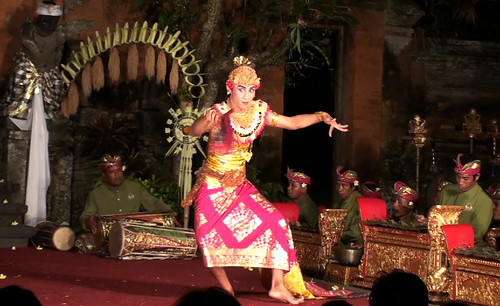
Topeng Tua Dance is part of a group of mask dance-dramas in Bali named Topeng, which literally means "to close or press against the face"(in reference to the use of a mask, of course). Covarrubias depicts these dances as "masked actors playing local historical plays (babad); mostly pantomime, but with dialogue by the comic characters"(1)
According to I Wayan Dibia and Rucina Ballinger "Topeng is done for Odalan (temple festivals) and a myriad of other rituals. In a traditional performance, five men play all the roles (called Topeng Panca, meaning "five dancers") simply by changing masks and headdresses. The drama begins with the panglembar or introductory characters who pave the way for the entrance of the king. The dancer show off his virtuosity through pure dance movements. The three most popular masks are Topeng Keras, a strong primer minister character with red or brown face denoting strength and courage; Topeng Keras Bues, strong yet goofy with bulbous eyes and large, humorous movements; and the beloved Topeng Tua, an old man who remembers his youth. He stumbles, wipes the sweat off his brow, breathes heavily with exertion and blows his nose"(2) It is a long ritual dance-drama festivity where these three characters, the king and clowns interact with the people in a rather comic way.
That evening at Ubud Royal Palace's stage, in July 2009, I only had the opportunity to see the Topeng Tua Dance, the dance of the old men remembering his youth, a short choreography (6 minutes) among the 9 other dance performances, so it was only a small bite of the Topeng dances. From my point of view it wasn't the best choreography of that night, especially after have seen the Legong Kraton and the Baris Tunggal dances, but it kept my attention very well and I enjoyed it.
depicts these dances as "masked actors playing local historical plays (babad); mostly pantomime, but with dialogue by the comic characters"(1) According to I Wayan Dibia and Rucina Ballinger
"Topeng is done for Odalan (temple festivals) and a myriad of other rituals. In a traditional performance, five men play all the roles (called Topeng Panca, meaning "five dancers") simply by changing masks and headdresses. The drama begins with the panglembar or introductory characters who pave the way for the entrance of the king. The dancer show off his virtuosity through pure dance movements. The three most popular masks are Topeng Keras, a strong primer minister character with red or brown face denoting strength and courage; Topeng Keras Bues, strong yet goofy with bulbous eyes and large, humorous movements; and the beloved Topeng Tua, an old man who remembers his youth. He stumbles, wipes the sweat off his brow, breathes heavily with exertion and blows his nose"(2) It is a long ritual dance-drama festivity where these three characters, the king and clowns interact with the people in a rather comic way.That evening at Ubud
Royal Palace's stage, in July 2009, I only had the opportunity to see the Topeng Tua Dance, the dance of the old men remembering his youth, a short choreography (6 minutes) among the 9 other dance performances, so it was only a small bite of the Topeng dances. From my point of view it wasn't the best choreography of that night, especially after have seen the Legong Kraton and the Baris Tunggal dances, but it kept my attention very well and I enjoyed it.You will see in the video I recorded how the old character, Topen Tua, as they said (I Wayan Dibia and Rucina Ballinger) "stumbles, wipes the sweat of his brow, breathes heavily with exertion and blows his nose", but also how he picks up a head lice from his white long hair, kills it with his finger nails and then shakes it off his fingers only to come back to his hair and pick another one. I have no information about weather this was a change of the original dance or simply our writers didn't want to embarrass anyone mentioning it as a part of the choreography. I can remember the same kind of actions missing in narrations of Chinese Theatre by Chinese writers in reference to spitting.
) "stumbles, wipes the sweat of his brow, breathes heavily with exertion and blows his nose", but also how he picks up a head lice from his white long hair, kills it with his finger nails and then shakes it off his fingers only to come back to his hair and pick another one. I have no information about weather this was a change of the original dance or simply our writers didn't want to embarrass anyone mentioning it as a part of the choreography. I can remember the same kind of actions missing in narrations of Chinese Theatre by Chinese writers in reference to spitting. What it is remarkable in the technique of this dance is the continuous use of codified movements and series of physical actions with a minimum of improvisation, what it seems to be one of the secrets of its every night success.
You can find many videos of the other Topeng dances in Youtube.