Showing posts with label Pingyao. Show all posts

Tuesday, December 23, 2008

Pingyao Tea House Theater (3): Three scenes of Shanxi Opera

Shanxi Opera (晋剧) Scenes performance: Changing Masks


Following my series of "Pingyao Tea House Theater" (1), this last part presents three scenes performed during the same spectacle for tourists I have been talking in part 1: one acrobatic scene, one comic scene and one quick-changing masks scene.

Even the spectacle that night were not only of Shanxi Opera it was an unique opportunity to see a company specialized on it playing some characteristic scenes of that kind of Chinese theatre. Shanxi Opera performances are not as easy to find than Peking Opera performances; there are no much companies and their seasons are rare, usually they give some isolated performances in very special occasions.

The acrobatic scene did not show to me anything special, being very similar to other kind of Chinese operas I have seen before, I only corroborated my appreciation of those amazing actors-acrobats always working to perfection (even in spectacles like this).

The Comic scene was an interesting surprise; it was the first time I heard singing like that, not only comically but with a very special use of the rhythm. This Shanxi Opera song showed to me a very fresh way to sing in traditional Chinese theatre, codification was still there but the difference with Peking Opera (the opera I have seen the most) seemed huge.


I couldn't miss a quick-changing Mask scene; people from all over the world come to the South of China to see these actors doing that amazing switch of masks. It was a pity they did not do that inside a real opera scene, instead of it they performed those changes like an act of Magic. Not bad but it seemed to me more Las Vegas-kind spectacle than a Shanxi Opera one.


(1) "Pingyao Tea House Theater (1): Shanxi Opera Scenes Murals.", and
"Pingyao Tea House Theater (2): Seeing today Chinese spectators as an anthropological experience?"


Texts, photographs and videos in this Blog are all author's property, except when marked. All rights reserved by Gustavo Thomas. If you have any interest in using any text, photograph or video from this Blog, for commercial use or not, please contact Gustavo Thomas at gustavothomastheatre@gmail.com.


Wednesday, December 3, 2008

Pingyao Tea House Theater (2): Seeing today Chinese spectators as an anthropological experience?


The Pingyao Tea House Theater is, as its name says, a Tea House; ancient tea houses in China were much more than their name implies to us in these days: they were hostels (special ones, not just anyone could stay there, only people from a specific region or group), party saloons, theaters, a kind of cabaret, restaurants and, of course, places where you could drink some tea. Historians say that performances in there were done in the middle of a unimaginable chaos ( it seems a common characteristic of theaters around the world in the past): people were eating, drinking, having fun, playing all kinds of table games, shouting, laughing, walking, and not always with an interest in the spectacle being performed at the moment. You can observe in detail the picture above, a Tea House performance during the last years of Qing Dinasty, as a very good example of what I am talking about.

It seems that temples and palaces were similar, a theater performance was part of a huge movement around festivities or court parties. None of these conducts seem to have bothered the artists, they were used to it.

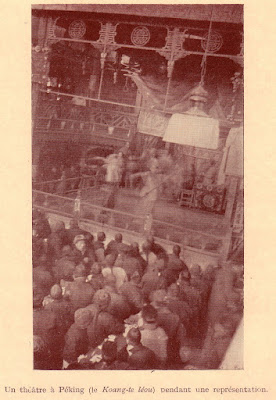
The next photographs show not a tea house but a theatre (Kuang-te lou) in central Beijing at the beginning of 20th Century (1), you can even see tables and how, during the performance, people are served food and drinks.

Chinese spectators has changed a little bit ( in comparison to Western ones); the arriving of Western codes of conduct at theatres at the end of the 19th Century created an intellectual elite who knew very well how to act as a spectator of any Western style performance (music concerts, theatre, ballet, opera, etc), but Chinese traditional performing arts maintained the same conduct depicted above: chaos and more chaos. It is until the end of the Mao era that Chinese spectators start to see both kinds of spectacles, Western and Chinese, with only one code of conduct, the culture of silence, at least in theory. Playwright Arthur Miller had a fantastic experience in 1980's Beijing and depicts very well, in his book "Salesman in Beijing", how Chinese spectators behaved during performance. (2)

Today, a common Western spectator still perceives as different how a Chinese spectator reacts to any spectacle and how they behave during a performance, but the change with how it used to be in the past is remarkable. Even today in the VIP section you can be served tea and cookies, with waiters walking from one seat to another during the performance, people receiving phone-calls and people talking in a normal level of voice, yet the theatre staff always ask for silence and for people to turn off their mobiles.

So, that code of conduct during a spectacle is threatened with its end, except for one special place, tea houses for tourists.

Now we can come back to our post subject. The Pingyao Tea House Theater is a theater which opens for tourists, for groups and more groups of hungry and energetic Chinese tourists. They come to this place after a long day of walking and visiting temples, museums, shops around the ancient city of Pingyao, and they want to finish the day with a meal (the most important experience for any Chinese), a laugh and enjoying a very traditional show. That is what I called an anthropological experience: a bit of that ambiance and public conduct under which performances were done in the past. A game, of course, but a very interesting one.

It is kind of difficult, due to the noise during Chinese opera performances, to differentiate the spectators’ noise, but you can taste a little bit of it in the next videos:


Video: spectators getting into Prince Gong Residence Tea House Theatre


And the last one, in the turist village of Wuzhen, a Shadow Puppet Theatre spectacle; spectators were children but that afternoon none of their teachers asked for silence... (if you listen carefully you will noticed voices of adults as well)

I remember some of the words my teachers tried to define (in their ignorance of it) the Oriental theatre: a theatre where dance, acting, singing, acrobacy, secular parties and religion were mixed... and its spectator behaved in accord to it.


(1) "Théâtre et Music Modernes en Chine" by George Souliè de Morant. Librairie orientaliste Paul Geuthner. Paris, 1926.
(2) "Salesman in Beijing" by Arthur Miller. London, 1984.


Sunday, November 23, 2008

Pingyao Tea House Theater (1) : Shanxi Opera Scenes Murals

Pingayo Tea House Theater is a recent rebuilt building, it was constructed during Ming Dinasty (around 1700 AD) at the best moment of Pingyao City. It is called Tea house because remains on it that special character of the "Chinese cabaret place", a theater where is possible to see in one evening, drama, opera, acrobatics, singing, magic and clowns while a dinner, and tea of course, is served.

Its stage hosts one company of Shanxi Opera, a regional style of Chinese Traditional Theater, offering scenes from this kind of Opera to hungry groups of Chinese turists. (It will be the subject of other posts)

There are, inside the Tea House Theater complex, and surrounded by traditional gardens, one long wall with clay made murals, in high reliefs o "altorelieve", showing scenes from Shanxi opera plays. Even the artistic work is not fantastic it is an interesting experience.

The amount of artistic depictions of theater artists and scenes of plays in China is comparable to the amount of religious images in temples or political scenes in palaces, that is something I have never seen in other part of the world. The social importance of theater before the Communist era was really remarcable, and these murals are a prove of it.


Video: Murals of Pingyao Tea House Theater

Shanxi Opera Clay Murals at Pingyao Tea House Theatre from Gustavo Thomas on Vimeo.
http://gustavothomastheatre.blogspot.com/2008/11/pingyao-tea-house-theater-shanxi-opera.html

Pingyao Tea House Theatre is one of some well preserved (and rebuilt) theatres inside Pingyao Ancient City in Shanxi province. It has many clay murals depicting scenes from Shanxi Opera


Photographs: Murals of Pingyao Tea House Theater


Texts, photographs and videos in this Blog are all author's property, except when marked. All rights reserved by Gustavo Thomas. If you have any interest in using any text, photograph or video from this Blog, for commercial use or not, please contact Gustavo Thomas at gustavothomastheatre@gmail.com.


Monday, September 15, 2008

Temple-Theatres of Pingyao Ancient City


There is a common idea in Chinese culture that is almost impossible to find (literally) in the North of the country, the idea of theatre and religion as one architectonic entity. Theatre in China is not any more something sacred but many of its subjects came from religious stories; it is said some theatre buildings are built where used to be temples (1) , but at least in Beijing (and other cities on the North) you don't see anyone where people worship and see theatre.

So, last July 2008 when I visited the ancient city of Pingyao in Shanxi province (one hour-flight from Beijing) I was very surprised of finding three theatre buildings not where used to be a temple but built inside the temple itself!, and temples where people keep worshiping.

Every temple (taoist temples) in Pingyao has its own stage, usually the same stage than any other Chinese Opera theatre, but not with the same style Court Qing dynasty theatres have (2); many Pingyao's temple-theatres where built during Ming dynasty when Pingyao was an important financial city in China. Details from Ming and Qing style can be seen in any of them.


Pingyao is a very important sight because it is a place almost entirely preserved as an early 18-19th Century Chinese city was, with a big wall surrounded it and houses, palaces, temples, and shops inside. Built around 1200 A.D. its glory was during last years of Ming Dynasty (around 1600 A.D.). In early 19th Century, when the ancient financial system failed in China, (due to the incursion of Western banks in the country), Pingyao was literally abandoned, and during more than hundred years there weren't significantly changes in the city. It was after the 90's of 20th Century, that UNESCO and other organizations took part in the preservation of this treasure.

The city now have one modern theatre and one Tea house-style (3) where usually are performances for tourists of local dances, songs and local opera (Shanxi Opera), but those theatre-temples I'm talking about are unused most of the time.


One curious singularity of this stage buildings are their main entrance, down stage; people, priests and anyone entered to the temple square through a tunnel situated exactly down the stage.


Chenghuang Temple-Theatre in Pingyao

Chinese Opera Theatre Stage at Chenghuang Temple (Pingyao) from Gustavo Thomas on Vimeo.


Caishen Temple-Theatre in Pingyao

Caishen Temple-Theatre in Pingyao Ancient City from Gustavo Thomas on Vimeo.


Cuohou Temple-Theatres in Pingyao

Cuohou Temple-Theatres in Pingyao Ancient City from Gustavo Thomas on Vimeo.


(1) Zhenyici theatre in Hepingmen (in Peking's downtown) is one of them. Today totally rebuilt.
(2) See my post of 24/April/2007: "China:Court Theatres in the Qing Dynasty"
(3) I have a special post for the performance I saw in one of this tea house-theatre.


If you are interested in using any text, image or video from this Blog, please contact the author writing your e-mail and information in comments. (comments are private)
Gustavo Thomas. Get yours at bighugelabs.com